
What Was Found — and How Confident Should We Be?
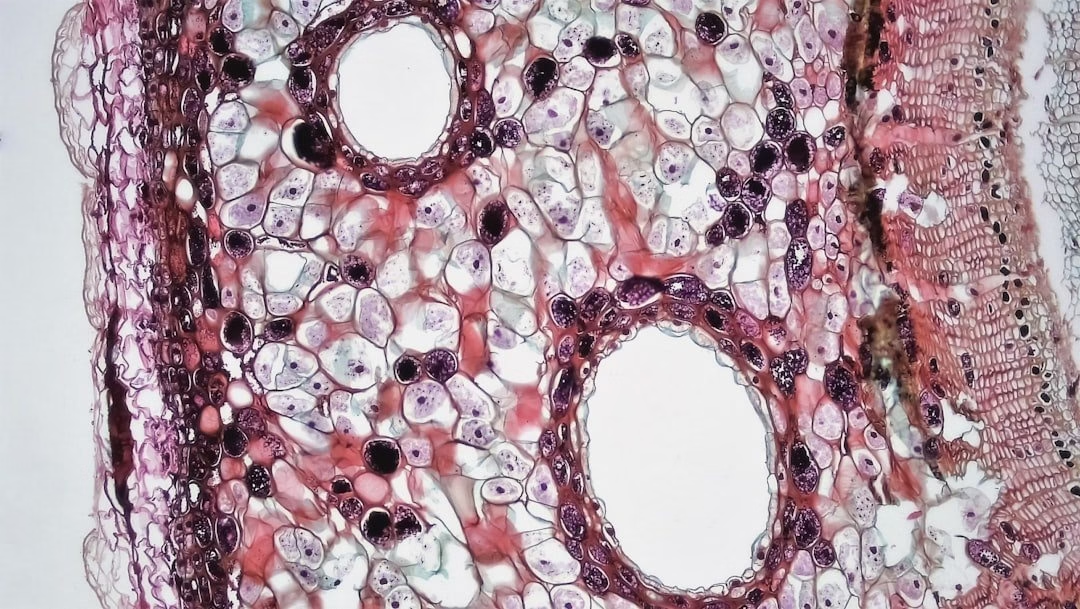
Scientists at the University of Arizona have identified a previously unknown cell type in the roots of bean seedlings. According to the university’s news office, this cell appears to help young plants manage two of the most hostile conditions they face early in life: soil that lacks water and soil that is low in key nutrients. The finding has not yet been independently replicated, and the full paper should be checked for peer-review status before drawing broad conclusions.
The discovery is early-stage. What researchers have established is an association between the presence of this cell and better seedling performance under stress — not a proven causal mechanism. That distinction matters, because plant biology is full of promising cellular findings that turn out to be more complicated once studied in real field conditions.
Background: Why Root Biology in Seedlings Matters
The first days of a plant’s life are among its most vulnerable. Once a seed germinates, the young root system has to do several things at once: anchor the seedling, absorb water, and take up dissolved minerals such as phosphorus and nitrogen. In many agricultural soils — and in a large fraction of the world’s arable land — at least one of those tasks is severely hindered by drought or nutrient scarcity.
Beans in particular are a critical protein source for hundreds of millions of people, especially in sub-Saharan Africa and Latin America, where soils are frequently both dry and nutrient-poor. Breeders and agronomists have long sought traits that improve seedling establishment under these conditions. Understanding what happens at the cellular level in roots is one route toward that goal, though the path from a laboratory cell discovery to a field-ready crop variety is long and uncertain.
Root cell biology has seen substantial advances in recent decades, largely driven by work on the model plant Arabidopsis thaliana — a small weed with a fast life cycle and a well-mapped genome. But beans and Arabidopsis are not the same plant, and cell types found in one don’t always have direct equivalents in the other. Identifying novel cell types in an actual food crop is therefore scientifically meaningful, even at this preliminary stage.
What the Researchers Actually Did
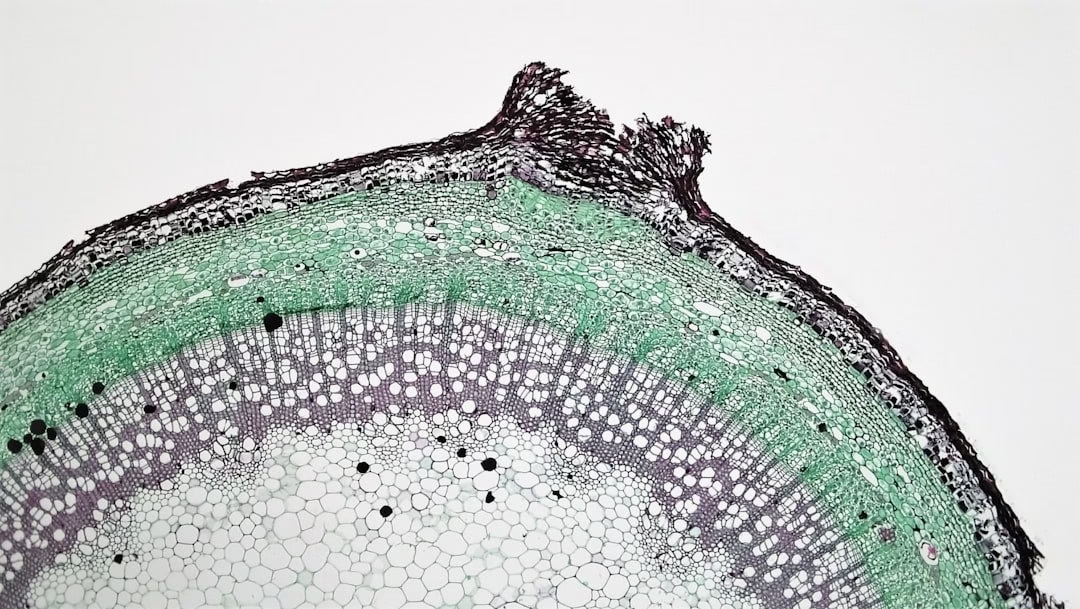
The University of Arizona team focused on the root tips of common bean (Phaseolus vulgaris) seedlings, examining cellular structure and gene expression under stress conditions. While the full methodological details are best read in the primary paper, the university’s summary indicates the researchers used a combination of microscopy and molecular profiling to distinguish this cell population from previously catalogued root cell types.
Lead researchers were not individually named in the available summary, but the work originates from the University of Arizona. The news release does not specify how many seedling samples were examined, over what time period experiments ran, or whether field trials accompanied the lab work. Those are important unknowns.
The cell type was identified in the context of two distinct stressors applied separately and, apparently, in combination: low soil moisture and low phosphorus availability. Phosphorus is one of the nutrients most commonly deficient in tropical and subtropical agricultural soils, making it a practically relevant choice of stressor.
What They Found
The newly described cell type appears to occupy a specific position within the bean root tip and shows a distinct pattern of gene activity compared with surrounding cells. Under drought-like and low-nutrient conditions, these cells appear to remain active — or become more active — in ways that may help the root continue to grow and function when other cellular processes are slowing down.
The university’s summary describes the cells as helping seedlings “survive” these hostile conditions, which is the observation. What the cells are actually doing biochemically — whether they are storing water, modifying root architecture, signaling to other tissues, or doing something else entirely — is not yet established. The “how” is an open question.
It is worth noting that “survives better” in a controlled lab setting and “performs better in a farmer’s field” are very different things. Root stress responses are sensitive to temperature, soil microbiome, the specific combination of stressors present, and dozens of other variables that laboratory conditions cannot fully replicate.
What It Means, What It Doesn’t, and What Comes Next
If the finding holds up under replication and further study, it could eventually inform breeding programs aimed at improving early seedling vigor in beans grown on marginal land. Knowing that a specific cell type is associated with stress resilience gives researchers a potential molecular target — a trait to look for or amplify when selecting or engineering new varieties.
But several steps would have to happen first. Independent labs would need to confirm the cell type exists and behaves as described. Researchers would need to work out what the cell is actually doing at the biochemical level. And any agricultural application would require demonstrating that manipulating this cell type improves outcomes in actual soil, with real weather, over multiple growing seasons.
None of that is impossible. Bean root biology is an active research area, and the University of Arizona has long-standing programs in drought-resilient crops. But the distance between “we found an interesting cell” and “farmers are growing a better bean” is measured in years of work, not months.
The open questions are substantial: Does this cell type exist in other legumes? Is it unique to beans, or does it have parallels in other crops? Can its activity be enhanced through conventional breeding, or would genetic modification be required? What gene or genes control its development? None of those answers are yet available from the current work.
For now, the finding is best understood as a useful addition to the map of bean root biology — a new landmark that researchers can work from, not a destination they have reached.