
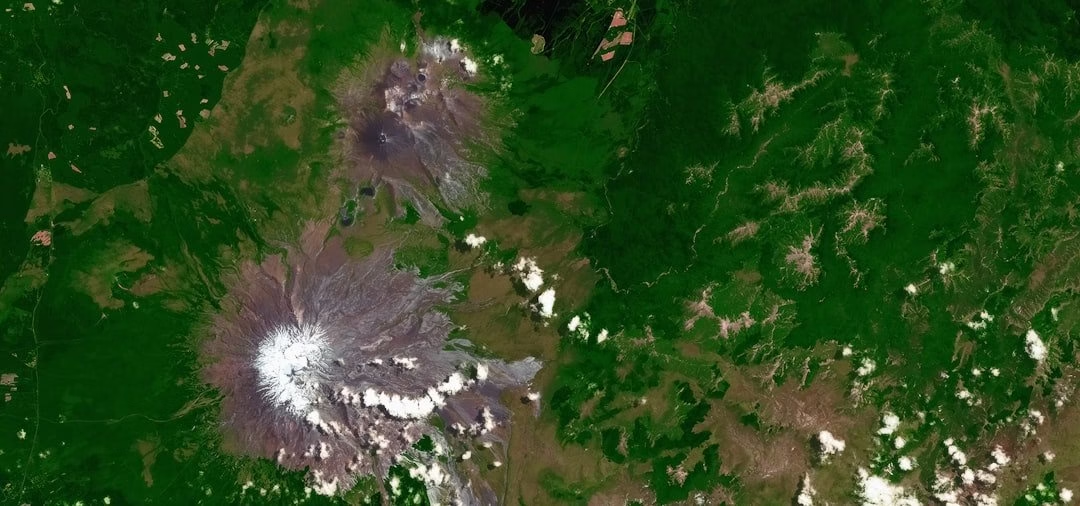
A Surprising Signal in the Sky After a Massive Eruption
When the Hunga Tonga–Hunga Ha’apai underwater volcano erupted in January 2022, it was one of the most powerful volcanic events recorded in decades. But scientists studying its aftermath found something unexpected in the atmosphere above the South Pacific: unusually high concentrations of formaldehyde — a chemical fingerprint that, in this context, points to methane being chemically broken down. The finding, published in a study summarized by Science Daily and sourced from researchers tracking the eruption’s atmospheric effects, raises an intriguing question: could volcanic chemistry play a role in destroying methane, one of the most potent greenhouse gases driving climate change?
The short answer is: possibly, but we don’t yet know how significant or reproducible this effect is. The research offers a genuinely novel observation about atmospheric chemistry following a rare event. What it does not do — and what the researchers are careful not to claim — is establish a reliable mechanism that could be harnessed or that will meaningfully offset human methane emissions. The distinction matters.
Why Methane Matters and What Was Already Known
Methane (CH₄) is a greenhouse gas roughly 80 times more potent than carbon dioxide over a 20-year window, though it breaks down faster in the atmosphere. It comes from many sources — livestock, rice paddies, landfills, fossil fuel extraction, and yes, natural events including volcanoes and the ocean floor. Reducing atmospheric methane is considered one of the faster levers available for slowing near-term warming, which is why the scientific community tracks its sources and sinks (the processes that remove it) carefully.
The primary natural mechanism that removes methane from the atmosphere involves hydroxyl radicals (OH) — highly reactive molecules that oxidize methane into water vapor, carbon dioxide, and ultimately formaldehyde before further breakdown. This is well-established atmospheric chemistry. What was not well understood before the Hunga Tonga eruption was whether volcanic ash interacting with seawater and sunlight could generate an additional removal pathway involving reactive chlorine compounds.
Hunga Tonga–Hunga Ha’apai sits in unusually shallow water for a caldera of its size, which meant the eruption injected an extraordinary quantity of seawater and ash directly into the stratosphere — the layer of atmosphere above weather. That combination appears to be key to what researchers observed next.
What the Researchers Actually Measured
Using satellite-based atmospheric sensors, the research team tracked the chemical composition of the plume spreading from the eruption site. The elevated formaldehyde readings they detected are not themselves proof of unusual methane destruction — formaldehyde has other sources — but the levels, location, and timing were consistent with accelerated methane oxidation tied to the volcanic plume rather than background atmospheric processes.
The proposed mechanism works roughly like this: volcanic ash particles, when mixed with the sodium chloride from injected seawater and energized by ultraviolet sunlight, can generate reactive chlorine species. These chlorine compounds are highly effective at breaking apart methane molecules — potentially faster and through a different pathway than the standard hydroxyl-radical route.
Importantly, the researchers note that the Hunga Tonga eruption itself released methane from the ocean floor during the event. The reactive chlorine chemistry appears to have destroyed some of that methane — making it, at least partially, a self-correcting system for this particular eruption. Whether the volcanic destruction exceeded the volcanic emission in net terms is not yet clear from the available summary.
What the Finding Does and Does Not Mean
This is a single observation tied to a single, unusually energetic geological event. The Hunga Tonga eruption sent more water vapor into the stratosphere than any recorded eruption in the satellite era, making its atmospheric chemistry genuinely unusual. Researchers are not suggesting that volcanoes in general are effective methane scrubbers, and the scientific consensus on the dominant drivers of atmospheric methane — human fossil fuel use, agriculture, and waste — remains unchanged.
What the finding does contribute is a potential new variable in atmospheric chemistry models. If reactive chlorine from seawater-ash interactions is a real methane-destruction pathway, then current models of methane’s atmospheric lifetime — which don’t account for this process — may need adjustment under specific conditions. That’s a narrow but legitimate scientific contribution.
It is also worth noting what this does not offer: no credible path to deliberately engineering volcanic-style chemistry to reduce human methane emissions, and no suggestion from the researchers that natural volcanic activity will meaningfully offset anthropogenic warming. The scientific consensus on climate change — that human greenhouse gas emissions are the dominant driver, and that reducing them is necessary — is not altered by this study.
One useful implication, if the mechanism is confirmed, involves how scientists model the atmospheric aftermath of future large submarine eruptions. Failing to account for enhanced methane destruction in those scenarios could lead to overestimates of post-eruption greenhouse forcing.
Open Questions and What Comes Next
Replication is the obvious next step — and here, nature presents a significant obstacle. Eruptions of Hunga Tonga’s scale and submarine character are rare enough that researchers cannot simply wait for another example. Instead, follow-up work will likely focus on laboratory simulations of ash-seawater-UV interactions to test whether reactive chlorine production occurs at the levels needed to explain the satellite observations.
Modelers will also need to examine whether incorporating this chemistry changes projections of atmospheric methane behavior following past large eruptions. Historical satellite records of other eruptions could be re-examined for similar formaldehyde signatures, though older data may lack the resolution needed for a clean comparison.
There is also a deeper atmospheric chemistry question: if reactive chlorine can be generated by this pathway, what other molecules might it affect? Chlorine radicals are indiscriminate oxidizers, and understanding their full suite of atmospheric interactions would matter for modeling ozone and other trace gases, not just methane.
For now, the Hunga Tonga finding is best understood as an observation that opens a question rather than one that closes it. The researchers have identified a signal that existing models don’t fully explain. Whether that signal represents a robust, generalizable atmospheric process or a peculiarity of one extraordinary geological moment is exactly what further work needs to determine. In atmospheric science, as in most fields, a genuinely surprising observation is the beginning of an investigation, not the end of one.