
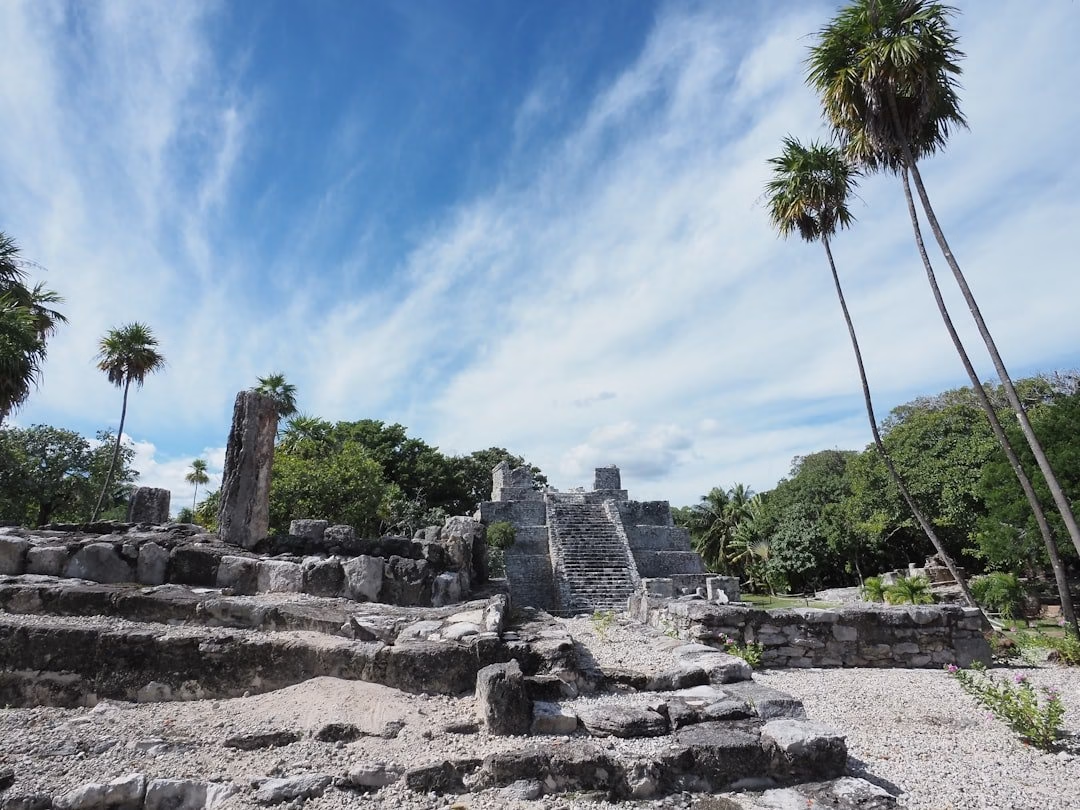
Sometime in the first millennium CE, a dog was born in the lowland forests of the Yucatan Peninsula. It lived, ate, and grew in one place — then was loaded onto a carrying frame or canoe and moved, still breathing, across hundreds of miles of jungle, river, and coastline to a distant Maya city. We know this not from any written record, but from the chemistry locked inside the animal’s teeth.
That single detail — a dog’s isotopic signature pointing to a birthplace far from its burial site — sits at the center of a study published in 2025 and widely discussed by archaeologists in early 2026. The findings, reported by Archaeology News Online Magazine, draw on strontium and oxygen isotope analysis of dog remains recovered from several Maya sites. The results suggest that live dog trading formed a meaningful strand in the larger web of Maya long-distance exchange, one that scholars had not fully appreciated before.
What the Isotopes Actually Tell Us
Isotope analysis works by reading the geological fingerprint of the water and food an animal consumed during the years its teeth were forming. Strontium ratios in bedrock vary from region to region; those ratios pass through plants and into the bodies of animals that eat them. When a dog’s tooth enamel shows a strontium signature inconsistent with the soil chemistry at its burial site, the most straightforward explanation is that the animal grew up somewhere else entirely.
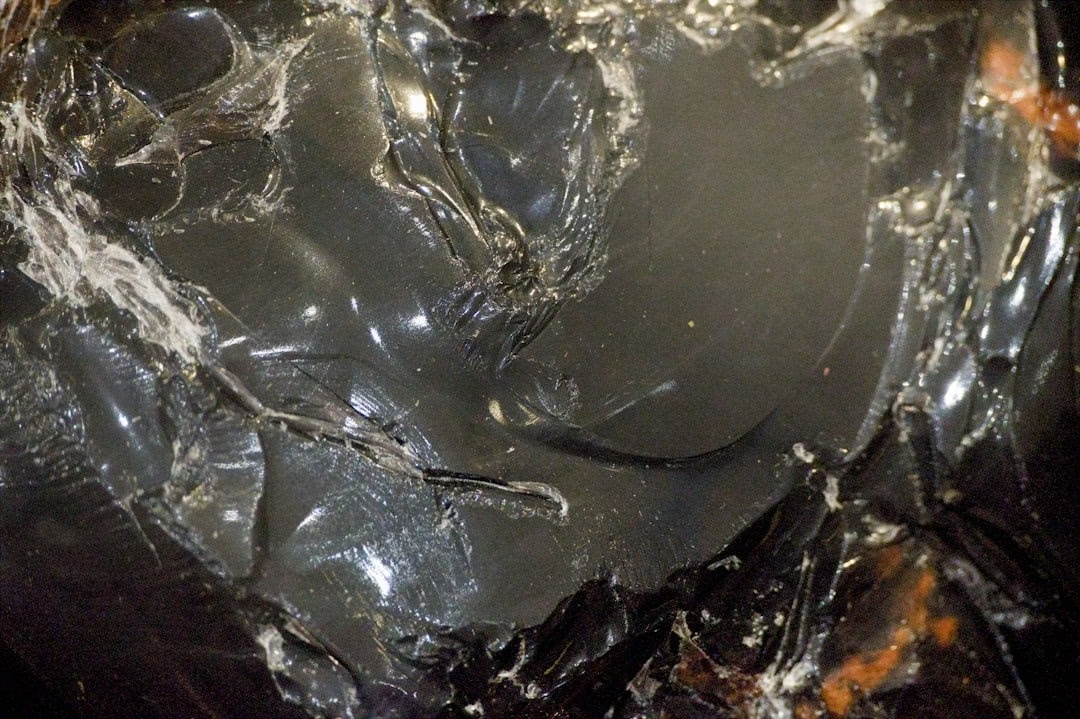
According to the study, several dogs interred at major Maya centers showed exactly this mismatch. The distances implied — in some cases several hundred miles — rule out casual wandering or short-range herding. The researchers argue that the most plausible interpretation is organized, intentional transport of living animals across the Maya world. Dogs were not simply local utility animals; they were commodities moving along the same corridors that carried obsidian, jade, cacao, and salt.
Why Dogs Mattered in Maya Society
To understand why this trade existed, it helps to set aside modern assumptions about dogs as purely domestic companions. In Classic Maya society — roughly 250 to 900 CE — dogs occupied several distinct roles simultaneously. They were eaten, particularly a breed scholars call the perro pelón or hairless dog, which archaeological evidence suggests was deliberately fattened for consumption. They also served in ritual contexts, appearing in ceramic art and burial assemblages alongside human remains, sometimes positioned as guides for the dead in the underworld.
Certain elite burials at Copán, Tikal, and other centers included dogs that show signs of having been well-fed and carefully kept, suggesting that some animals carried social or ceremonial status. A dog transported hundreds of miles and interred beside a nobleman was not merely a pet; it was, probably, a prestige object — a signal of the owner’s reach within trade networks.
“The movement of live animals implies logistical complexity — food, water, handlers — that points to organized, institutionalized exchange.” — Archaeology News Online Magazine, reporting on the 2025 isotope study
The logistical point matters. Moving a live dog hundreds of miles through tropical terrain requires sustained effort: the animal must be fed, watered, and kept healthy enough to arrive in usable condition. This is not the kind of thing individuals do on a whim. It implies route planning, specialist handlers, and likely some form of institutional backing — elite patronage, market infrastructure, or both.
Fitting Dogs Into the Broader Maya Trade Network
Maya long-distance trade is well-documented for durable goods. The distribution of obsidian from Guatemalan highland sources across lowland sites hundreds of miles away is one of Mesoamerican archaeology’s clearest supply chains. Jade moved from the Motagua Valley into elite contexts across the Maya world. Marine shells traveled inland. Cacao, though perishable, left enough residue in ceramic vessels to trace its movement.
What the dog isotope study adds is evidence that perishable, living cargo also moved through these networks — and moved regularly enough to show up in multiple burial assemblages at multiple sites. This pushes scholars to reconsider how they model Maya trade. Standard reconstructions tend to focus on raw materials and finished objects because those survive archaeologically. But if dogs were traveling these distances, other live or perishable goods — birds, medicinal plants, captive animals for menageries — may have been moving alongside them, simply leaving no isotopic trace.
What This Means for Understanding Maya Political Economy
The political implications are as interesting as the economic ones. Classic Maya political organization was not a unified empire but a mosaic of competing city-states, some dominant, some subordinate, constantly negotiating alliances and rivalries. Long-distance exchange was one of the mechanisms through which elites projected power and maintained relationships. Receiving a rare dog — or a breeding pair — from a distant lord was a form of diplomatic currency.
Scholars of Maya political economy, working broadly within what anthropologists call a prestige-goods model, have long argued that control over exotic imports was central to elite authority. The dog evidence fits this framework neatly. A ruler who could supply his court and his rivals with specially bred animals sourced from far-off regions was advertising access, connections, and organizational capacity all at once.
There is also a more mundane economic reading. Dogs raised for food represented a reliable protein source in a region where large domesticated mammals were scarce. The Maya had no cattle, horses, or pigs. Dogs and turkeys were among the few animals that could be herded and managed at scale. A brisk interregional trade in dogs for slaughter would have made practical sense even without any prestige dimension at all.
Gaps in the Evidence and Ongoing Debates
The study is compelling, but it rests on a sample that is, by necessity, incomplete. Isotope analysis requires well-preserved dental enamel, and not every Maya burial yields suitable specimens. The sites sampled so far skew toward larger, better-excavated centers. Whether the same patterns held at smaller secondary sites, or along coastal versus inland routes, remains an open question.
There is also interpretive uncertainty about directionality. Isotope data can identify where an animal was not from, and narrow down likely source regions, but pinpointing an exact origin is difficult when several geological zones share similar signatures. Some of the long-distance attributions in the study could, scholars note, reflect shorter moves between geologically similar areas that happen to be spatially separated. The broad conclusion — that dogs moved significantly — seems solid; the precise mileage figures are more tentative.
A further debate concerns whether the trade was primarily elite-driven or whether commoner households also participated. Most of the sampled dogs come from formal burial contexts, which skew toward high-status individuals. Middens and refuse deposits, where ordinary household dogs would more likely appear, have been less systematically sampled for isotopic analysis. The full social range of this trade may look different once those contexts are more thoroughly studied.
What the evidence does establish, fairly clearly, is that the ancient Maya saw dogs as valuable enough to justify the substantial cost of moving them alive across the landscape. That reframes the animal’s place in Maya life — not as a passive domestic presence, but as an active participant in the exchange systems that held Maya civilization together.
Sources
- Ancient Maya traded live dogs across hundreds of miles, isotope study finds — Archaeology News Online Magazine