

On an ordinary morning walk somewhere in Norway, a hiker looked down and noticed a glint of gold half-buried in the soil. What they had found was a decorative fitting from a sword, crafted roughly 1,500 years ago — likely during the Migration Period, that convulsive stretch of European history when the Roman world was fracturing and peoples across the continent were on the move. The object is small enough to hold in one hand, yet it carries the weight of a society that measured a man’s worth, his alliances, and his place in the cosmos by the quality of his blade.
Finds like this are rare not simply because gold survives poorly, but because so few were made in the first place. A gold-adorned sword in Migration-Period Scandinavia was not a weapon — or at least not primarily. It was a statement, probably an heirloom, possibly a diplomatic gift, and almost certainly the possession of someone whose name people around them knew.
A World Coming Apart at the Seams: The Migration Period in Northern Europe
To understand what this fitting meant to the person who once owned the sword it decorated, it helps to understand the world they inhabited. The Migration Period — roughly 375 to 568 CE — was triggered in part by the westward pressure of the Huns from Central Asia, which pushed Germanic and other groups into territories previously held or influenced by Rome. By the late fifth century, the Western Roman Empire had effectively ceased to exist as a political unit. What replaced it across Europe was a mosaic of smaller kingdoms and chiefdoms, each jostling for land, tribute, and legitimacy.
Scandinavia sat on the northern edge of this turbulence. Though Norse peoples were not directly overrun, they were not isolated either. Trade and raiding networks connected them to the continent. New wealth flowed in. So did new ideas about power and display. Archaeologists working across Norway, Sweden, and Denmark have documented a notable increase in high-status grave goods from this period — gold bracteates, weapon fittings, elaborate jewelry — that suggests the consolidation of local elites who wanted their status made visible, even in death.
It is in this context that a gold sword fitting makes sense as an object. The sword, in Migration-Period Scandinavia, carried enormous symbolic weight. According to surviving accounts preserved much later in Old Norse literature, the gifting of a named sword from a lord to a follower was a binding act of loyalty. A gold-adorned hilt was not gilded for battle; it was gilded to be seen.
What the Object Is — and What It Tells Archaeologists
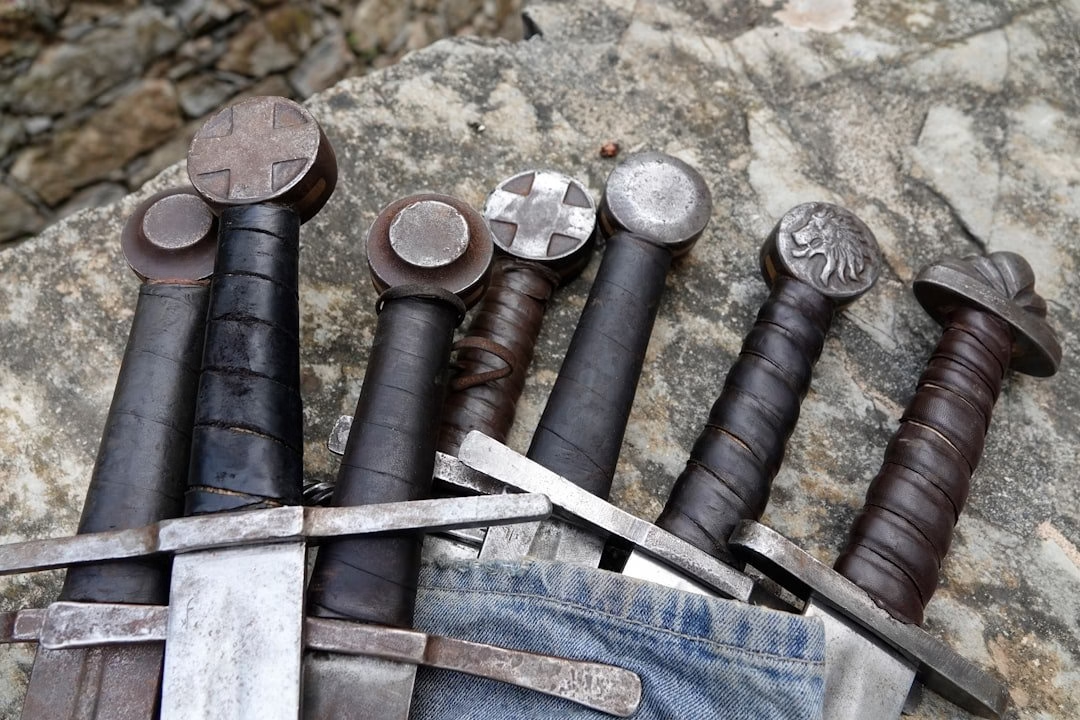
Sword fittings of this type typically formed part of the hilt assembly — the guard, grip, or pommel — and were crafted separately from the blade itself. Gold fittings were sometimes produced using filigree or granulation techniques that demand considerable skill, and they occasionally incorporate garnet inlays in a style known as cloisonné, which was fashionable across Europe during this era. The style connected Scandinavian workshops to a broader world of luxury craft production stretching from the British Isles to the Black Sea.
The Norwegian find, according to Archaeology News Online Magazine, is described as rare, which is consistent with how infrequently such pieces surface. Most Migration-Period gold objects come from deliberate deposits — hoards buried during times of danger, or grave assemblages placed with the dead. A surface find recovered by a casual hiker suggests either that the soil has shifted over centuries to bring the object up, or that it was deposited separately from any broader assemblage. Archaeologists will likely examine the surrounding area carefully for further evidence.
The precise location within Norway has not been publicly disclosed in detail, which is standard practice when a find may indicate an unexcavated site. Releasing coordinates before a proper survey can attract looters, and the context surrounding an object — the soil layer it came from, what lies nearby — is often as historically valuable as the object itself.
Reading Status Through Metal: Warrior Culture and Gift Exchange
Modern frameworks of social anthropology, particularly those drawing on Marcel Mauss’s concept of the gift economy, have been applied to Migration-Period Scandinavia to explain why objects like this sword fitting were made and circulated at all. In a society without stable coinage or centralized taxation, wealth moved through gifts, tribute, and the redistribution of prestige goods by powerful individuals. A lord who could give a gold-hilted sword demonstrated not just wealth but access — to skilled craftspeople, to raw materials, to the networks that supplied both.
The recipient of such a sword was bound into a relationship. They owed loyalty, military service, and support. The sword itself, worn publicly, advertised that relationship to everyone who saw it. This is why weapon fittings were so elaborately decorated: they functioned as visible symbols of a social contract in a world where written documents were rare and public display was everything.
Scholars debate exactly how fluid or rigid these elite networks were. Some researchers emphasize the instability of Migration-Period chiefdoms, where a leader’s authority could dissolve quickly if they lost military success or the ability to reward followers. Others point to the evidence for multigenerational dynasties. A gold sword fitting passed down through two or three generations would accumulate meaning with each owner, becoming something closer to what we might call a relic — an object whose value was partly historical.
Accidental Discovery and the History of Norwegian Finds
Norway has a long record of significant archaeological objects found outside formal excavation contexts. The country’s varied terrain — mountains, hillsides, peat bogs, and eroding coastal cliffs — regularly exposes buried material as the landscape shifts. Norwegian law requires that all pre-Reformation objects found in the ground belong to the state, and finders are expected to report discoveries to the relevant county authority or museum. In practice, most people do report finds, and the system has produced a steady stream of important objects that might otherwise have been lost.
Metal detecting, legal under permit in Norway, has also contributed significantly to the archaeological record in recent decades. Whether this particular hiker was using a detector or simply spotted the object visually is not specified in the available reporting, but either scenario is plausible. What matters more, from a historical standpoint, is that the object entered the documented record rather than disappearing into private hands.
The fitting will likely be analyzed for its gold content and alloy composition, which can sometimes indicate where the raw material originated. Isotopic analysis and X-ray fluorescence are among the tools researchers use to trace the provenance of precious metals. Results can take months or years to publish, but they occasionally reveal that gold found in Scandinavia originated in coin melted down from far to the south — a material trace of the long-distance connections that defined the Migration Period.
What One Small Object Illuminates About a Larger World
The significance of this find extends beyond Norway. Each well-documented Migration-Period gold object adds a data point to maps that archaeologists and historians use to reconstruct networks of exchange, zones of influence, and the distribution of elite culture across early medieval Europe. A single sword fitting cannot rewrite the history of the period, but it contributes to an accumulating picture.
What the object also does is humanize that picture in a way that textual sources rarely can. The Migration Period is known largely through chronicles written by literate Romans watching their world change, or through later Norse sagas that compress centuries into myth. The sword fitting was made by someone’s hands, worn by someone’s side, and lost or deposited by someone who had reasons we can only guess at. That specificity — this object, this person, this hillside — is what makes archaeology a distinct discipline. It recovers things that writing left out.
“The sword was more than a weapon; it was a social instrument, a marker of identity and allegiance in a world where such markers were life and death.” — Archaeology News Online Magazine
Much remains uncertain. We do not know the precise provenance of the fitting beyond its Norwegian location. We do not know whether it was buried deliberately or lost. We cannot say whether a broader assemblage lies nearby. And we do not know who carried this sword, what battles they witnessed, or how the fitting came to rest in the earth where a morning walker found it fifteen centuries later. Those are not failures of archaeology — they are its honest condition. History is never entirely recovered, only approached.
Sources
- Rare 1,500-year-old gold sword fitting found by hiker in Norway during morning walk — Archaeology News Online Magazine