

The Delayed Heartbeat Nobody Expected
Fur seals hauled out on a rocky shoreline look like they’re doing nothing more demanding than napping. But according to new research, their cardiovascular systems are running a quiet, intense recovery operation that doesn’t even begin in earnest until well after the animal has come ashore. Scientists have found that the heart rates of fur seals can abruptly double — hours after the animals return from deep-sea hunting trips — in what appears to be a delayed physiological recovery response.
The finding is intriguing, but some important caveats apply. The study is specific to fur seals and to the particular conditions under which these animals were monitored. Whether the mechanism generalizes to other diving mammals, or what its precise physiological triggers are, remains an open question. What the researchers found is a pattern; what drives it is, for now, a well-reasoned hypothesis.
What We Knew About Deep-Diving Mammals
Marine mammals that dive to significant depths face a physiological puzzle. During a dive, the body needs to conserve oxygen — heart rate drops dramatically, blood flow is redirected away from non-essential organs, and muscles run partly on stored oxygen-carrying molecules. This suite of responses is called the dive response, and it is well-documented across seals, whales, and dolphins.
What happens after the dive is less well understood. On land, humans who have exercised hard show elevated heart rates and elevated breathing for a predictable period as the body clears lactic acid (a metabolic byproduct of anaerobic activity) and replenishes oxygen stores. Researchers had assumed something similar happened in seals. But the timing and magnitude of that recovery — and the specific possibility that it could be substantially delayed — had not been clearly established.
Fur seals are a useful study subject because they alternate between extended foraging trips at sea, during which they dive repeatedly and continuously, and rest periods on land. This on-off cycle gives researchers natural windows into both the active and recovery phases of the animals’ physiology.
How the Researchers Tracked What Was Happening Inside the Seals
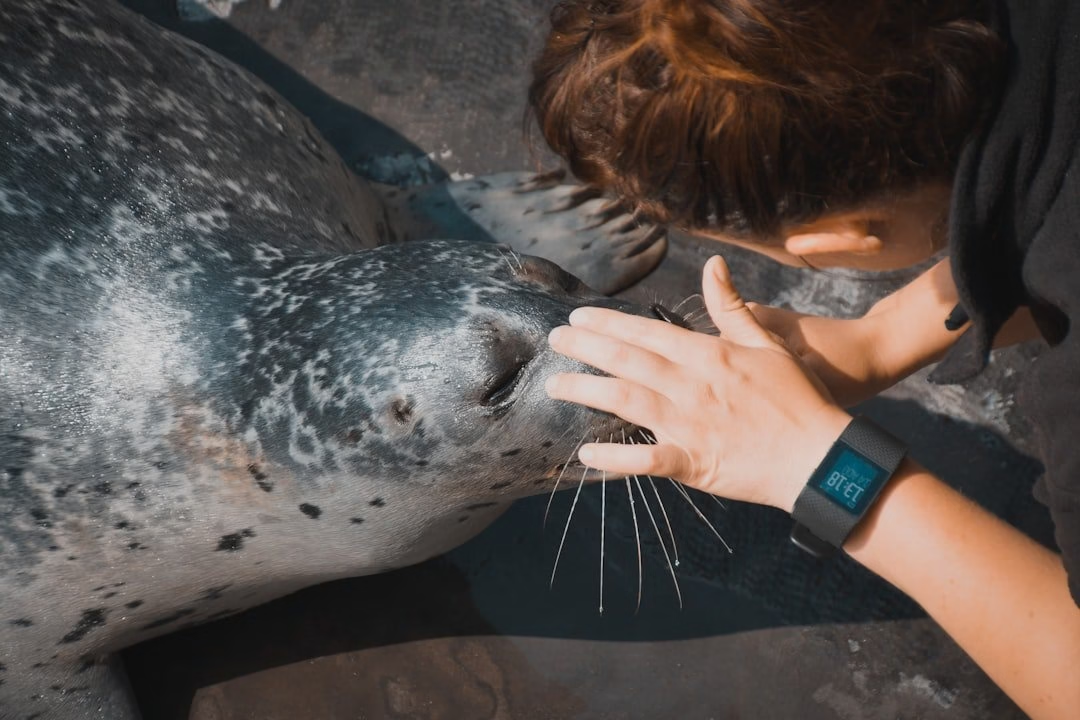
The research team fitted fur seals with data loggers capable of recording heart rate continuously — both during time at sea and after the animals returned to land. The devices allowed scientists to follow the animals’ cardiac activity through complete foraging cycles without intervening in the seals’ behavior. (The source material available for this article does not name the lead authors, their institution, or the journal where these findings were published; we will update this post when that information is confirmed.)
The key methodological point is that continuous logging captured not just in-water diving behavior but also the hours immediately following a seal’s return to shore — a window that previous work had not examined as closely. This allowed the team to notice something that spot-check measurements would likely have missed entirely: a distinct surge in heart rate occurring well after the animal had already come ashore and appeared to be resting.
What the Data Actually Showed
The clearest finding is that fur seals experience a pronounced increase in heart rate during their time on land — not immediately upon arriving, but with a delay of several hours. In some cases, the heart rate approximately doubled relative to the rate recorded shortly after the animal came ashore. The researchers interpret this surge as the body belatedly processing the metabolic costs of sustained deep diving: clearing lactic acid that accumulated during anaerobic effort and restoring the oxygen stores that the muscles and blood use during dives.
In other words, the seals appear to defer a substantial portion of their physiological recovery. While at sea and actively hunting, their bodies prioritize performance. The recovery work — the metabolic cleanup, the resupply — happens primarily on land, and it takes time to get going.
It is worth being precise about what this is and is not. This is an observed pattern in heart rate data, combined with a plausible physiological interpretation. The researchers have not directly measured lactic acid clearance or oxygen store replenishment in real time during these surges. The hypothesis that those processes drive the heart rate increase is consistent with what we know about exercise physiology, but it is still a hypothesis rather than a directly demonstrated mechanism.
What It Means — and What It Doesn’t
If the interpretation holds up, it changes how scientists should think about seal recovery. Researchers studying the energetics of marine mammals have often focused on what happens during dives. This work suggests the post-dive, on-land phase may be more physiologically active than it looks — and that measuring a seal’s heart rate shortly after it comes ashore might significantly underestimate the full cardiovascular work of a foraging trip.
There are also potential conservation implications, though these should not be overstated at this stage. If fur seals need extended, undisturbed rest periods on land to complete their recovery, then haul-out sites — the beaches and rocks where the animals come ashore — may be more important to their health than previously appreciated. Human disturbance at those sites, if it repeatedly interrupts recovery, could theoretically carry costs that aren’t visible from the outside. That is a hypothesis worth investigating, not a conclusion to draw from this study alone.
This finding does not apply, at least not directly, to other species. The dive depths, foraging durations, and physiology of fur seals differ from those of elephant seals, Weddell seals, or cetaceans. Patterns found in one species need to be tested in others before any general claim about diving mammals can be made.
What Comes Next
The obvious follow-up questions are mechanistic: can researchers directly measure lactic acid levels or blood oxygen saturation in free-ranging seals during these post-dive surges, confirming or refuting the proposed explanation? Advances in biologging technology — the sensors and data loggers attached to wild animals — have made it possible to record physiological variables that were inaccessible even a decade ago, so this kind of work is at least technically feasible.
A second priority is replication: do other research groups, working with different fur seal populations or in different geographic settings, see the same delayed heart rate pattern? Consistency across populations would substantially strengthen the finding.
Comparative work across seal species would also help determine how widespread this phenomenon is. If the delayed recovery surge turns out to be a common feature of deep-diving mammals rather than a quirk of one species, that would carry more weight for both basic physiology and conservation planning.
For now, what the study contributes is a well-documented observation that challenges a simple picture of seal recovery — and a reminder that an animal’s outward stillness can conceal a great deal of internal activity. The most accurate summary of where the science stands: we have a compelling pattern, a reasonable explanation for it, and a list of questions that still need answers.