
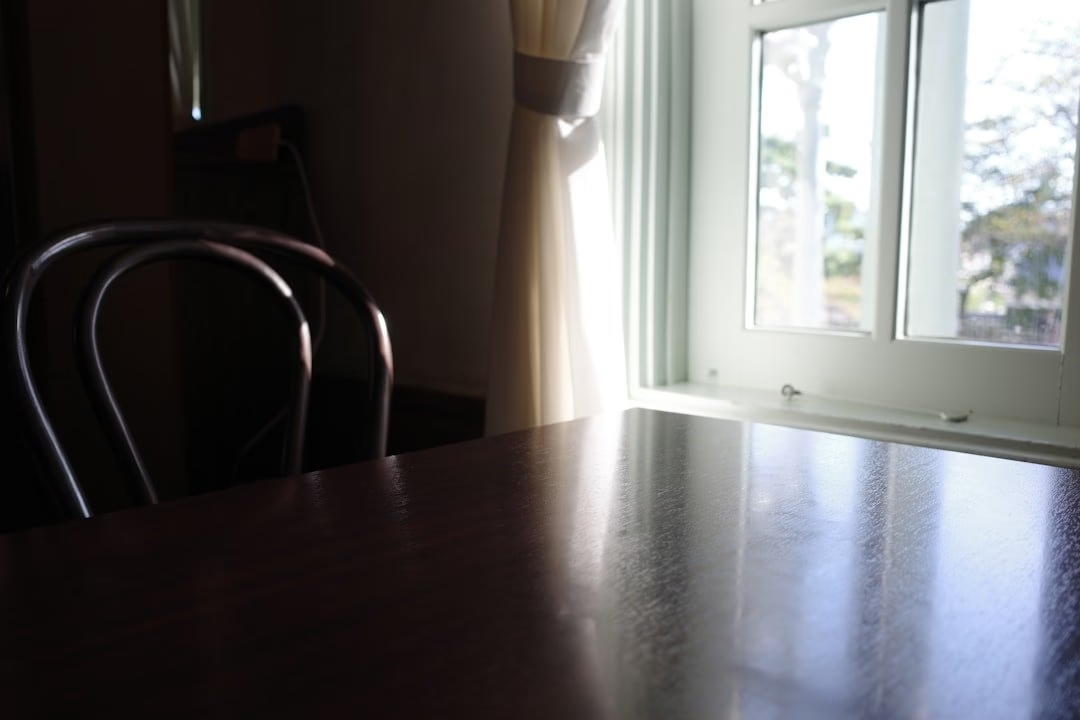
There is a moment — familiar to many, named by few — that arrives just before the day takes hold. The coffee is still brewing. The screen has not yet been touched. For a few seconds, something settles. It is not nothing. It may, in fact, be quite a lot.
Zina Jacque, reflecting on what Interfaith America calls “a sacred pause,” points to this quality of intentional stopping as something more than rest. It is, she suggests, a kind of listening — not to anything in particular, but to the texture of the present moment itself. The question worth sitting with is: what are we pausing from, and what might we be pausing toward?
On What the Pause Actually Is
The sacred pause is not a technique invented by any single tradition. It appears under different names in nearly every contemplative lineage humanity has produced. In its simplest form, it is the deliberate interruption of automatic movement — a voluntary return to awareness before thought rushes back in.
Within Zen and Theravāda Buddhism, this quality of halting and noticing is foundational. The late Vietnamese Thiền master Thich Nhat Hanh wrote and taught extensively on the relationship between stillness and perception — how the quality of our attention changes what we are able to see. In his essay “Sunshine and Green Leaves,” published in Tricycle: The Buddhist Review, he reflects on interdependence and a life immersed in meditation as conditions for genuine understanding, not merely relaxation. According to this tradition, the pause is not an escape from life but a way of returning to it more fully.
In the Christian contemplative stream, the pause takes the form of what is sometimes called “recollection” — a gathering of scattered attention back toward the center. The Desert Fathers of the fourth century practiced what they called hesychia, a Greek word meaning quiet or stillness, understanding it as the ground from which prayer becomes authentic. This wasn’t silence as absence, but silence as presence.
On Many Ways of Stopping
What is striking, when one looks across traditions, is how different the reasoning for stillness can be — and yet how convergent the practice itself often appears.
For the Orthodox Christian tradition, stillness is inseparable from relationship — with God, with community, with creation. The Ecumenical Patriarch Bartholomew, who has engaged in extensive interfaith dialogue and recently met with former Greek Prime Minister George Papandreou to discuss global crises, has long emphasized that contemplative life is not withdrawal from the world’s suffering but a way of holding that suffering more honestly. According to Orthodox teaching, the interior life and the engaged life are not opposites.
Progressive Christianity, as explored by theologian Jim Burklo — whose work Water in the Desert addresses those he calls “spiritually thirsty” — takes a different angle. Burklo’s approach makes space for doubt, for question, for the person who finds traditional frameworks constraining. Here, the pause is less about doctrine and more about permission: permission to stop performing certainty and simply rest in honest unknowing. As Burklo has written, “The spiritual life is not about having the right answers but about asking the right questions.”
In secular mindfulness contexts, the same territory is mapped without religious language. Some research suggests that measurable changes in brain activity can begin within just two to three minutes of sitting quietly with attention — a finding that, while modest, points toward something contemplatives have long described: even a brief pause is not wasted. Separately, some studies indicate that sustained mindfulness training over eight weeks may be associated with improvements in cardiovascular markers. These findings are worth noting, though they say nothing about the deeper questions traditions have always asked about the meaning of stillness.
On the Texture of Ordinary Days
What does a sacred pause actually look like when woven into the fabric of an ordinary week?
The honest answer is that it varies enormously — and that variation may itself be part of the point. Some find that a few minutes before the morning begins, simply sitting with breath and sensation, is enough to shift the quality of everything that follows. Others discover that a pause mid-afternoon — a genuine stopping, not scrolling — works better for their particular rhythms.
Thich Nhat Hanh described the practice of mindful breathing as something that can happen anywhere: washing dishes, walking between rooms, waiting. The pause, in this framing, doesn’t require special conditions. It asks only for honesty about the moment one is actually in.
Within Jewish contemplative practice, the concept of shabbat — the weekly cessation of ordinary work — encodes the pause at the level of community and calendar rather than individual discipline. According to this tradition, rest is not earned; it is built into the structure of time itself. One stops not because everything is finished but because stopping is its own form of completion.
For those who hold no religious framework, the secular invitation might be framed simply as: what happens when you choose not to fill a quiet moment? Not as a productivity strategy, and not because some tradition says so, but as a genuine experiment in paying attention.
One might notice, over time, that the pause does something unexpected — not relaxation exactly, but a kind of clarification. As if the water, briefly stilled, shows what was always at the bottom of it.
On What Remains When We Stop
There is a temptation — especially in wellness culture — to treat stillness as a tool for self-optimization, a way of becoming more productive or less anxious. That framing is not wrong, exactly, but it may miss something. The traditions that have practiced contemplative pausing for centuries generally weren’t doing it to improve performance metrics. They were doing it because they believed — or in some cases simply noticed — that something real was available in the silence.
What that something is, each tradition names differently. Some call it God. Some call it Buddha-nature. Some call it presence, or awareness, or simply the fact of being alive. The secular practitioner might call it nothing at all and find the pause valuable anyway.
What is perhaps more interesting than any particular name is the quality of attention that the pause makes possible — an attention that is, for a moment, not aimed at solving anything. Simply here. Simply noticing.
If you are struggling with anxiety, grief, or mental health challenges, professional support is meaningful — spiritual practice is a complement to it, not a substitute.
A leaf, Thich Nhat Hanh once observed, does not need to do anything to be fully itself. It simply receives the light. One wonders, in the small still moments of an ordinary morning, whether something similar might be said of us.
Sources
- Sunshine and Green Leaves — Tricycle: The Buddhist Review
- A Sacred Pause with Zina Jacque — Interfaith America
- ATSS: Jim Burklo: Water in the Desert — Adventist Today
- Former Greek PM and Ecumenical Patriarch discuss global crises and interfaith dialogue — Orthodox Times
- Your brain starts changing within 2-3 minutes of meditation, study finds — MSN
- Mindfulness training improves heart health in just eight weeks — Earth.com