
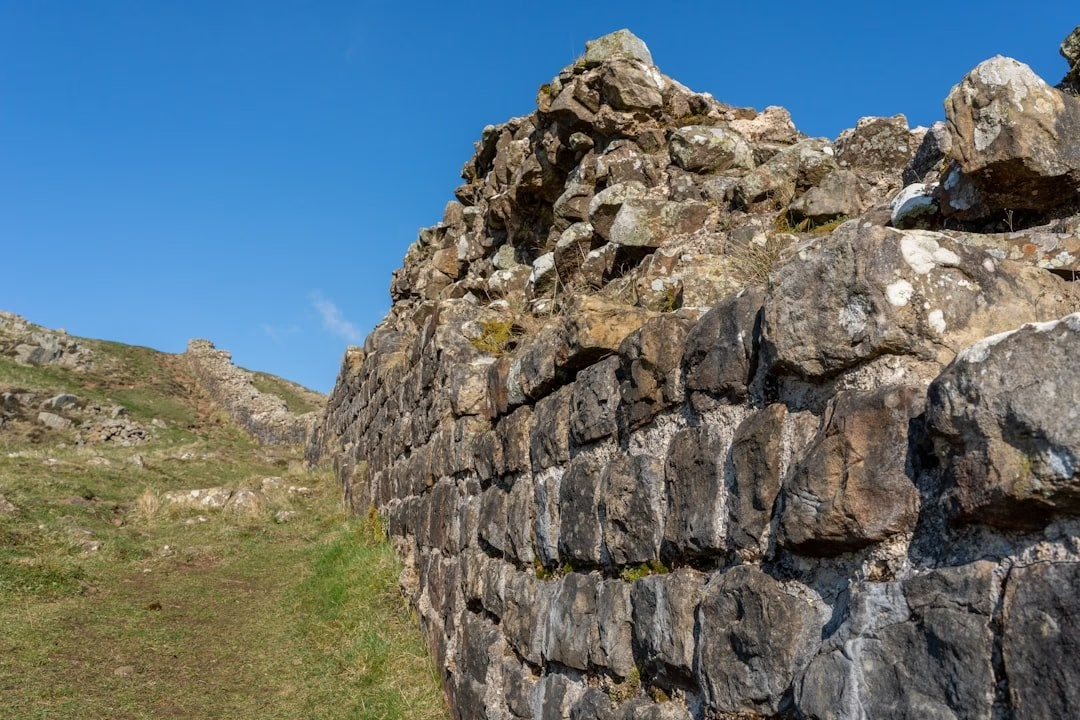
Somewhere along the seventy-three miles of stone that Rome dragged across northern Britain in the second century, a soldier lost something small. Not a weapon, not a coin, not a document of state — something kept close for reasons that had nothing to do with warfare. Researchers analyzing a recently studied keepsake recovered from the Hadrian’s Wall zone are now piecing together what that object meant, who likely carried it, and what it reveals about the human texture of frontier life at the empire’s northern limit.
It is a reminder that archaeology rarely delivers grand answers. More often it offers the intimate and the mundane: a token pressed into a palm, a memento tucked into a tunic. The Wall itself is one of antiquity’s most recognizable monuments, yet the people who garrisoned it remain, in many respects, strangers to us. Objects like this one push against that anonymity.
A Frontier Built in Stone and Anxiety
When the emperor Hadrian visited Britain in approximately 122 CE, the northern edge of Roman control was a contested, restless place. The decision to build a continuous barrier — running from the Solway Firth in the west to the mouth of the River Tyne in the east — reflected both military pragmatism and imperial projection. It was a statement as much as a fortification.
Garrisoning the Wall was not a prestigious posting. Units rotated through from across the empire: infantry cohorts from Spain, cavalry regiments from the Balkans, auxiliary soldiers from North Africa and the Rhine frontier. According to surviving inscriptions and discharge documents, many of these men spent years or even decades at remote milecastles and forts, far from home and far from Rome’s urban center. The Wall, for them, was not a monument but a workplace — cold, damp, and administratively demanding.
This context matters when interpreting small personal objects. A keepsake is not the residue of official Rome. It belongs to private life, to memory, to the things a person chooses to carry rather than those assigned by the army.
What the Researchers Found — and What They Are Reading Into It
According to Archaeology Magazine, researchers have been analyzing a keepsake recovered from the Hadrian’s Wall area, examining its material composition, wear patterns, and iconography. The precise findspot and the full details of the analysis have not been broadly published at this stage, so caution is warranted about drawing firm conclusions.
What such studies typically attempt is a layered reading: Where was the object made? What imagery does it carry? Does the wear suggest it was handled repeatedly? Does its chemistry point to a particular region of origin? Each of those questions, if answerable, adds a thread to the larger story of who carried it and why.
“Small finds from military contexts can be more revealing than monumental inscriptions about the inner life of the garrison.” — Archaeology Magazine, May 2026
Keepsakes in the Roman world carried real weight. Amulets, miniature figurines, engraved gemstones, and decorated pendants appear throughout the archaeological record of Roman Britain, often associated with protection, luck, or devotion to a particular deity. Some were likely gifts from family members at the time of enlistment — objects meant to bridge the distance between the soldier and his home community. Others were probably purchased at the many civilian settlements, known as vici, that grew up just outside Wall forts.
The Archaeology of Personal Attachment
Scholars who study Roman material culture have increasingly moved toward what might be called, using a modern framework, the archaeology of identity — the effort to understand how individuals within large institutions like the Roman army maintained a sense of self, origin, and belonging. Keepsakes are central to that project.
The Wall forts have yielded a remarkable variety of personal objects over the decades of excavation. Vindolanda, just south of the Wall line, produced not only wooden writing tablets — thin slices of correspondence that constitute the oldest surviving handwritten documents from Britain — but also shoes, textiles, and small decorative items that speak to a community rather than simply a garrison. A child’s shoe found there, roughly dated to the late first or early second century, carries an emotional charge that no battle report could replicate.
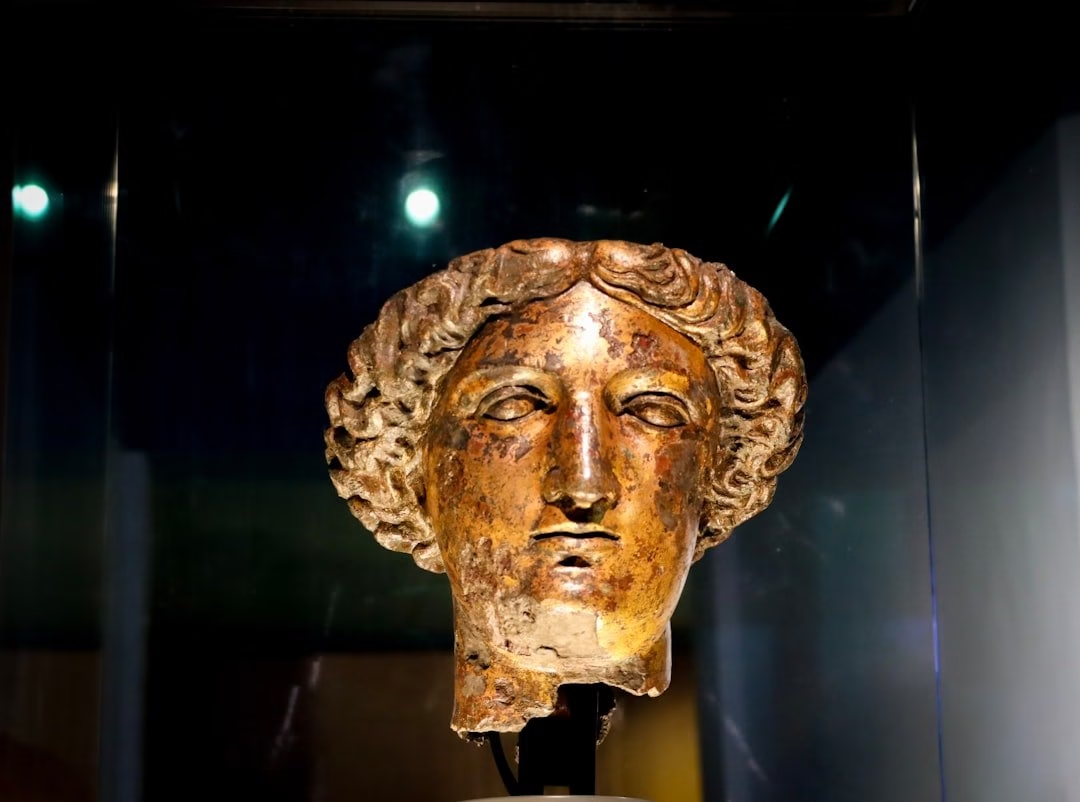
The keepsake now under analysis fits into that tradition of intimate evidence. Whether it belonged to a common soldier, an officer, or a civilian attached to the fort community is, according to available reporting, not yet established. Scholars debate precisely how to read social status from small finds when context is incomplete.
What Changed — and What the Wall Left Behind
Hadrian’s Wall remained an active military installation for the better part of three centuries, though its function and the intensity of its garrison shifted over time. By the late fourth century, as Roman administrative authority in Britain weakened, the organized frontier system began to dissolve. The Wall was not so much abandoned as gradually emptied, its stones later quarried for medieval churches and farmhouses across Northumberland and Cumbria.
What remained underground was the debris of centuries of human occupation: coins, tools, weapons, animal bones, and — crucially — the small personal objects that soldiers and their families left behind, whether by loss, by intention, or by the simple accumulation of time. Each excavation season adds to this inventory, and each new analysis of existing finds has the potential to shift understanding.
The significance of the keepsake study lies partly in its methodology. Modern analytical techniques — X-ray fluorescence, isotopic analysis, high-resolution imaging — can now extract information from objects that earlier excavators could only describe visually. A pendant that looks generically Roman to the naked eye might, under isotopic scrutiny, turn out to have been cast from lead mined in Sardinia, or silver refined in the Rhineland. That kind of provenance data connects individual objects to trade networks and, by extension, to the movement of people.
The Gaps That Remain
Roman frontier archaeology is rich, but it is also uneven. The written record overwhelmingly reflects the perspective of officers and administrators. Common soldiers — the auxiliaries especially, who were not Roman citizens until the Constitutio Antoniniana of 212 CE — left far fewer documents and far more objects. Reconstructing their inner lives from material evidence alone is an exercise in informed inference, and historians are careful to mark the boundaries of what the evidence actually supports.
For the Hadrian’s Wall keepsake specifically, several questions will likely remain open. Who exactly owned it? What did they believe it offered them — divine protection, emotional comfort, social signaling? Was it lost accidentally or deposited deliberately, perhaps as an offering? The object survives; the intentions behind it do not.
There is also the broader uncertainty that surrounds any Roman small find: the question of what was never preserved at all. Organic materials — wood, leather, textile, papyrus — survive only under exceptional conditions. The keepsakes that endure in the archaeological record are a biased sample, weighted toward metal and stone, toward the durable over the precious. The things people may have valued most — a lock of hair, a scrap of cloth from home — have almost certainly vanished.
What remains is enough to ask better questions. And in the study of Rome’s distant frontier, better questions are the closest thing we have to answers.
Sources
- News – Researchers Analyze Roman Keepsake From Hadrian’s Wall — Archaeology Magazine