
15 Days in the Dark: How a Fisherman Survived a Flooded Cave in Mexico
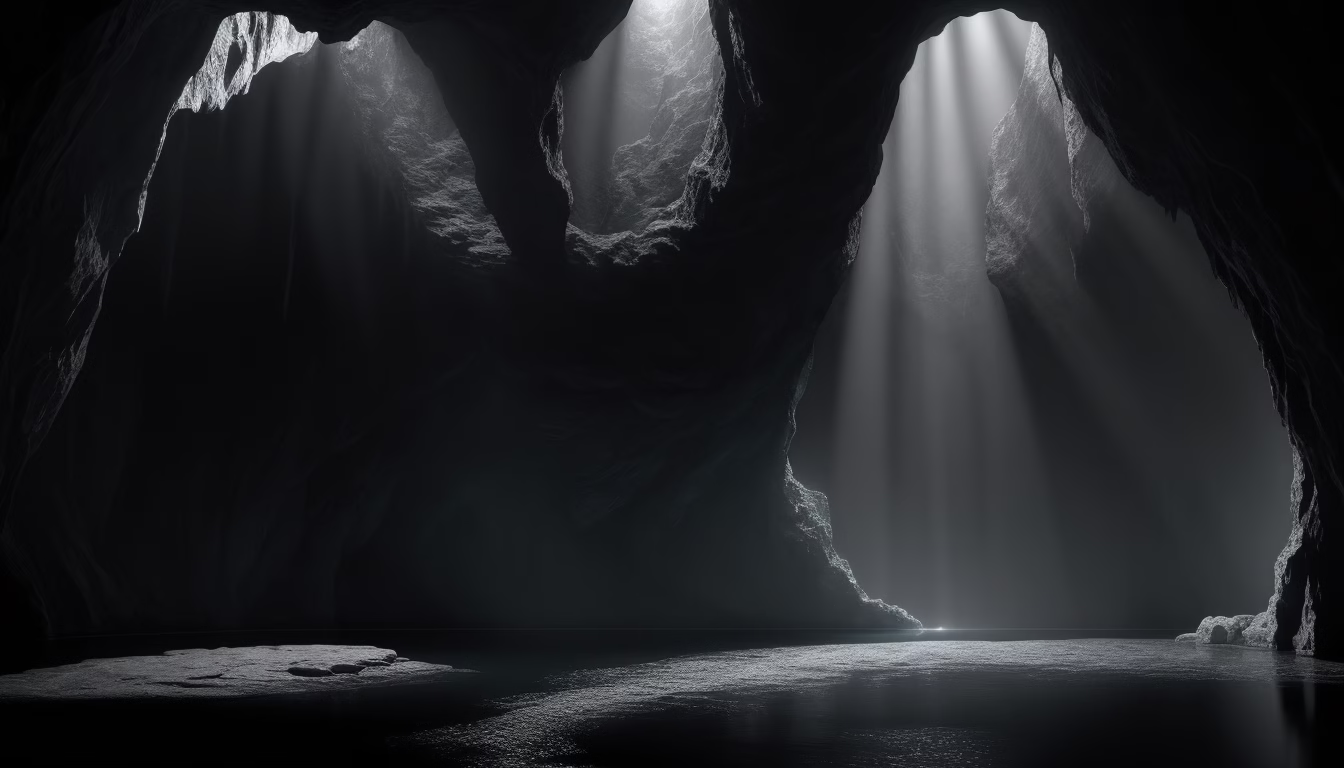
On July 23, Erasto Crisanto Valdez was fishing with his father near San Francisco La Paz, in the Uxpanapa region of Mexico, when he followed a fish into a flooded cave and lost the way out. Fifteen days later, specialist divers found him alive in a dark chamber more than 328 feet below the surface — reachable only through a flooded passage roughly 100 yards long (The Scuba News Mexico, 2026).
Key Takeaways
– Valdez survived 15 days with no food, sustained only by an air pocket and a spring of drinkable water (Good News Network, 2026).
– The rescue operation had shifted from search-and-rescue to body recovery before divers heard him respond on August 7.
– Valdez says the 15 days felt like only three — a distortion researchers link to real, documented effects of sensory deprivation on time perception.
How Did Erasto Crisanto Valdez Get Trapped in the Cave?
Valdez, 31, disappeared on July 23 while fishing with his father in the Uxpanapa region of Mexico after following a fish into an unfamiliar flooded cave and losing his route back out (The Scuba News Mexico, 2026). In his own words, recounted from a hospital bed afterward: “I went inside … and then, when I turned back, I couldn’t find the exit. I was just swimming aimlessly, trying to get out, but there was no way out … I don’t know how I got there — or how I spent those 15 days inside” (The Mary Sue, 2026).
Flooded caves like this one form when mildly acidic rainwater slowly dissolves limestone bedrock over thousands of years, carving out tunnel networks that can run for miles underground. Divers who work in these environments point to a specific hazard: it’s an overhead environment, meaning a swimmer can’t simply ascend straight to the surface if they lose their way, and stirred-up sediment can reduce visibility to zero within seconds (Down To Scuba, 2026).
Southern Mexico’s karst landscape, including the Uxpanapa region where Valdez was fishing, is riddled with exactly this kind of terrain — sinkholes, flooded passages, and cave systems that can look, from the surface, like nothing more than a still pool of water. A fish disappearing into what looks like a shallow opening can lead a swimmer much further than expected before the passage narrows, turns, or simply stops resembling anything a person could retrace from memory. That gap between what a cave entrance looks like and what it actually is has been part of nearly every flooded-cave rescue story on record, not just this one.
How Did He Survive 15 Days With No Food?
Valdez survived 15 days without food by relying on a natural air pocket trapped in the cave’s upper reaches and drinking from a nearby freshwater spring — nothing else sustained him during the ordeal (Good News Network, 2026). He was hospitalized afterward with severe dehydration and malnutrition. There’s no survival technique to extract from this detail, no takeaway that generalizes. There was water, there was air, and there was a man who kept breathing until someone found him.
By his own account, he spent much of that time asleep or in prayer, and has said plainly that faith carried him through it — not as a figure of speech, but as the thing he reached for when there was nothing else in the dark to hold onto (The Mary Sue, 2026).
Why Did 15 Days Feel Like Only Three to Him?
Valdez has said the 15 days felt like only three — a distortion consistent with documented research on how sensory deprivation affects time perception, where the absence of light, sound, and routine markers can cause the brain to significantly under- or overestimate elapsed time. Peer-reviewed research on perceptual isolation confirms that removing sensory input measurably impairs time estimation, and that the effects can appear after a relatively brief period in isolation (MDPI, Sensory Deprivation and the Brain, 2026).
We tend to assume suffering makes time crawl. Valdez’s account suggests something closer to the opposite can happen once there’s truly nothing left to measure it by — no meals, no light, no arrivals or departures. Time doesn’t just slow down without those markers. It can lose its shape entirely, and the research on sensory deprivation backs that up: this isn’t just one man’s impression, it’s a documented neurological effect.
The same body of research notes that sensory deprivation can produce perceptual disturbances, including hallucinations, in some people after only a relatively brief period of isolation (Wikipedia, Sensory deprivation, 2026). Set against that, what stands out about Valdez’s account is how composed and coherent it is — a description of prayer, sleep, and a compressed sense of time, rather than the disorientation the research suggests would have been an equally plausible outcome after fifteen days in total darkness.
Who Found Him, and How Close Did the Search Come to Ending?
Specialist cave divers Harry Gust and Rosalino “Rosso” Rivera found Valdez alive on August 7 in an operation that had already shifted from rescue to body recovery, after search efforts spanning land, river, and air over more than two weeks (The Scuba News Mexico, 2026). Gust reached the submerged chamber first and called out into the dark. Somewhere inside it, Valdez answered.
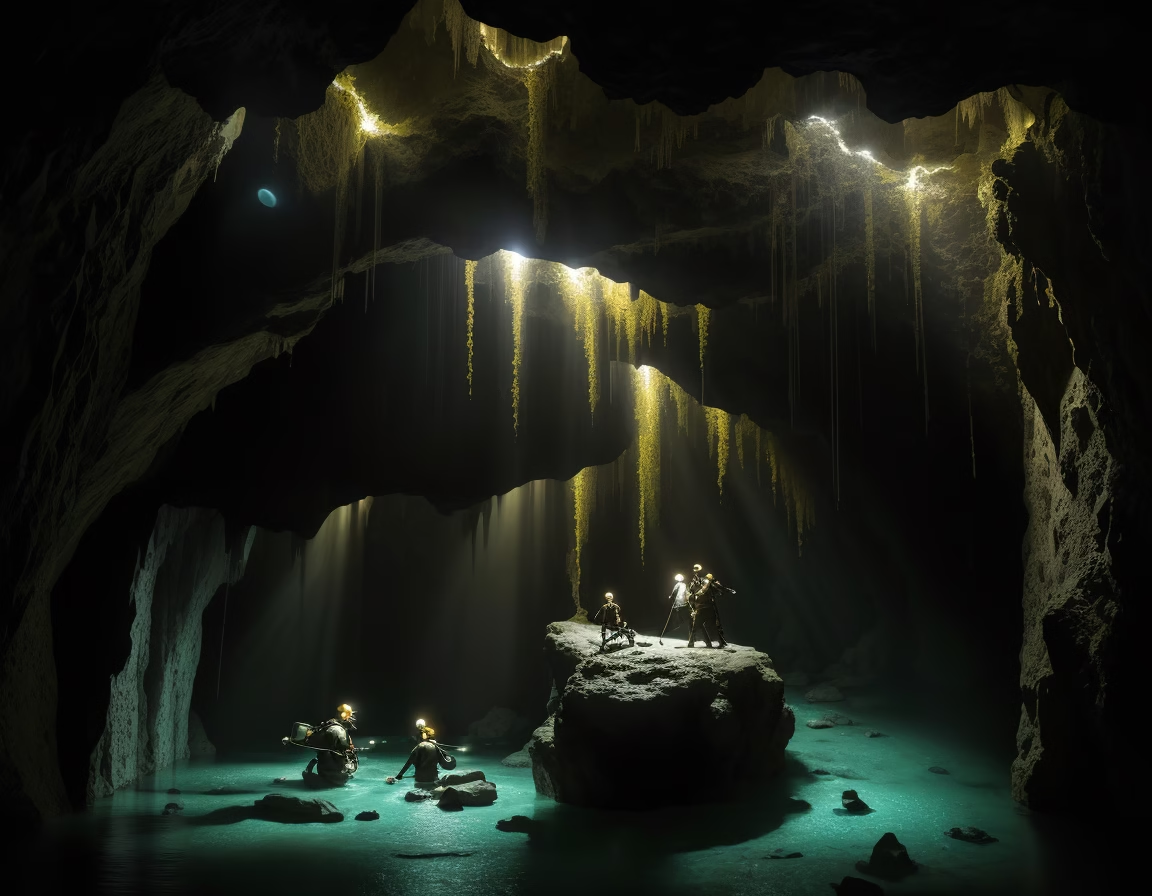
By day fifteen, an operation searching for a missing man had, by most reasonable expectations, become an operation to recover a body. The search’s organizers described it as guided by “the firm conviction of not giving up until finding him” (Yahoo News, 2026). Gust and Rivera supplied Valdez with breathing equipment and escorted him back through the roughly 100-yard submerged passage to the surface.
How Does This Compare to Other Famous Cave Rescues?
Valdez’s ordeal invites comparison to the 2018 Tham Luang cave rescue in Thailand, where a youth soccer team of 12 boys and their coach survived 18 days trapped by rising floodwater before an international team of more than 100 divers brought them out alive (Wikipedia, Tham Luang cave rescue, 2026). That operation involved roughly 10,000 people at its peak and cost the life of Saman Kunan, a volunteer diver and former Thai Navy SEAL who ran out of oxygen while placing air tanks along the escape route.
The two rescues share a shape, even at different scales: an initial disappearance, a search that stretches past the point most people would consider hope reasonable, and cave divers willing to enter flooded, disorienting passages that killed a trained professional in the more famous case. What made both endings possible wasn’t luck alone — it was specialists refusing to treat “unlikely” as “impossible,” in Thailand for nearly three weeks, and for Valdez, for slightly less than that.
What Happens to the Body After 15 Days Without Food?
Fifteen days without food creates serious, potentially life-threatening risk during recovery, not just during the ordeal itself — a complication called refeeding syndrome, which can occur when eating resumes too quickly after prolonged starvation. The condition involves dangerous shifts in electrolytes, particularly phosphorus, potassium, and magnesium, and can trigger cardiac arrhythmias, breathing difficulties, or seizures within the first four days of eating again (Cleveland Clinic, 2026).
This is precisely why Valdez’s hospitalization for “dehydration and malnutrition” matters as more than a footnote. Medical teams treating survivors of prolonged starvation typically reintroduce nutrition slowly and under close monitoring, aware that the body’s own metabolic response to being fed again can be as dangerous, in the short term, as the starvation was. Surviving 15 days in the dark was, in a real sense, only the first of two medical ordeals Valdez had to get through safely.
What Can This Story Teach the Rest of Us?
Valdez’s survival depended on something internal — faith, breath, whatever kept him oriented in a place built to disorient anyone. It also depended entirely on divers who had no evidence left to justify continuing to look, and searched anyway. Fifteen days is a long time to hold onto anything. It’s a longer time to hold onto nothing but belief.
Whatever carried Valdez through that chamber, and whatever kept two divers searching a passage most people had already given up on, they met somewhere in that submerged tunnel on August 7 — and both, it turns out, were forms of the same thing: a refusal to stop believing there was still an exit.
Frequently Asked Questions
How long was Erasto Crisanto Valdez trapped in the cave?
Valdez was trapped for 15 days, from July 23 to August 7, in a flooded cave more than 328 feet below the surface in Mexico’s Uxpanapa region (The Scuba News Mexico, 2026).
What did the trapped fisherman eat and drink for 15 days?
He had no food for the full 15 days and survived on water from a natural spring inside the cave, relying on a trapped air pocket to breathe (Good News Network, 2026). He was hospitalized with dehydration and malnutrition after rescue.
Why do people underestimate time in complete darkness?
Removing light, sound, and routine cues impairs the brain’s ability to track elapsed time, a well-documented effect of sensory deprivation confirmed in peer-reviewed neuroscience research (MDPI, 2026). Some people underestimate elapsed time significantly; others overestimate it.
Is it dangerous to eat normally right after surviving starvation?
Yes — reintroducing food too quickly after prolonged starvation can trigger refeeding syndrome, a dangerous shift in electrolytes like phosphorus, potassium, and magnesium that can cause cardiac or breathing complications within days (Cleveland Clinic, 2026). Hospitals typically reintroduce nutrition slowly and under close monitoring for exactly this reason.
Is Valdez’s rescue similar to the Thailand cave rescue?
The situations share real similarities: a disappearance, an extended search, and specialist divers navigating flooded, disorienting passages. The 2018 Tham Luang rescue in Thailand involved 12 boys and their coach trapped for 18 days and required roughly 10,000 people at its peak, including over 100 divers (Wikipedia, 2026). Valdez’s rescue was smaller in scale but followed a similar arc of persistence past the point of reasonable hope.
Why are flooded caves in Mexico so dangerous to explore?
Flooded limestone caves are overhead environments, meaning divers or swimmers can’t ascend directly to the surface if they lose orientation, and disturbed sediment can reduce visibility to zero almost instantly (Down To Scuba, 2026). Experienced guides and proper training are considered essential for safe exploration.
Sources (retrieved 2026-08-27):
– The Scuba News Mexico, “Cave Divers Find Fisherman Alive After 15 Days in Mexican Cenote,” https://www.thescubanews.com/2026/08/17/cave-divers-find-fisherman-alive-mexican-cenote/
– Good News Network, “Man Rescued Alive After Being Trapped in Underwater Cave for 15 Days Without Food or Light,” https://www.goodnewsnetwork.org/man-rescued-alive-after-being-trapped-in-underwater-cave-for-15-days-without-food/
– The Mary Sue, “What Happened to the Guy Trapped in an Underwater Cave?,” https://www.themarysue.com/15-days-trapped-in-an-underwater-cave-without-food-and-rescued-alive-i-kept-my-faith-in-god/
– Yahoo News, “Man, 31, Rescued Alive After Being Trapped in Underwater Cave for 15 Days Without Food,” https://www.yahoo.com/news/world/articles/man-rescued-alive-being-131442952.html
– Down To Scuba, “What Is a Cenote? Formation, Types, Risks, and Cenote Diving Explained,” https://downtoscuba.com/what-is-a-cenote/
– MDPI, “Sensory Deprivation and the Brain: Neurobiological Mechanisms, Psychological Effects, and Clinical Implications,” https://www.mdpi.com/2076-3425/16/2/122