
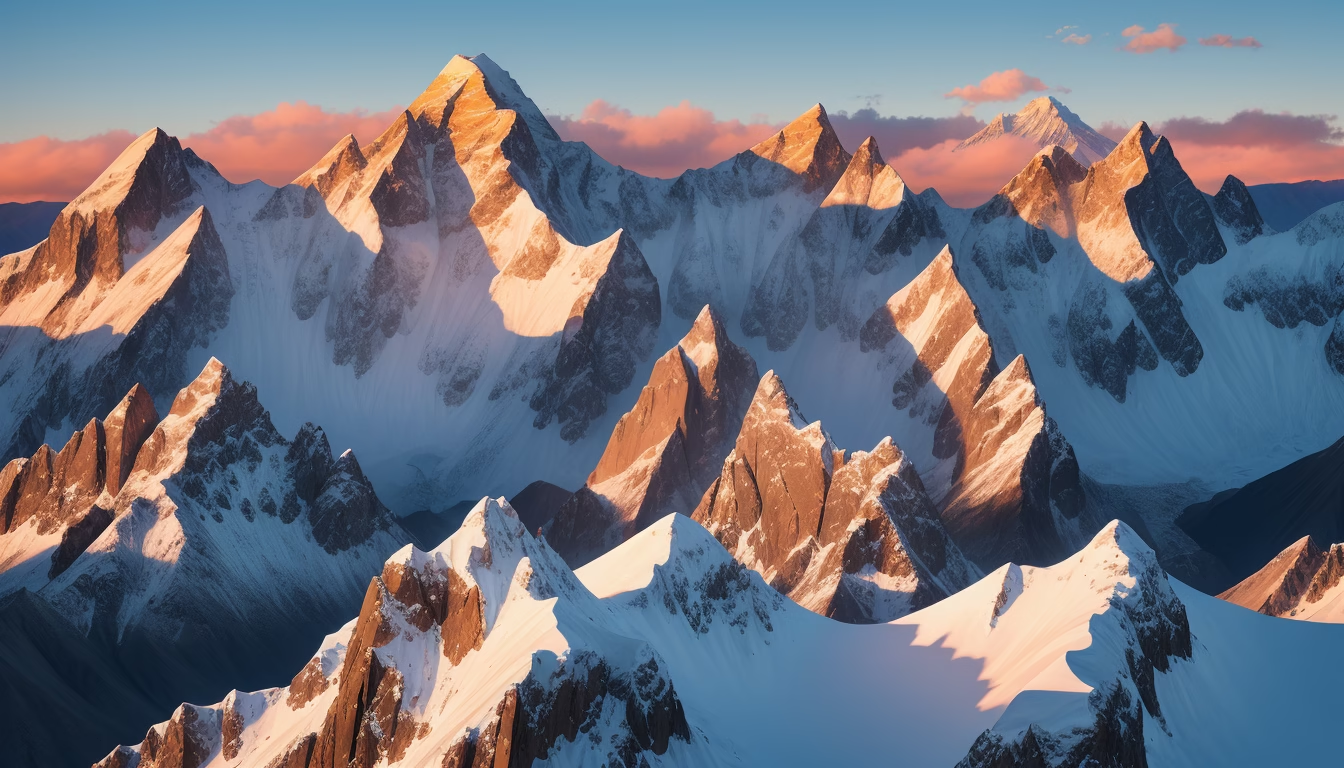
Every one of the world’s 14 peaks above 8,000 meters sits within the Himalaya-Karakoram mountain system spanning Nepal, Tibet, India, and Pakistan. Step outside that single, extraordinary mountain complex, and the tallest peak on the planet turns out to be Argentina’s Mount Aconcagua, rising 6,961 meters — over 1,800 meters shorter than Mount Everest, yet still the undisputed roof of every other continent and mountain range on Earth (Britannica, 2026).
That gap says a lot about just how anomalous the Himalaya-Karakoram region really is. Nowhere else on the planet does tectonic collision produce anything close to the same elevation, which is why this list pulls entirely from South America’s Andes, North America’s Alaska Range, Africa’s volcanic highlands, Europe’s Caucasus, and even Antarctica.
Key Takeaways
– Mount Aconcagua in Argentina is the highest peak outside the Himalaya-Karakoram system at 6,961 meters (22,838 ft) (Britannica, 2026).
– Six of the top 10 peaks on this list sit in South America’s Andes mountain range, more than any other range on Earth.
– Ojos del Salado, the second-highest peak on this list at 6,893 meters, is also the highest active volcano in the world.
– Denali in Alaska, at 6,190 meters, is the highest peak in North America and the highest peak entirely within the Arctic Circle’s broader region.
What Is the Highest Mountain Peak Outside the Himalayas?
Mount Aconcagua, located in Argentina’s Mendoza Province near the Chilean border, is the highest mountain peak in the world outside the Himalaya-Karakoram system, rising 6,961 meters (22,838 ft) above sea level (Britannica, 2026). It’s one of the celebrated Seven Summits, the highest peak on each continent, and the tallest mountain anywhere in the Western or Southern Hemispheres.
| Rank | Peak | Elevation | Location |
|---|---|---|---|
| 1 | Aconcagua | 6,961 m (22,838 ft) | Argentina, Andes |
| 2 | Ojos del Salado | 6,893 m (22,615 ft) | Argentina/Chile, Andes |
| 3 | Huascarán | 6,768 m (22,205 ft) | Peru, Andes |
| 4 | Chimborazo | 6,268 m (20,561 ft) | Ecuador, Andes |
| 5 | Denali | 6,190 m (20,310 ft) | United States, Alaska Range |
| 6 | Kilimanjaro | 5,895 m (19,341 ft) | Tanzania, East African Rift |
| 7 | Mount Elbrus | 5,642 m (18,510 ft) | Russia, Caucasus |
| 8 | Pico de Orizaba | 5,636 m (18,491 ft) | Mexico, Trans-Mexican Volcanic Belt |
| 9 | Mount Ararat | 5,137 m (16,854 ft) | Turkey, Armenian Highlands |
| 10 | Vinson Massif | 4,892 m (16,050 ft) | Antarctica, Ellsworth Mountains |
(Sources: Britannica, 2026; elevation data cross-checked against Wikipedia, “List of mountains by elevation”.)
Aconcagua, despite its extreme elevation, is technically one of the more accessible non-technical high-altitude climbs in the world via its Normal Route, requiring no ropes or specialized climbing equipment for experienced high-altitude trekkers — though altitude sickness remains a serious risk given the summit sits above 60% of the Earth’s usable atmosphere.
Why Is Ojos del Salado Called the World’s Highest Volcano?
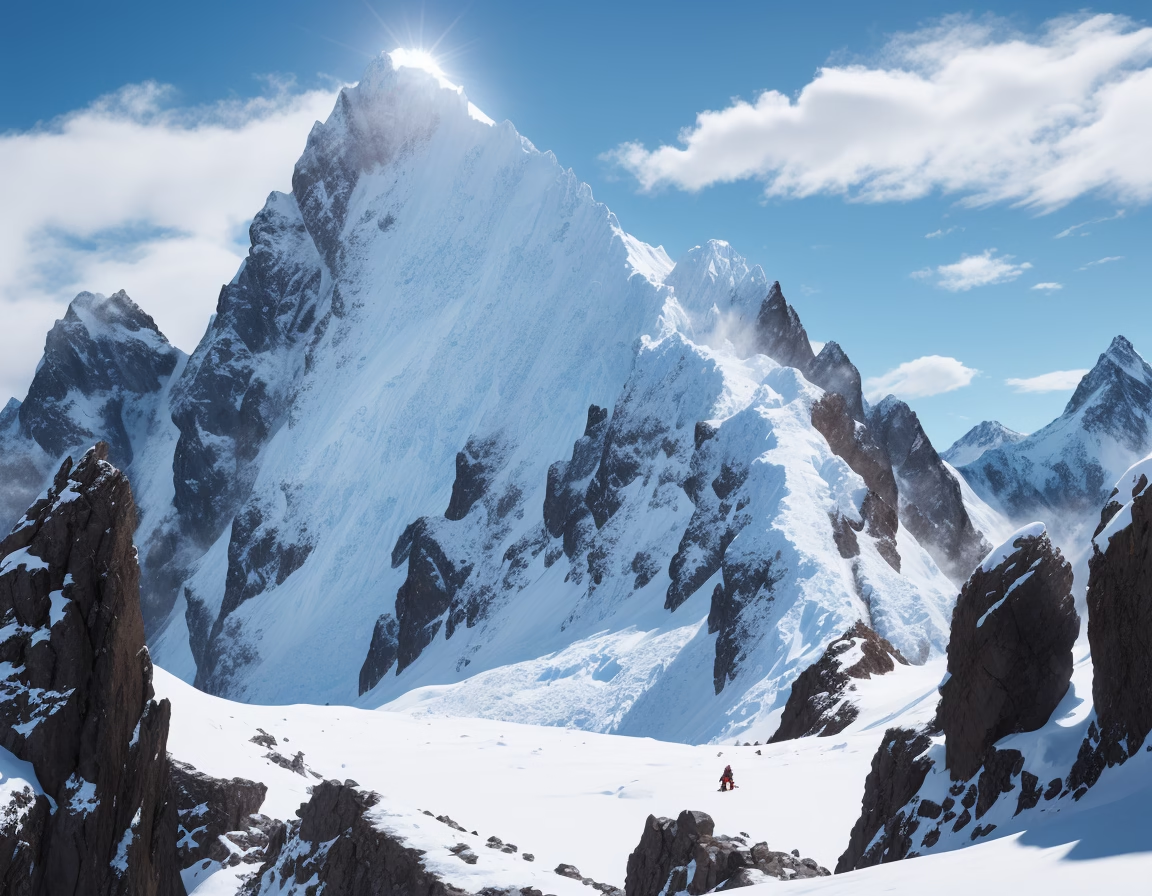
Ojos del Salado, straddling the Argentina-Chile border, reaches 6,893 meters and holds the distinct title of the highest active volcano on Earth, even though it hasn’t erupted in recorded history and shows only occasional fumarolic activity (Britannica, 2026). Its extreme elevation makes it second only to Aconcagua among peaks outside the Himalaya-Karakoram system.
The mountain sits in the Atacama region, one of the driest places on Earth, and its slopes are so arid that despite its towering elevation, the mountain holds a permanent crater lake near its summit — reportedly the highest lake of any kind in the world. That combination of extreme dryness and extreme altitude makes Ojos del Salado a magnet for scientific research into conditions comparable to those on Mars.
Why Do Six of the Top 10 Peaks Sit in the Andes?
Six of the ten highest peaks outside the Himalayas — Aconcagua, Ojos del Salado, Huascarán, and Chimborazo directly, plus the broader Andean range’s influence — sit in South America’s Andes, the longest continental mountain range on Earth at roughly 7,000 km, formed by the ongoing subduction of the Nazca Plate beneath the South American Plate (Britannica, 2026). No other mountain range outside Asia comes close to matching that concentration of extreme elevation.
Huascarán, Peru’s highest peak at 6,768 meters, sits in the Cordillera Blanca, the world’s highest tropical mountain range, and its slopes hold the largest concentration of tropical glaciers on Earth — glaciers now retreating rapidly due to warming temperatures, a change scientists studying the region have documented as one of the more visible signals of climate change in the tropics. Chimborazo, Ecuador’s highest peak at 6,268 meters, holds an entirely different superlative: because Earth bulges at the equator, Chimborazo’s summit is the single point on the planet’s surface farthest from Earth’s center — farther even than Mount Everest’s summit, despite Everest’s much greater elevation above sea level.
Is Denali the Highest Peak in North America?
Yes — Denali, in Alaska’s Alaska Range, is the highest peak in North America at 6,190 meters (20,310 ft), and it holds a distinct claim to fame: measured from base to summit rather than from sea level, Denali has the greatest vertical rise of any mountain on Earth, exceeding even Everest’s base-to-peak prominence (Britannica, 2026). Its base sits at a relatively low elevation, meaning nearly its entire towering height is visible from the surrounding lowlands.
Denali’s climate is brutally harsh despite its comparatively modest elevation next to Andean or Himalayan peaks — its high latitude means the mountain experiences some of the coldest recorded temperatures of any mountain on Earth, with wind chills that have plunged below -75°C near the summit. That combination of extreme cold and technical terrain makes Denali, statistically, one of the more dangerous of the Seven Summits relative to its elevation.
How Do Kilimanjaro, Elbrus, and Orizaba Compare?
Kilimanjaro in Tanzania (5,895 m), Mount Elbrus in Russia’s Caucasus (5,642 m), and Pico de Orizaba in Mexico (5,636 m) each hold the title of highest peak on their respective continent or region, despite ranking well below the Andean giants on raw elevation (Britannica, 2026). All three are volcanic in origin, though Kilimanjaro and Orizaba are considered dormant rather than fully extinct.
Kilimanjaro holds a particular distinction as the tallest free-standing mountain in the world — meaning it isn’t part of a larger mountain range, rising instead directly from surrounding plains near sea level to its full height. Its retreating summit glaciers, among the few permanent ice fields near the equator, have shrunk dramatically over the past century, a change widely documented by climate researchers and visible even to casual visitors comparing recent photos to those from a few decades ago.
Why Do Ararat and Vinson Massif Close Out the List?
Mount Ararat in Turkey (5,137 m) and Vinson Massif in Antarctica (4,892 m) round out the top 10, representing the highest points of the Armenian Highlands and the entire Antarctic continent respectively — both far from any of the well-known climbing hubs associated with the rest of this list (Britannica, 2026). Both peaks carry outsized cultural or exploratory significance relative to their global elevation ranking.
Ararat holds deep religious and cultural significance as the traditional resting place of Noah’s Ark in biblical accounts, and its dormant volcanic cone dominates the skyline visible from Armenia, despite sitting within Turkey’s borders — a geographic fact that carries real political weight in the region. Vinson Massif, discovered only in 1958 during a US Navy aerial survey, remained unclimbed until 1966 and today requires a specialized, costly Antarctic expedition, making it logistically the most difficult of the Seven Summits to reach despite not being the tallest.
How Do These Peaks Compare for Climbing Difficulty?
Elevation alone doesn’t determine how hard a mountain is to climb, and the peaks on this list vary enormously in technical difficulty despite their relatively close elevations. Aconcagua’s Normal Route is considered a non-technical high-altitude trek requiring no ropes or specialized climbing gear, which is why it draws thousands of climbers annually despite its extreme elevation — though the mountain’s notoriously violent windstorms and altitude-related illness still make it far from easy, and it has a fatality rate higher than many technically harder peaks.
Denali, despite being roughly 770 meters shorter than Aconcagua, is widely considered a more demanding climb overall because of its extreme cold, frequent severe weather, glacial crevasse hazards, and the sheer physical effort required to haul gear up its long approach routes without porter support, which is banned on the mountain. Vinson Massif presents almost the opposite challenge: the climbing itself is only moderately technical, but simply reaching Antarctica requires a specialized, expensive logistics operation involving chartered aircraft landing on ice runways, putting it out of reach for all but well-funded expeditions.
Why Do Mountaineers Use the “Seven Summits” Challenge?
Several peaks on this list — Aconcagua, Denali, Kilimanjaro, and Vinson Massif — are famous specifically because they’re part of the “Seven Summits,” a mountaineering challenge popularized after American businessman Richard Bass became the first person to climb the highest peak on every continent in 1985. The challenge has since driven significant guided-expedition tourism to each of these mountains, particularly Kilimanjaro and Aconcagua, both considered relatively achievable for determined amateur climbers with proper guiding support.
The Seven Summits list itself has a long-running internal dispute mirroring the “outside the Himalayas” framing of this article: some versions use Mount Kosciuszko in Australia (just 2,228 meters) as the Australian continent representative, while the more physically demanding “Messner list” substitutes Puncak Jaya in Indonesia’s mountainous Papua region instead, since Kosciuszko is barely more than a large hill by comparison to every other entry on the list.
Frequently Asked Questions
What is the highest mountain outside the Himalayas?
Mount Aconcagua in Argentina is the highest mountain outside the Himalaya-Karakoram system at 6,961 meters (22,838 ft), making it the tallest peak in the Western and Southern Hemispheres and one of the Seven Summits (Britannica, 2026). It sits in the Andes near the Chilean border.
Is Ojos del Salado taller than Aconcagua?
No — Ojos del Salado, at 6,893 meters, ranks just below Aconcagua’s 6,961 meters, but it holds a separate record as the highest active volcano in the world, despite showing no eruptions in recorded history (Britannica, 2026). Both peaks sit along the Argentina-Chile border in the Andes.
What is the highest mountain in North America?
Denali, in Alaska’s Alaska Range, is the highest mountain in North America at 6,190 meters (20,310 ft), and it holds the record for greatest base-to-summit vertical rise of any mountain on Earth, exceeding even Mount Everest’s prominence measured the same way (Britannica, 2026).
Why is Chimborazo considered the farthest point from Earth’s center despite not being the tallest?
Chimborazo’s summit, at 6,268 meters, sits nearly on the equator, where Earth’s rotation causes the planet to bulge outward more than at higher latitudes, making Chimborazo’s peak the single point on Earth’s surface farthest from the planet’s center — farther than Everest’s summit despite Everest’s far greater elevation above sea level.
How many of the world’s tallest mountains are in the Himalayas?
All 14 of the world’s peaks above 8,000 meters are located within the Himalaya-Karakoram mountain system spanning Nepal, Tibet, India, and Pakistan, which is why the highest peak outside that system, Aconcagua at 6,961 meters, stands over 1,800 meters shorter than Mount Everest (Britannica, 2026).
Sources (retrieved 2026-08-28):
– Britannica, “The World’s Highest Mountains by Continent,” https://www.britannica.com/story/7-or-8-summits-the-worlds-highest-mountains-by-continent
– Wikipedia, “List of mountains by elevation” (cross-reference), https://en.wikipedia.org/wiki/List_of_mountains_by_elevation
– NOAA Ocean Service, “The highest point on Earth” (Chimborazo equatorial bulge fact), https://oceanservice.noaa.gov/facts/highestpoint.html