
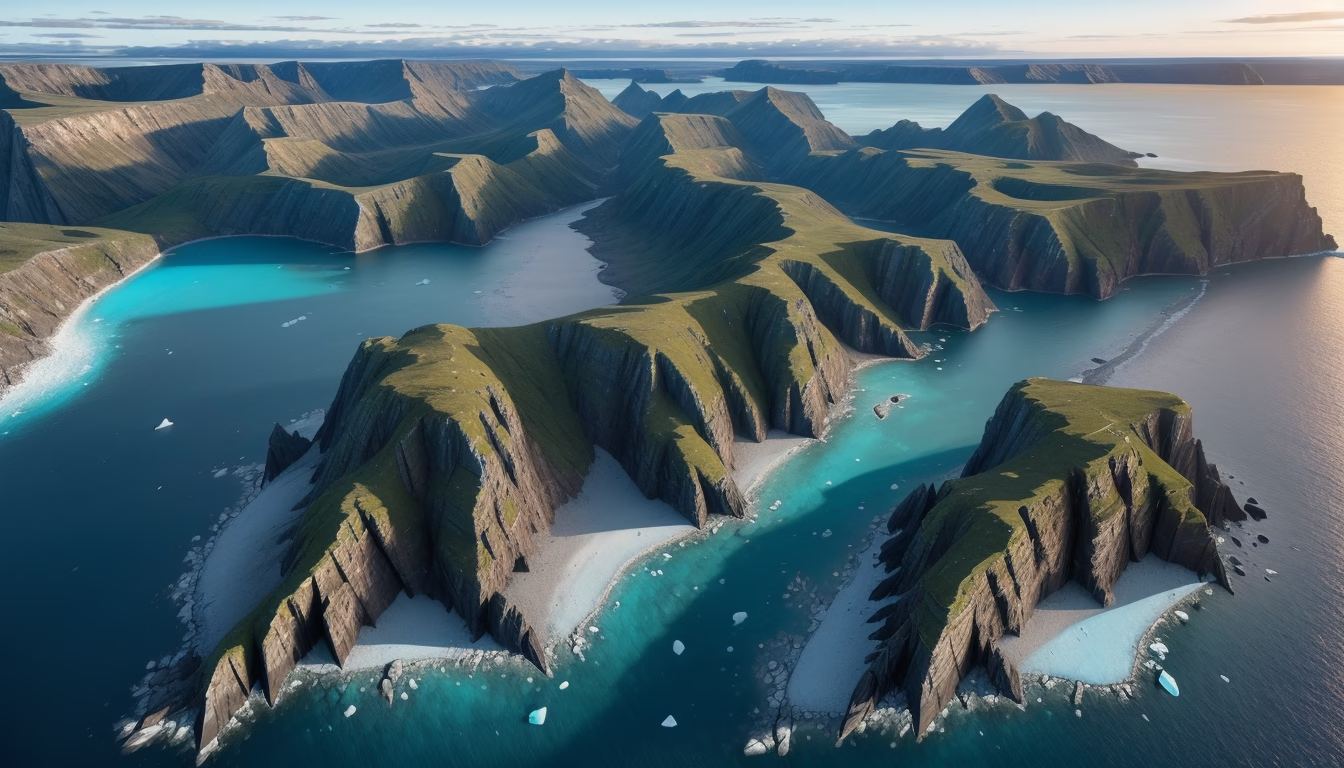
Norway’s coastline hides more than 320,000 islands, and the overwhelming majority of them are uninhabited rocky outcrops so small they barely register on a standard map (World Population Review, 2026). Sweden and Finland aren’t far behind, and together the three Nordic countries account for more than 766,000 islands between them — a number so large it only makes sense once you understand the specific glacial process that created them.
Counting a country’s islands turns out to be far less precise than it sounds. Different governments and researchers use different minimum-size thresholds for what officially counts as an “island” versus a mere rock or skerry, which means island counts can swing by tens of thousands depending entirely on the counting methodology used. The rankings below reflect the most widely cited figures, with that caveat built in.
Key Takeaways
– Norway has more islands than any other country — over 320,000 — most of them small, uninhabited skerries shaped by glacial retreat (World Population Review, 2026).
– Sweden ranks second with roughly 267,570 islands, and Finland third with about 178,947.
– Japan is the highest-ranked non-Nordic country, with approximately 120,729 islands.
– Island counts vary significantly between sources because there’s no universal size threshold for what qualifies as an island.
Which Country Has the Most Islands in the World?
Norway has more islands than any other country on Earth, with a commonly cited count of roughly 320,249, the direct result of glaciers scraping and fracturing its coastline into thousands of rocky fragments during the last ice age (World Population Review, 2026). Most of these islands, called skerries, are far too small and barren to support permanent habitation.
| Rank | Country | Number of Islands |
|---|---|---|
| 1 | Norway | 320,249 |
| 2 | Sweden | 267,570 |
| 3 | Finland | 178,947 |
| 4 | Japan | 120,729 |
| 5 | Canada | 52,455 |
| 6 | Chile | 43,471 |
| 7 | United States | 18,617 |
| 8 | Indonesia | 17,508 |
| 9 | Australia | 8,222 |
| 10 | Philippines | 7,641 |
(Source: World Population Review, “Number of Islands by Country 2026”, citing aggregated national geographic survey data, 2026.)
Norway’s fjord coastline, itself carved by the same glacial forces, stretches for more than 100,000 km when every inlet is measured — a coastline so convoluted that its outlying skerries and islets multiply the effective shoreline many times over compared to a smoother coastline of similar overall length.
Why Do Sweden and Finland Also Have So Many Islands?
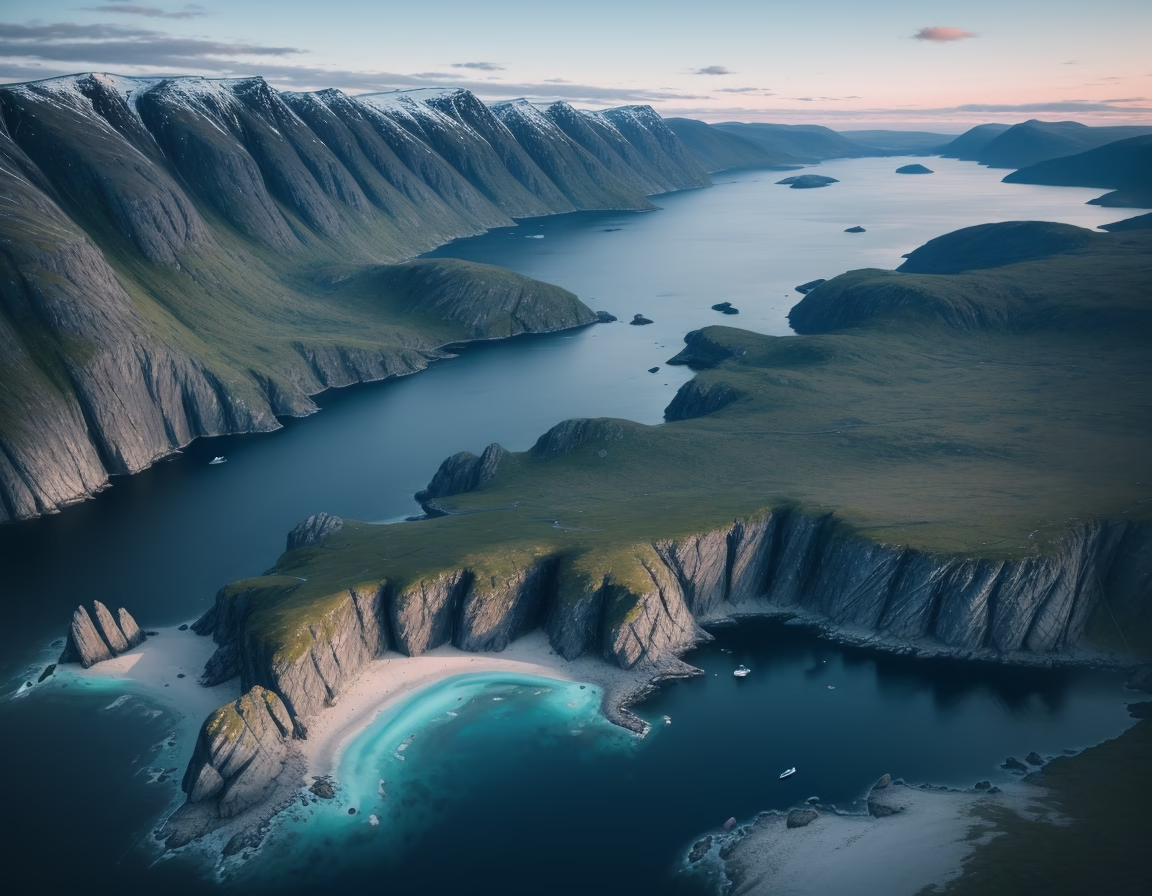
Sweden and Finland rank second and third globally with approximately 267,570 and 178,947 islands respectively, both shaped by the same Scandinavian glacial retreat that produced Norway’s fragmented coast, but expressed differently across each country’s distinct terrain (World Population Review, 2026). Sweden’s Stockholm Archipelago alone contains roughly 30,000 islands.
Only about 1,000 of Sweden’s islands are permanently inhabited, concentrated mainly along the west coast and around the Baltic islands of Öland and Gotland. Finland’s island count is driven by a slightly different mechanism — the country is famously known as the “Land of a Thousand Lakes,” and many of its actual lake count runs into the tens of thousands, with numerous small islands scattered within those inland lakes in addition to its fragmented Baltic Sea coastline, giving Finland one of the most physically fragmented landscapes on Earth by any measure.
Why Does Japan Have So Many Islands Despite Not Being Nordic?
Japan holds approximately 120,729 islands, the fourth-highest count in the world and by far the most of any non-Nordic country, a result of its position along a highly active volcanic and tectonic arc rather than glacial carving (World Population Review, 2026). Unlike Norway’s glacial skerries, most Japanese islands formed through volcanic activity and tectonic uplift along the Pacific Ring of Fire.
Japan’s government formally recognizes four main islands — Honshu, Hokkaido, Kyushu, and Shikoku — but a 2023 Geospatial Information Authority resurvey using more precise satellite mapping technology found the true count of Japanese islands to be roughly double the previously accepted official figure, illustrating just how much a national island count can shift with improved measurement technology alone.
How Do Canada and Chile Compare?
Canada ranks fifth globally with approximately 52,455 islands, driven substantially by its Arctic archipelago, while Chile ranks sixth with roughly 43,471, shaped by its fragmented southern Patagonian coastline of fjords and channels (World Population Review, 2026). Both countries owe much of their island count to remote, sparsely populated coastal regions far from their major cities.
Canada’s Arctic Archipelago alone contains more than 36,000 islands, including Baffin Island, the world’s fifth-largest island by area, and Ellesmere Island, among the northernmost inhabited landmasses on Earth. Chile’s southern fjord region, stretching from Chiloé Island down through the Strait of Magellan toward Tierra del Fuego, was carved by glaciers in a process broadly similar to Norway’s coastline, just at the opposite end of the planet.
Why Do the US, Indonesia, Australia, and the Philippines Round Out the Top 10?
The United States, Indonesia, Australia, and the Philippines close out the top 10 with island counts ranging from roughly 7,600 to 18,600, each shaped by a different geological process — Alaska’s glacial and volcanic coastline for the US, tectonic volcanic arcs for Indonesia and the Philippines, and a mix of coral and continental shelf islands for Australia (World Population Review, 2026). Indonesia’s 17,508 islands span more than 5,000 km of the equator, making it the world’s largest archipelagic nation by geographic spread even though its total island count trails several other countries on this list.
The Philippines’ 7,641 islands formed through a combination of volcanic activity and tectonic uplift along its own segment of the Ring of Fire, and only about 2,000 of them are named, with roughly 1,000 permanently inhabited — a reminder that raw island counts include enormous numbers of uninhabited rocks and islets across every country on this list, not just population centers.
What’s the Difference Between an Island, an Islet, and a Skerry?
Geographers distinguish between several categories of small landmasses, and the terminology matters more than it might seem for understanding why island counts vary so dramatically between sources. A skerry, the term most associated with Norway and Sweden’s massive island counts, refers specifically to a small, rocky, often uninhabitable island typically formed by glacial scouring, distinguished from a full “island” mainly by size and lack of vegetation or soil rather than any strict legal threshold.
An islet is a broader, less formally defined term for any small island, generally smaller than a standard island but larger than a bare rock, while some national surveys apply a specific minimum size — often a certain number of square meters of land above high tide — before a landmass officially counts toward the national total. This inconsistency across countries and organizations is precisely why Norway’s island count is sometimes cited anywhere from roughly 50,000 to over 320,000 depending on which threshold a given source applies, and why any single figure in this article should be read as one reasonable estimate rather than a settled fact.
How Do Island Nations Manage Governing Thousands of Islands?
Governing a country spread across tens or hundreds of thousands of islands creates practical challenges most mainland nations never have to solve. Indonesia, despite ranking eighth on this list by raw island count, faces some of the most complex logistical governance challenges of any country on Earth, given its population is spread across roughly 6,000 permanently inhabited islands spanning three time zones and multiple distinct ethnic and linguistic regions.
The Philippines addresses this challenge partly through its regional government structure, delegating significant authority to island-group-level administrations rather than governing every inhabited island directly from Manila. Norway and Sweden, by contrast, face a much simpler version of this problem since the overwhelming majority of their islands are uninhabited — governance challenges concentrate mainly around the roughly 1,000 inhabited islands in each country rather than the hundreds of thousands of bare skerries that make up most of their official island counts.
Which of These Island Nations Are Best for Island-Hopping Travel?
Not every country on this list is equally practical for a travel itinerary built around visiting multiple islands, since most of Norway’s and Sweden’s roughly 588,000 combined islands are tiny, uninhabited skerries with no facilities of any kind. Norway’s inhabited islands, concentrated along the Lofoten and Vesterålen archipelagos in the north, offer some of the most dramatic scenery on this entire list — jagged peaks rising directly from the sea, connected by an extensive ferry and bridge network built specifically to serve small coastal communities.
The Philippines and Indonesia, despite ranking lower in total island count than the Nordic countries, are far more geared toward island-hopping tourism, with established ferry, small-boat, and domestic flight networks connecting popular destinations like the Philippines’ Palawan and Visayas island groups, or Indonesia’s Gili Islands near Bali. Croatia, not in this top 10 but frequently mentioned alongside it, has built one of the world’s most tourist-friendly island-hopping cultures around a comparatively modest island count, proving that a well-developed ferry network can matter more to travelers than raw island totals.
How Has Climate Change Affected These Island-Rich Coastlines?
Rising sea levels affect the countries on this list very differently depending on elevation and geology. Norway’s, Sweden’s, and Finland’s rocky, glacially formed islands sit largely on solid granite bedrock well above sea level, making them far more resilient to rising seas than low-lying coral or sedimentary island nations elsewhere in the world. Canada’s Arctic Archipelago faces a different climate pressure entirely: warming temperatures are reducing seasonal sea ice that many remote Arctic communities have historically relied on for winter transportation between islands.
The Philippines and Indonesia, both prone to typhoons and tropical storms, face compounding risk as warming ocean temperatures are linked to more intense storm systems, threatening low-lying coastal communities across thousands of their smaller inhabited islands. Australia’s Great Barrier Reef region, adjacent to many of its counted islands, has experienced repeated coral bleaching events tied to rising ocean temperatures, a slower-moving but ecologically significant threat distinct from the direct flooding risk facing lower-lying archipelagos elsewhere on this list.
Frequently Asked Questions
Which country has the most islands in the world?
Norway has the most islands of any country, with a commonly cited count of roughly 320,249, most of them small uninhabited skerries formed by glacial retreat along its fjord coastline (World Population Review, 2026). Sweden and Finland rank second and third with similarly glacier-shaped coastlines.
How many islands does Sweden have?
Sweden has approximately 267,570 islands, the second-highest count of any country, though only about 1,000 are permanently inhabited (World Population Review, 2026). The Stockholm Archipelago alone accounts for roughly 30,000 of that total.
Why does Japan have so many islands?
Japan has approximately 120,729 islands, formed mainly through volcanic activity and tectonic uplift along the Pacific Ring of Fire rather than glacial carving. A 2023 satellite resurvey by Japan’s Geospatial Information Authority roughly doubled the previously accepted official island count.
Is Indonesia the country with the most islands?
No — despite being the world’s largest archipelagic nation by geographic spread, Indonesia ranks eighth in total island count at approximately 17,508, well behind Norway, Sweden, Finland, Japan, Canada, and Chile, all of which have more fragmented coastlines relative to their land area (World Population Review, 2026).
Why do island counts vary so much between different sources?
Island counts vary because there’s no universally agreed minimum size or definition distinguishing an “island” from a mere rock or skerry, so different national surveys and international databases can report significantly different totals for the same country (World Population Review, 2026). Improved satellite mapping has also led some countries, like Japan in 2023, to revise their official counts substantially.
Sources (retrieved 2026-08-28):
– World Population Review, “Number of Islands by Country 2026,” https://worldpopulationreview.com/country-rankings/number-of-islands-by-country
– Wikipedia, “List of countries by number of islands” (underlying data source), https://en.wikipedia.org/wiki/List_of_countries_by_number_of_islands