
Astronomers May Have Just Solved a 100-Year Mystery About Betelgeuse
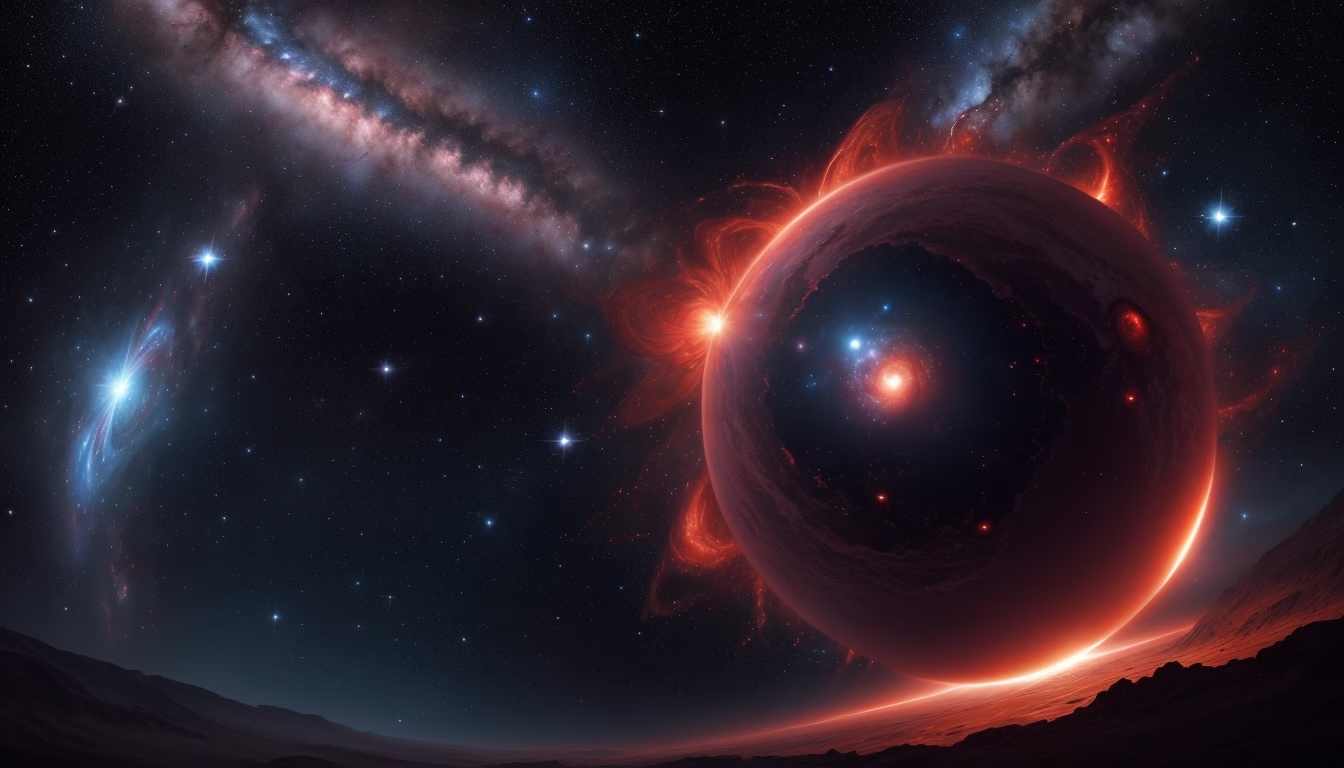
For more than a century, astronomers have suspected Betelgeuse wasn’t alone. In 2026, a team using the European Southern Observatory’s Very Large Telescope finally proved it — directly imaging a faint companion star hiding in the glare of one of the night sky’s brightest supergiants. “This is the conclusion of a century-long quest,” said lead astronomer Miguel Montargès of the Paris Observatory (European Southern Observatory, 2026).
Key Takeaways
– In 2026, astronomers directly imaged Betelgeuse’s companion star for the first time, ending a search that traces back to 1908 (ESO, 2026).
– The companion, provisionally “Betelgeuse B,” is only 2-3 solar masses — tiny next to Betelgeuse’s 15-20 solar masses (Universe Today, 2026).
– Betelgeuse likely won’t go supernova for a few hundred thousand years, despite recurring internet rumors (Scientific American, 2026).
How Long Have Astronomers Suspected Betelgeuse Has a Companion?
Astronomers have suspected Betelgeuse hosts a hidden companion for nearly 120 years, dating back to early radial-velocity studies by Plummer in 1908, followed by Campbell in 1910 and 1911, Lunt in 1916, and Spencer Jones in 1928, all of which flagged Betelgeuse as a possible spectroscopic binary (IOPscience, 2026). None could confirm it. In 1986, a team led by Karovska used an early imaging technique called speckle interferometry and proposed not one but two companions — a claim that also went unconfirmed.
The hypothesis got new life in 2024, when two independent research teams used more than a century of accumulated Betelgeuse observations to model a companion on a roughly six-year orbit and predict exactly where — and when — it would be easiest to spot. NASA astronomer Steve Howell used a speckle imager called ‘Alopeke and reported a faint hint of something near Betelgeuse, but it wasn’t a definitive image (Sky & Telescope, 2026).
That’s the detail worth pausing on: astronomers didn’t stumble onto this star by luck. Four separate generations of researchers, working roughly a century apart, each predicted something was there before anyone could actually see it.
Why Was a Star This Close Impossible to See?
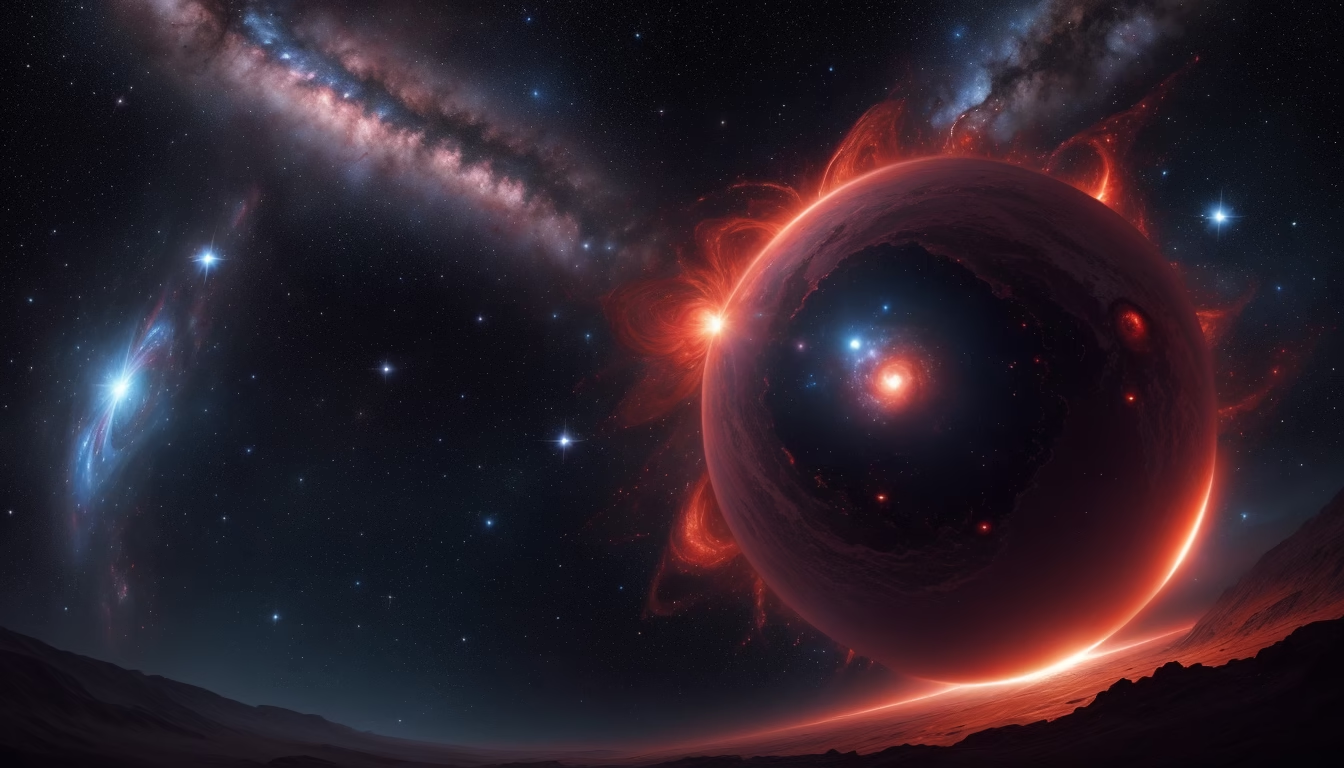
Betelgeuse’s companion stayed hidden for so long because the red supergiant is roughly 764 times the Sun’s radius and vastly brighter, meaning any faint nearby star gets lost in the glare — like trying to spot a candle held next to a wildfire. Set Betelgeuse where our Sun sits, and its surface would swallow everything out to about the orbit of Mars (Britannica, 2026). The star sits 650 light-years away, meaning the light we see tonight left Betelgeuse sometime in the Middle Ages.
The breakthrough that finally worked depended on precise timing. The 2024 studies predicted the companion would reach its point of maximum separation from Betelgeuse in early December of that year — the one moment in its orbit when a faint object might briefly clear enough of the glare to be caught. Montargès’s team pointed the VLT’s SPHERE instrument at Betelgeuse on December 3 and 6, 2024, aiming for exactly that window, and captured the first direct image of light coming from the companion itself, rather than just its gravitational fingerprint (Universe Today, 2026).
What Kind of Star Is Betelgeuse’s Companion?
Betelgeuse B is a much smaller, younger star weighing an estimated two to three times the mass of the Sun, compared to Betelgeuse’s own 15 to 20 solar masses packed into an enormous, bloated envelope (Universe Today, 2026; Scientific American, 2026). On its own, a star that size would barely make the news. Next to Betelgeuse, it’s the answer to a question that outlived several careers’ worth of astronomers who asked it.
That size mismatch matters for a related mystery astronomers have been untangling separately: Betelgeuse’s irregular brightness cycles. A close, low-mass companion orbiting near a supergiant’s outer atmosphere can help explain certain longer-period brightness variations that a single star alone struggles to account for.
Did the Companion Star Cause Betelgeuse’s “Great Dimming”?
No — Betelgeuse’s dramatic 2019-2020 “Great Dimming,” when the star lost roughly two-thirds of its normal brightness, has its own separate explanation and isn’t directly caused by the newly imaged companion. Research published in Nature and confirmed by Harvard-Smithsonian Center for Astrophysics and Hubble Space Telescope observations found the dimming was caused by a dust cloud: superhot plasma from a convective upwelling on Betelgeuse’s surface was ejected into its cooler outer atmosphere at roughly 200,000 miles per hour, condensed into dust, and blocked light from about a quarter of the star’s visible surface starting in late 2019 (Harvard-Smithsonian Center for Astrophysics, 2026). The star returned to normal brightness by April 2020.
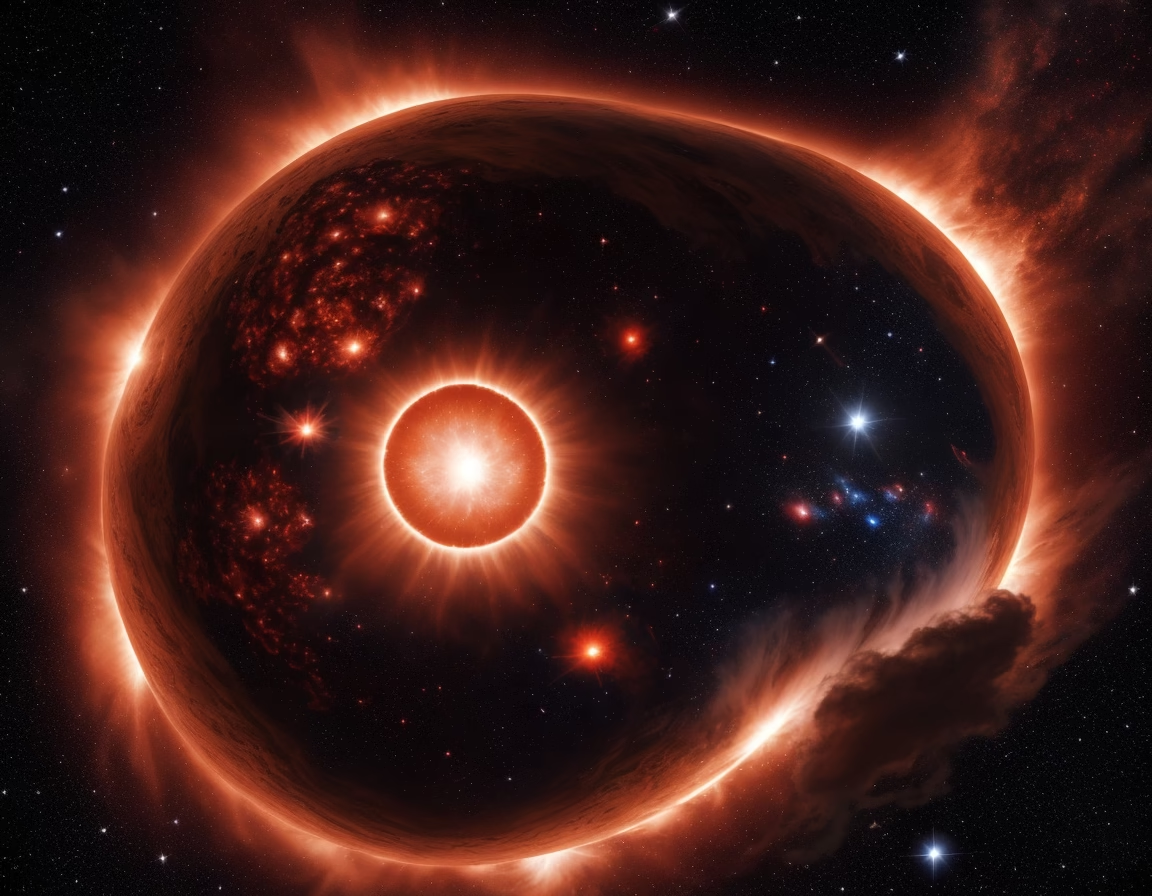
The companion star discovery and the Great Dimming explanation are two separate breakthroughs solving two separate puzzles. It’s a useful reminder that a single famous star can generate more than one genuine mystery at once — and that a tidy, satisfying answer to one doesn’t automatically explain the other.
Has Betelgeuse Made Astronomical History Before?
Yes — Betelgeuse was the first star other than the Sun ever directly imaged, when the Hubble Space Telescope’s Faint Object Camera captured its surface in March 1995 (NASA Science, 2026). That image revealed something nobody expected: an enormous bright spot on the star’s surface, roughly twice the diameter of Earth’s orbit around the Sun, and at least 2,000 Kelvin hotter than the surrounding surface — evidence of the same kind of violent convective activity that would later help explain the Great Dimming decades afterward.
It’s worth noting how much of Betelgeuse’s scientific fame rests on being “first”: first star imaged directly, among the first strongly suspected of having a companion, one of the most closely watched supergiants for signs of its eventual supernova. Few stars accumulate that many scientific firsts, and fewer still remain close and bright enough for backyard stargazers to keep tabs on the same object professional observatories are studying.
What Will Happen to the Companion When Betelgeuse Eventually Explodes?
Betelgeuse B’s future depends on the same physics that has produced known “runaway stars” elsewhere in the galaxy: a nearby companion can be shock-heated and partially stripped by a supernova’s ejecta, then either remain gravitationally bound to whatever remnant is left behind, or be flung outward at speeds up to roughly 500 kilometers per second (ESO, 2026). One well-documented example, HD 254577, is believed to have been ejected this way when its own companion exploded somewhere between 10,000 and 30,000 years ago.
If Betelgeuse goes supernova with its companion still nearby, astronomers expect something similar: the smaller star surviving the blast itself, battered and partially stripped of its outer layers, then either settling into orbit around whatever neutron star or black hole Betelgeuse leaves behind, or being hurled off into interstellar space to spend the next tens of thousands of years as one more runaway star with a violent, half-forgotten origin story. Either way, the century-long search that ended in 2026 will have identified a star that’s likely to have a second, much more dramatic story still ahead of it.
So Is Betelgeuse Actually Going to Explode Soon?
Probably not on any human timescale. Researchers estimate Betelgeuse is likely a few hundred thousand years from going supernova, based on its mass, rotation rate, and the chemical composition of its outer layers (Scientific American, 2026). Periodic viral rumors that it’s “about to explode” tend to resurface after dimming events like 2019-2020, but astronomers have found no evidence the star’s timeline has moved up.
It’s a strange thing to hold two ideas at once: the star could, technically, have already exploded a century ago and we simply haven’t seen the light yet — and also, statistically, that’s extraordinarily unlikely to be this century’s problem. Neither the companion star discovery nor the Great Dimming explanation changes that outlook; if anything, both replace uncertainty with a clearer, calmer picture of what’s actually happening 650 light-years away.
There’s something worth sitting with in how long the companion question took to resolve. It’s not really a story about a star. It’s a story about a question outliving several generations of astronomers who asked it, until the instruments finally caught up to the curiosity — four separate research efforts, a century apart, each one narrowing the search until December 2024 finally closed it.
Betelgeuse will keep dimming and brightening in the night sky, visible to the naked eye from most of the world through the winter months, indifferent to whichever century finally understood what was really happening beside it.
Frequently Asked Questions
What is Betelgeuse’s companion star called?
The newly imaged companion is provisionally called Betelgeuse B. It’s an estimated 2-3 solar masses, directly imaged for the first time in 2026 using the European Southern Observatory’s Very Large Telescope (ESO, 2026).
How far away is Betelgeuse from Earth?
Betelgeuse is about 650 light-years from Earth, meaning the light reaching us tonight left the star roughly 650 years ago, during the Middle Ages (Britannica, 2026). It remains visible to the naked eye as one of the brightest stars in the constellation Orion.
When will Betelgeuse go supernova?
Astronomers estimate Betelgeuse is likely a few hundred thousand years from going supernova, based on its mass, rotation, and atmospheric chemistry (Scientific American, 2026). Despite periodic online rumors, there’s no evidence an explosion is imminent.
Was Betelgeuse the first star ever photographed in detail?
Yes — Betelgeuse became the first star other than the Sun to have its surface directly imaged, captured by the Hubble Space Telescope’s Faint Object Camera in March 1995, revealing an unusually hot bright spot on its surface (NASA Science, 2026).
What will happen to Betelgeuse’s companion star when Betelgeuse explodes?
Astronomers expect the companion to survive the initial blast, partially stripped and shock-heated by the supernova ejecta, and then either settle into orbit around the resulting neutron star or black hole, or be ejected as a high-speed “runaway star” — a fate documented in other systems like HD 254577 (ESO, 2026).
What caused Betelgeuse’s Great Dimming in 2019-2020?
A dust cloud caused the Great Dimming. Superhot plasma ejected from the star’s surface cooled into dust in its outer atmosphere, blocking about a quarter of Betelgeuse’s visible surface from late 2019 until the star returned to normal brightness by April 2020 (Harvard-Smithsonian CfA, 2026).
Sources (retrieved 2026-08-27):
– European Southern Observatory, “Astronomers find strongest evidence yet that Betelgeuse has a companion,” https://www.eso.org/public/news/eso2611/
– Universe Today, “It Took a Century, but Astronomers Imaged Betelgeuse’s Companion,” https://www.universetoday.com/articles/it-took-a-century-but-astronomers-imaged-betelgeuses-companion
– Britannica, “Betelgeuse | Size, Dimming, Companion, Color, Meaning, & Facts,” https://www.britannica.com/place/Betelgeuse-star
– Scientific American, “When will Betelgeuse go supernova?,” https://www.scientificamerican.com/article/when-will-betelgeuse-go-supernova/
– IOPscience, “The Probable Direct-imaging Detection of the Stellar Companion to Betelgeuse,” https://iopscience.iop.org/article/10.3847/2041-8213/adeaaf
– Sky & Telescope, “Betelgeuse’s Elusive Companion Might Be Making Waves,” https://skyandtelescope.org/astronomy-news/betelgeuses-elusive-companion-might-be-making-waves/
– Harvard-Smithsonian Center for Astrophysics, “Mystery Solved: Dust Cloud Led to Betelgeuse’s ‘Great Dimming’,” https://www.cfa.harvard.edu/news/mystery-solved-dust-cloud-led-betelgeuses-great-dimming
– NASA Science, “Hubble Space Telescope Captures First Direct Image of a Star,” https://science.nasa.gov/missions/hubble/hubble-space-telescope-captures-first-direct-image-of-a-star/
– European Southern Observatory, “Enigma of Runaway Stars Solved,” https://www.eso.org/public/news/eso9702/