
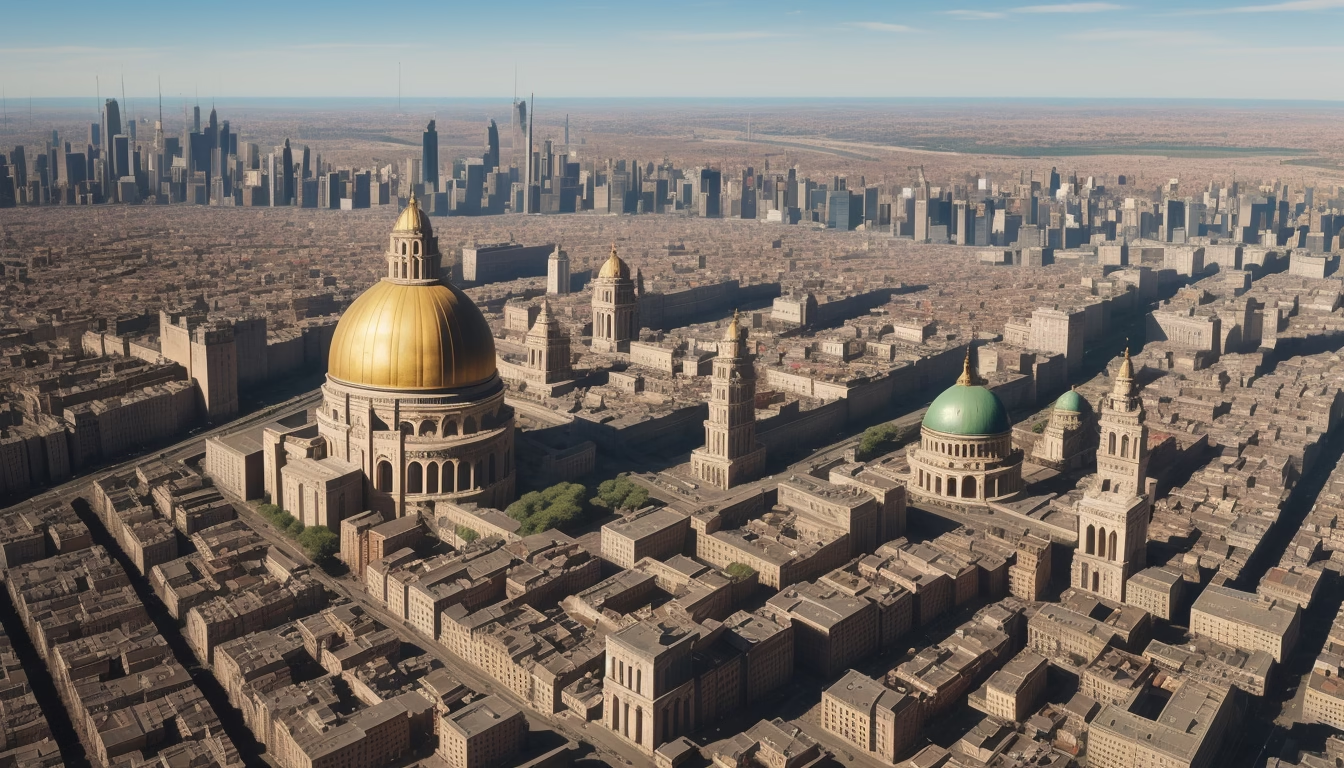
Vatican City covers just 0.49 square kilometers — smaller than most large public parks, and about 1/17th the size of New York’s Central Park (WorldAtlas, 2026). It’s an independent, sovereign country with its own postal system, newspaper, and head of state, entirely surrounded by the city of Rome. Nothing else on Earth comes close to its combination of tiny size and full international recognition.
The world’s smallest countries share a common origin story more often than you’d expect: most are survivors of an era of city-states and micro-principalities that, unlike their neighbors, never got absorbed into larger nations. A few others are remote island nations, too small and isolated to have ever attracted a colonizing power interested in merging them into something bigger.
Key Takeaways
– Vatican City is the smallest country in the world at just 0.49 square km, entirely enclosed within Rome, Italy (WorldAtlas, 2026).
– Monaco ranks second at 2.0 square km, despite being one of the world’s most densely populated and expensive places to live.
– Five of the top 10 smallest countries — Vatican City, Monaco, San Marino, Liechtenstein, and Malta — are in Europe.
– Nauru and Tuvalu, ranked third and fourth, are remote Pacific island nations facing serious long-term risk from rising sea levels.
What Is the Smallest Country in the World?
Vatican City is the smallest sovereign country in the world by land area, at just 0.49 square km, functioning as an independent city-state entirely enclosed within Rome and governed by the Holy See as the seat of the Catholic Church (WorldAtlas, 2026). Despite its size, it maintains full diplomatic relations with most of the world’s countries and its own distinct legal system.
| Rank | Country | Land Area |
|---|---|---|
| 1 | Vatican City | 0.49 km² (0.19 sq mi) |
| 2 | Monaco | 2.0 km² (0.77 sq mi) |
| 3 | Nauru | 21 km² (8.1 sq mi) |
| 4 | Tuvalu | 26 km² (10 sq mi) |
| 5 | San Marino | 61 km² (24 sq mi) |
| 6 | Liechtenstein | 160 km² (62 sq mi) |
| 7 | Marshall Islands | 181 km² (70 sq mi) |
| 8 | Saint Kitts and Nevis | 261 km² (101 sq mi) |
| 9 | Maldives | 300 km² (120 sq mi) |
| 10 | Malta | 316 km² (122 sq mi) |
(Source: WorldAtlas, “The Smallest Countries in the World”, 2026.)
Vatican City became fully independent under the 1929 Lateran Treaty with Italy, ending a decades-long dispute known as the “Roman Question” that followed the unification of Italy in the 19th century, when the Papal States lost most of their much larger historical territory.
Why Is Monaco So Small Yet So Wealthy?
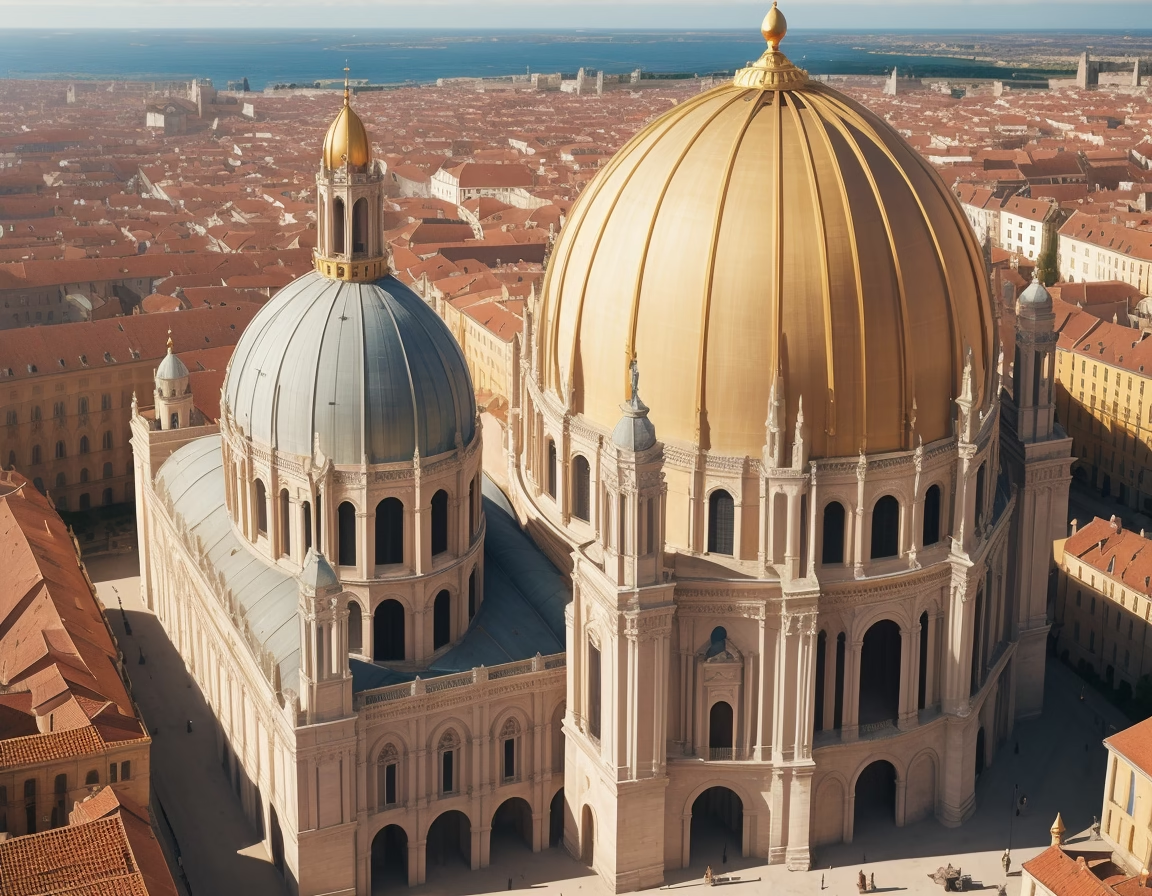
Monaco, the world’s second-smallest country at 2.0 square km, packs one of the highest population densities and highest per-capita incomes on Earth into a territory smaller than New York’s Central Park, largely due to its status as a tax haven and luxury tourism destination along the French Riviera (WorldAtlas, 2026). Its lack of available land has pushed the country into extensive land reclamation from the Mediterranean Sea.
Monaco has expanded its actual territory by roughly 20% over the past century through land reclamation projects, including the Fontvieille district built entirely on reclaimed land in the 1970s and a more recent offshore extension named Mareterra, completed in the 2020s. Despite these additions, Monaco remains overwhelmingly reliant on high-density vertical construction — the country has some of the highest real estate prices per square meter anywhere in the world, driven directly by its combination of extreme scarcity and its tax-haven status attracting wealthy residents.
Why Do Nauru and Tuvalu Face Existential Risk?
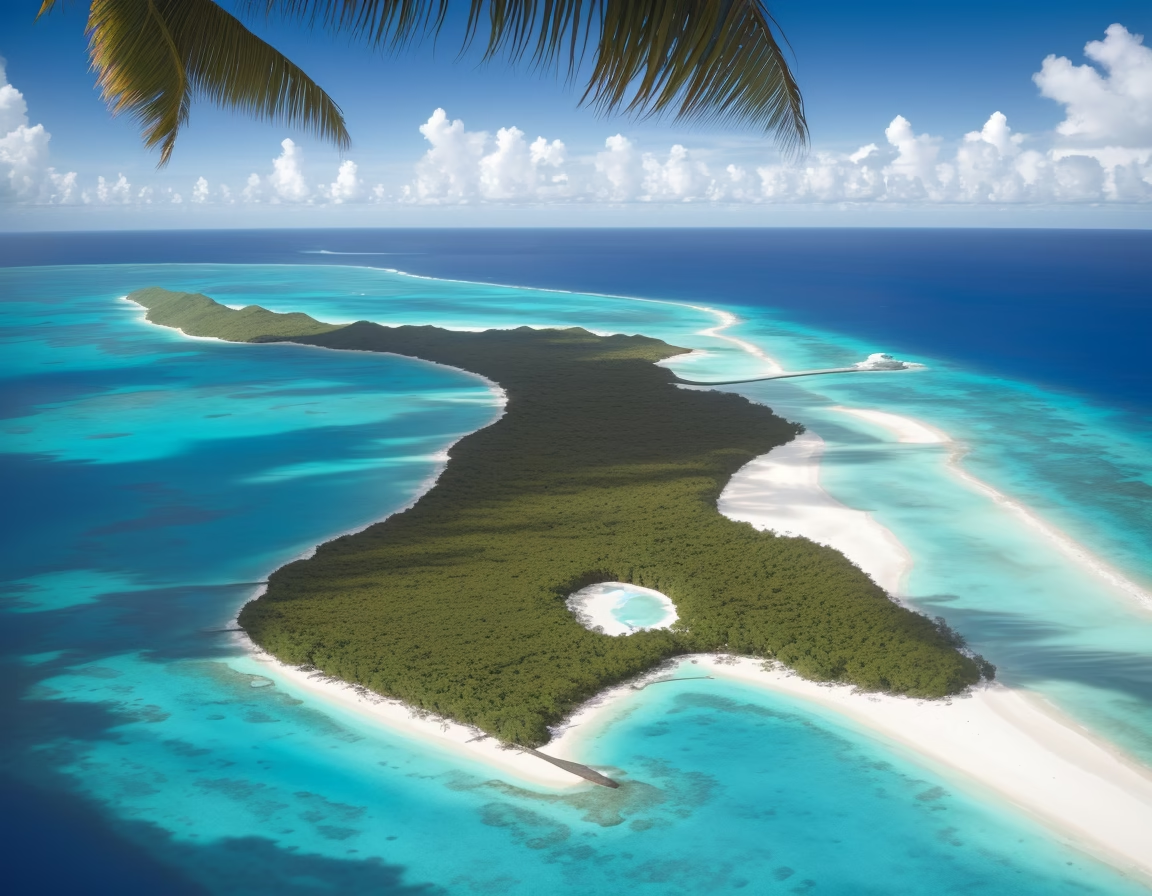
Nauru and Tuvalu, the world’s third- and fourth-smallest countries at 21 and 26 square km respectively, are low-lying Pacific island nations facing serious long-term threats from rising sea levels, with much of Tuvalu’s land area sitting less than 2 meters above sea level (WorldAtlas, 2026). Both nations have become prominent voices in international climate negotiations specifically because of this vulnerability.
Nauru’s small size comes with an unusual economic history — the island’s interior was extensively mined for phosphate deposits throughout the 20th century, leaving much of its land degraded and largely uninhabitable, which pushed nearly its entire population onto a narrow coastal strip. Tuvalu, facing similar existential pressure from sea-level rise, made international headlines when it began digitally archiving its government functions and cultural heritage, describing itself as potentially becoming the first nation to exist primarily in digital form should rising seas eventually submerge its physical territory.
What Makes San Marino One of the World’s Oldest Republics?
San Marino, the world’s fifth-smallest country at 61 square km, claims to be the oldest surviving sovereign state and constitutional republic on Earth, founded according to tradition in the year 301 AD and never conquered or absorbed by any of the larger Italian states that later unified around it (WorldAtlas, 2026). It sits entirely landlocked within Italy, perched atop Mount Titano.
San Marino’s survival as an independent microstate through more than 1,700 years of surrounding Italian political upheaval — including the rise and fall of the Roman Empire, the Renaissance city-states, and Italian unification in the 19th century — is largely attributed to its mountainous, easily defensible terrain and a long-standing tradition of neutrality that made conquering it more trouble than it was worth for surrounding powers.
How Do Liechtenstein and the Marshall Islands Compare?
Liechtenstein, at 160 square km, is one of only two doubly landlocked countries in the world — meaning it’s surrounded entirely by other landlocked countries — while the Marshall Islands, at 181 square km, is a widely scattered Pacific archipelago spread across more than 1,000 individual islands and islets (WorldAtlas, 2026). Both nations demonstrate that “small land area” can describe very different geographic realities.
Liechtenstein sits wedged between Switzerland and Austria in the Alps, and despite its tiny size, it maintains one of the highest GDP-per-capita figures in the world, built on a well-established banking and manufacturing sector. The Marshall Islands, by contrast, spreads its modest 181 square km of total land across a vast expanse of Pacific Ocean, meaning its exclusive economic zone — the maritime area over which it holds resource rights — covers a region larger than Mexico, illustrating how misleading land area alone can be when comparing island nations to compact European microstates.
Why Do Saint Kitts and Nevis, the Maldives, and Malta Close Out the List?
Saint Kitts and Nevis, the Maldives, and Malta — at 261, 300, and 316 square km respectively — round out the top 10, spanning the Caribbean, the Indian Ocean, and the Mediterranean, and each draws heavily on tourism built around their compact, easily explorable geography (WorldAtlas, 2026). All three rank among the more densely populated nations on Earth relative to their tiny land areas.
The Maldives, like Tuvalu, faces severe long-term risk from sea-level rise, with an average elevation of just 1.5 meters above sea level across its roughly 1,200 coral islands — making it, statistically, the lowest-lying country on Earth. Malta, meanwhile, is one of the most densely populated countries in the world, packing its population into a compact Mediterranean archipelago whose strategic location has made it a prize fought over by an unusually long list of historical powers, from the Phoenicians and Romans to the Knights of St. John, the French, and the British.
How Do These Tiny Countries Sustain Their Economies?
Running a functioning sovereign nation on a few square kilometers of land forces unusual economic strategies, and no two countries on this list have taken quite the same approach. Vatican City’s economy runs almost entirely on donations from the global Catholic Church, museum admissions, and the sale of stamps and publications, with no income tax and no dependence on trade or agriculture at all given its complete lack of arable land. Monaco has built its economy around finance, luxury real estate, and tourism tied to events like the Monaco Grand Prix, deliberately positioning itself as a tax-friendly haven for wealthy residents rather than developing any industrial base.
Liechtenstein has pursued yet another model, developing a diversified manufacturing and financial services sector that gives it one of the highest GDP-per-capita figures in the world despite having essentially no natural resources or agricultural capacity. San Marino leans heavily on tourism and its status as a duty-free shopping destination for day-trippers from surrounding Italy, while Pacific and Caribbean microstates like Nauru, Tuvalu, and Saint Kitts and Nevis depend more on a mix of fishing rights licensing, remittances from citizens working abroad, and, in Nauru’s case, the depleted remnants of a phosphate-mining economy that has never been fully replaced.
What Is It Like to Actually Visit These Countries?
Visiting most of the world’s smallest countries is logistically simple precisely because of their size — Vatican City, Monaco, and San Marino can each be explored on foot within a single day, and all three are easily reached as day trips from larger neighboring cities: Rome, Nice, and the Italian region of Emilia-Romagna respectively. That accessibility has made all three enormously popular add-ons to broader European itineraries rather than standalone destinations requiring dedicated travel planning.
The Pacific and Indian Ocean nations on this list require considerably more effort to reach, with Nauru, Tuvalu, and the Marshall Islands served by only a handful of weekly flights each, often routed through regional hubs like Fiji or Australia. The Maldives, by contrast, has built one of the most developed luxury tourism industries in the world despite its remoteness and small land area, with most visitors staying on private resort islands rather than experiencing the country’s more modest capital, Malé, one of the most densely populated cities on Earth relative to its physical footprint.
Frequently Asked Questions
What is the smallest country in the world?
Vatican City is the smallest country in the world by land area, at just 0.49 square km, entirely enclosed within the city of Rome, Italy (WorldAtlas, 2026). It has been fully independent since the 1929 Lateran Treaty and serves as the headquarters of the Catholic Church.
What is the second-smallest country in the world?
Monaco is the second-smallest country in the world at 2.0 square km, though it ranks among the most densely populated and wealthiest nations on Earth due to its status as a tax haven and luxury tourism hub on the French Riviera (WorldAtlas, 2026).
Which small countries are most at risk from rising sea levels?
Tuvalu and the Maldives face the most severe long-term risk from rising sea levels among the world’s smallest countries — Tuvalu’s land sits mostly under 2 meters above sea level, while the Maldives averages just 1.5 meters, making it statistically the lowest-lying country on Earth (WorldAtlas, 2026).
Is San Marino really the oldest country in the world?
San Marino claims, by tradition, to be the world’s oldest surviving sovereign state and constitutional republic, founded in 301 AD and never conquered by surrounding Italian powers over more than 1,700 years, though the claim rests partly on founding legend rather than fully documented historical record (WorldAtlas, 2026).
How many of the world’s smallest countries are in Europe?
Five of the world’s 10 smallest countries by land area — Vatican City, Monaco, San Marino, Liechtenstein, and Malta — are located in Europe, reflecting the continent’s long history of surviving city-states and micro-principalities that were never absorbed into larger nations (WorldAtlas, 2026).
Sources (retrieved 2026-08-28):
– WorldAtlas, “The Smallest Countries in the World,” https://www.worldatlas.com/geography/the-smallest-countries-in-the-world.html
– Nations Online Project, “The Largest and Smallest Countries in the World by Area” (cross-reference), https://www.nationsonline.org/oneworld/countries_by_area.htm