
How Loud Was Krakatoa? Inside the 1883 Eruption, 143 Years Later
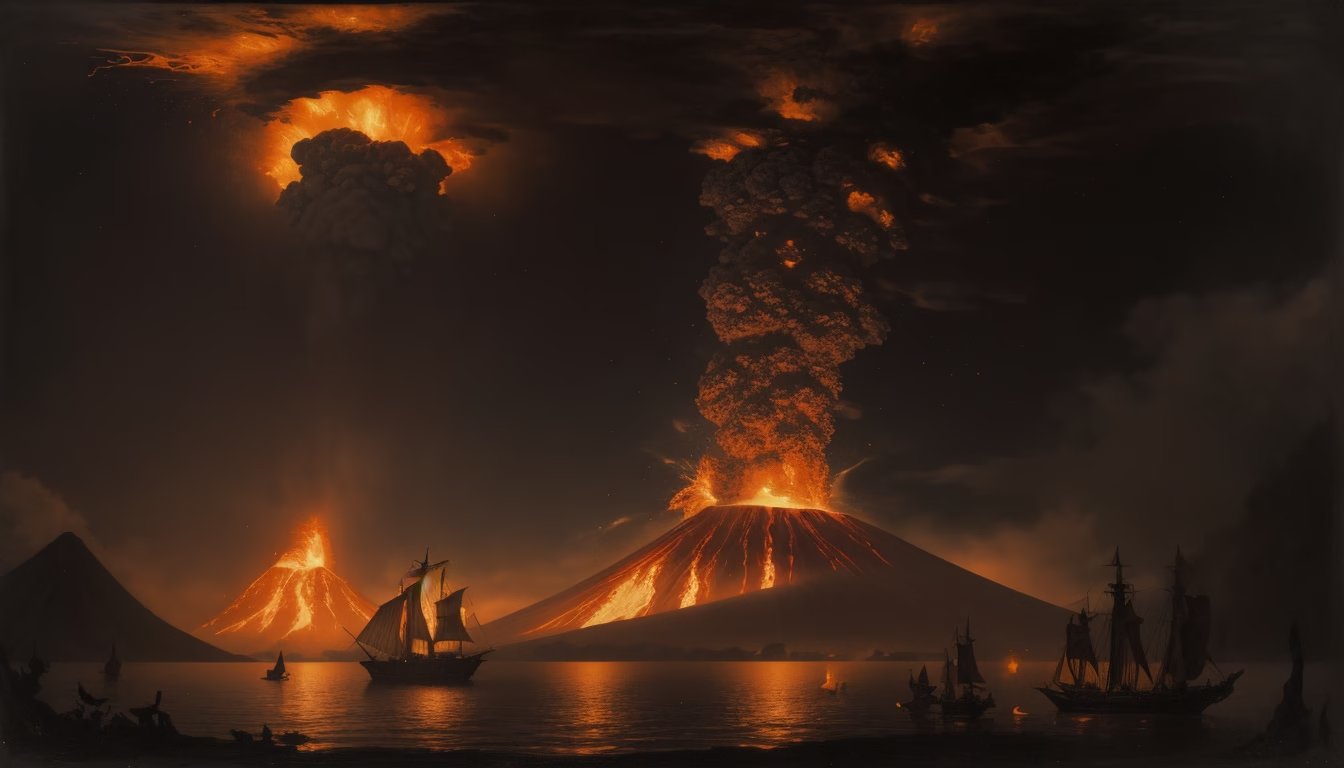
At 10:02 in the morning on August 27, 1883, a sound left the small volcanic island of Krakatoa and did something no recorded sound has done before or since: it circled the planet. Sailors on a ship 40 miles away had their eardrums ruptured. Four hours later, on the island of Rodrigues near Mauritius — nearly 3,000 miles from the eruption — people looked up, certain they’d just heard cannon fire from a nearby warship (Britannica, 2026).
There was no ship. There was no war. There was only Krakatoa, tearing itself apart in the Sunda Strait between Java and Sumatra.
Key Takeaways
– Krakatoa’s climactic blast hit roughly 310 decibels and was heard 3,000 miles away, making it the loudest sound in modern recorded history (Britannica, 2026).
– More than 36,000 people died, most from tsunamis up to 135 feet high, not the explosion itself (Smithsonian Global Volcanism Program, 2026).
– The volcano’s “child,” Anak Krakatau, triggered another deadly, unwarned tsunami in 2018 — proof the hazard never really ended.
How Loud Was the Krakatoa Explosion, Exactly?
Scientists estimate the climactic explosion registered around 310 decibels at the source — loud enough that, for comparison, the atomic bombs dropped on Hiroshima and Nagasaki measured roughly 248 decibels (Britannica, 2026). It isn’t a fair comparison in any moral sense. It is, at least, a useful one in physics: nothing else humans have measured has come close.
Captain Sampson of the British ship Norham Castle, anchored roughly 40 miles from the eruption, left one of the only written accounts from that close a range, scrawled into the ship’s log as the final blast hit: “I am writing this blind in pitch darkness. We are under a continual rain of pumice-stone and dust. So violent are the explosions that the ear-drums of over half my crew have been shattered. My last thoughts are with my dear wife. I am convinced that the Day of Judgement has come” (as documented in Simon Winchester’s Krakatoa: The Day the World Exploded, excerpted via Publicism, 2026).
Imagine a ripple that doesn’t fade after it reaches the shore, but keeps going — around the world, and back, and around again. Researchers at Oregon State University’s Volcano World project have documented that the eruption’s atmospheric pressure wave was picked up by barographs at more than 50 stations worldwide, with a station in Glasgow registering the wave passing seven separate times over five days as it bounced between Krakatoa and its antipodal point (Oregon State University, Volcano World, 2026). That means the pressure wave crossed the globe roughly three and a half times — something no eruption before it had ever done in a way scientists could measure.
What Warning Signs Came Before the Big Explosion?
Krakatoa gave nearly four months of warning before its climactic eruption, starting with ash and steam venting observed by a passing warship in May 1883 (1883 eruption timeline, historical accounts, 2026). What began as a minor curiosity escalated by August into the loudest event of the industrial age.
In early May, the captain of the German warship Elisabeth, passing through the strait, spotted a column of ash and steam rising from Perboewatan, one of three vents on the island. Over the following weeks, ships reported the same thing: steam, ash columns, occasional loud reports, nothing yet resembling catastrophe. By mid-June, activity intensified — explosions loud enough to be heard onshore, a thick black cloud settling over the strait for five days straight. When the ash finally cleared on June 24, observers noticed the summit cone of Perboewatan was simply gone.
For the rest of the summer, Krakatoa continued this pattern: venting, quieting, venting again. It became enough of a curiosity that ships altered course to let passengers watch from a safe distance. Nobody watching in July had any way of knowing they were observing the buildup to catastrophe.
The climax itself unfolded in stages rather than a single blast. Between 5:30 a.m. and 10:02 a.m. on August 27, four colossal explosions tore through the island in succession, each larger than the last, culminating in the detonation that produced the 310-decibel sound and collapsed two-thirds of the island into the sea. Ships anchored in the strait that morning experienced not one shockwave but a rolling sequence of them, over more than four hours, before the final and largest explosion arrived.
Why Did the Eruption Kill So Many People?
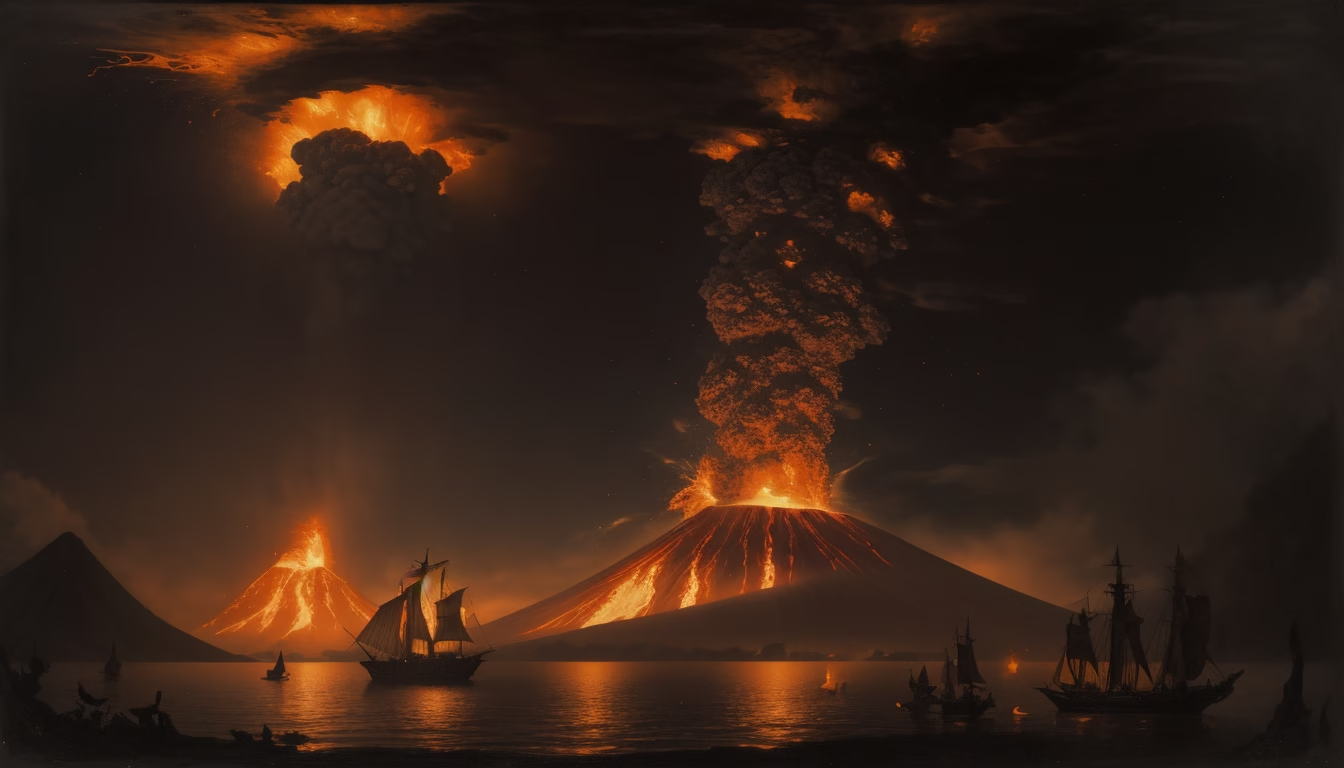
Most of Krakatoa’s more than 36,000 victims died from tsunamis, not the eruption itself — the largest wave reached an estimated 135 feet and destroyed roughly 165 coastal settlements across Java and Sumatra (NOAA National Centers for Environmental Information, 2026). It’s tempting to imagine the death toll came from lava, ash, or fire. It didn’t, mostly. What made August 27 catastrophic was the water.
The Smithsonian Institution’s Global Volcanism Program, which maintains the standard reference record for the world’s volcanoes, lists Krakatoa’s 1883 eruption at a VEI (Volcanic Explosivity Index) of 6, a “colossal” rating on an 8-point logarithmic scale (Smithsonian Global Volcanism Program, 2026). Pyroclastic surges — fast-moving currents of hot gas and volcanic material — traveled some 40 kilometers across open water to reach the Sumatran coast, something scientists at the time struggled to explain, since surges of that kind weren’t thought to survive a journey across the sea.
Two-thirds of the island of Krakatoa itself simply collapsed into the caldera the eruption carved out beneath it. What was left above the waterline was a fragment called Rakata — and, for the next four decades, nothing at all where the rest of the island had stood.
How Did Krakatoa Change the Sky Around the World?
Krakatoa’s ash and sulfur dioxide cooled global temperatures by roughly 0.5°C for several years and produced vivid red sunsets worldwide for months afterward, some so intense that fire brigades were called out by residents who mistook them for distant fires (NOAA National Centers for Environmental Information, 2026). The eruption injected an estimated 25 million tonnes of sulfur dioxide into the stratosphere, where it combined with water vapor to form a global haze of sulfuric acid aerosols (Knowable Magazine, 2026).
It’s worth sitting with that image for a second: for the better part of a year, people in cities that had nothing to do with Krakatoa, that may never have heard of it, kept calling the fire department on the sunset.
One of those skies may have ended up in a museum. Art historians have long debated whether Edvard Munch’s 1893 painting The Scream — with its blood-red, wavering sky — was inspired by the volcanic sunsets Munch would have seen in Norway roughly a decade after the eruption. A 2026 analysis published by Science, the journal of the American Association for the Advancement of Science, revisits the debate and notes that some atmospheric scientists favor a different explanation: rare, iridescent nacreous clouds, which can also produce dramatic color effects and were separately documented in Scandinavia around the same period (Science / AAAS, 2026). Nobody alive can ask Munch which sky he meant — not every thread from 1883 ties off neatly.
Is Krakatoa Still Active Today?
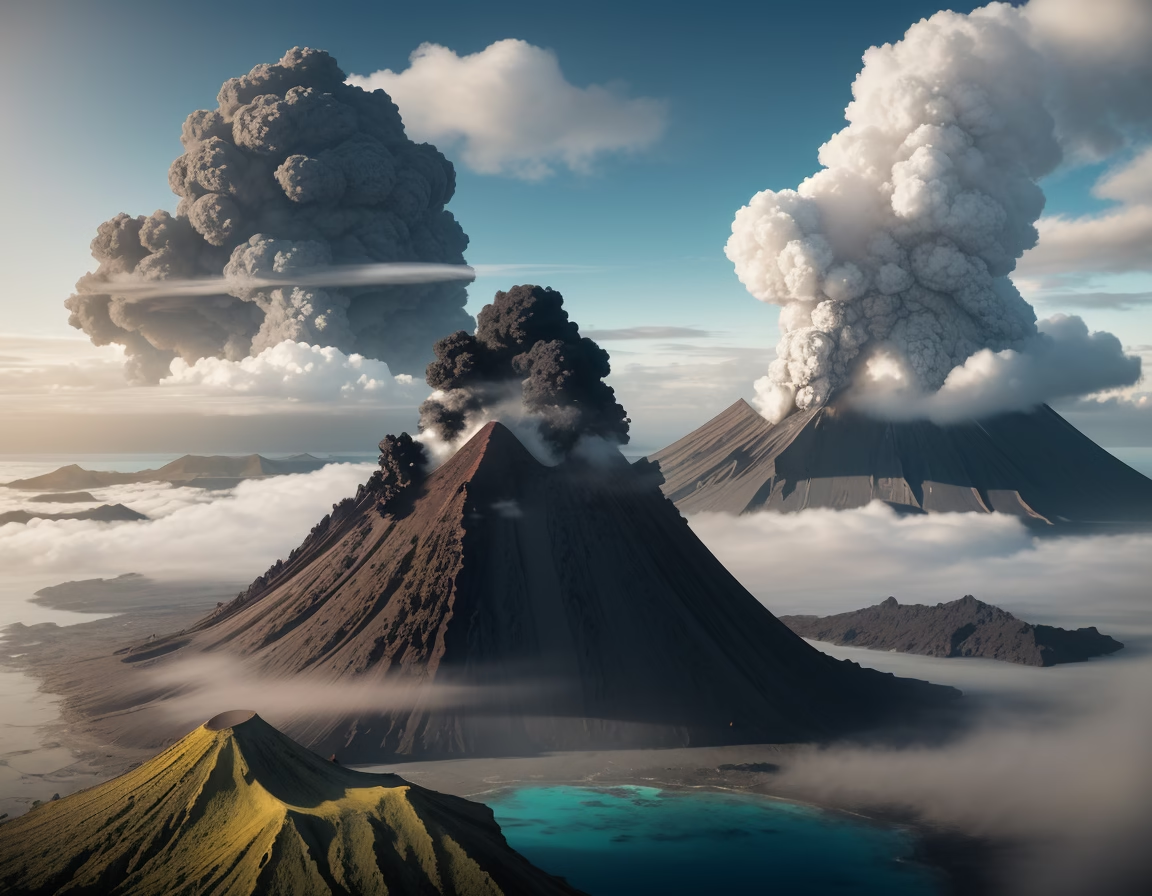
Yes — a new cone called Anak Krakatau (“Child of Krakatoa”) has been growing inside the 1883 caldera since 1927 and caused a deadly, unwarned tsunami as recently as December 2018. In that event, a flank collapse — modest by geological standards, well under a quarter of a cubic kilometer of material — slid into the surrounding caldera during an active eruption and sent a tsunami crashing into Java and Sumatra with runups as high as 13 meters, killing at least 437 people (Science Advances, 2026).
There was no warning, and there’s a specific, sobering reason why. Indonesia’s tsunami detection network is built to catch tsunamis triggered by earthquakes, watching for seismic shaking that normally precedes them. A landslide-generated tsunami doesn’t produce that signature. The ground barely shook. The water simply arrived (British Geological Survey, 2026). It remains the deadliest volcanically triggered tsunami since Krakatoa itself in 1883 and the collapse of nearby Ritter Island in 1888.
What Does Krakatoa Still Teach Us 143 Years Later?
The clearest lesson from both 1883 and 2018 is that volcanic hazards don’t always look like the disaster people are braced for — the wave that killed the most people each time wasn’t the one anyone was watching for, and existing warning systems were built to catch something else. Rodrigues Island, where people mistook a volcanic explosion for cannon fire nearly 3,000 miles away, is a strange kind of monument. Nothing was built there to mark what happened. The sound simply arrived, was heard, and passed into the historical record as a line in an old ship’s log.
Anak Krakatau is still there, still growing, still erupting in small fits inside the scar its parent left behind. It will, geologists generally agree, do something dramatic again eventually — not on a schedule anyone can name, but on the same long, indifferent timeline that produced the morning of August 27, 1883.
Frequently Asked Questions
How many people died in the Krakatoa eruption?
More than 36,000 people died in the 1883 Krakatoa eruption, the vast majority from tsunamis rather than the explosion itself, according to the Smithsonian’s Global Volcanism Program (Smithsonian GVP, 2026). Some historical estimates run higher, but 36,000-plus remains the standard reference figure.
Was Krakatoa really the loudest sound ever recorded?
Yes — at an estimated 310 decibels, Krakatoa’s 1883 eruption is considered the loudest sound in modern recorded history, audible roughly 3,000 miles away on Rodrigues Island near Mauritius (Britannica, 2026). No other single event has matched that combination of intensity and measured distance.
What is Anak Krakatau?
Anak Krakatau, meaning “Child of Krakatoa,” is a volcanic cone that has been growing inside Krakatoa’s 1883 caldera since 1927. It erupts periodically and caused a deadly tsunami in December 2018 that killed at least 437 people with no advance warning (Science Advances, 2026).
Did Krakatoa’s eruption affect the climate?
Yes — the eruption injected an estimated 25 million tonnes of sulfur dioxide into the stratosphere, cooling global average temperatures by roughly 0.5°C for several years and producing vivid red sunsets worldwide for months (Knowable Magazine, 2026).
Sources (retrieved 2026-08-27):
– NOAA National Centers for Environmental Information, “On This Day: Historic Krakatau Eruption of 1883,” https://www.ncei.noaa.gov/news/day-historic-krakatau-eruption-1883
– Smithsonian Institution, Global Volcanism Program, Krakatau volcano profile, https://volcano.si.edu/volcano.cfm?vn=262000
– Britannica, “What’s the Loudest Sound in History? Krakatoa, Decibels, & Facts,” https://www.britannica.com/science/Whats-the-Loudest-Sound-in-History
– Oregon State University, Volcano World, “Describe the 1883 eruption of Krakatau,” https://volcano.oregonstate.edu/faq/describe-1883-eruption-krakatau
– Science (AAAS), “Munch’s The Scream was probably inspired by rare clouds,” https://www.science.org/content/article/munch-s-scream-was-probably-inspired-rare-clouds
– Knowable Magazine, “Six historic volcanic eruptions changed the world and history,” https://knowablemagazine.org/content/article/physical-world/2026/volcanoes-that-made-history
– Simon Winchester, Krakatoa: The Day the World Exploded, excerpted via Publicism, https://publicism.info/history/krakatoa/9.html
– Science Advances, “The 22 December 2018 tsunami from flank collapse of Anak Krakatau volcano during eruption,” https://www.science.org/doi/10.1126/sciadv.aaz1377
– British Geological Survey, “Child of Krakatoa – why the 2018 eruption caused a tsunami,” https://www.bgs.ac.uk/news/child-of-krakatoa-why-the-2018-eruption-caused-a-tsunami/
– Wikipedia, “1883 eruption of Krakatoa” (timeline cross-reference), https://en.wikipedia.org/wiki/1883_eruption_of_Krakatoa