
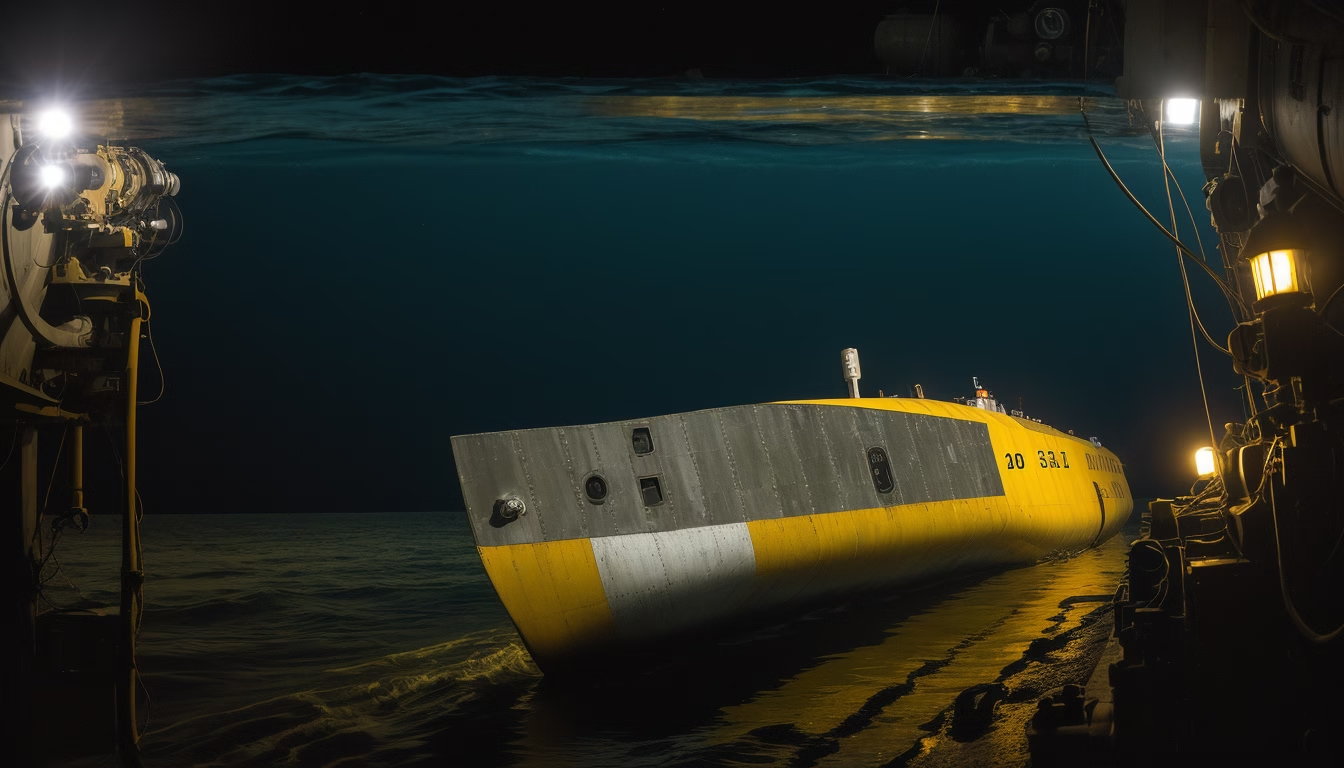
At the bottom of the Mariana Trench, in a spot called the Challenger Deep, the water presses down with more than 1,000 times the pressure at sea level. Only four people in history have ever been there. It took a 2021 peer-reviewed study, using pressure sensors precise enough to correct for gravity anomalies and the weight of the water column itself, to pin the depth down to 10,935 meters, give or take six meters – and even that figure isn’t the last word.
Key Takeaways
– The Challenger Deep is the ocean’s deepest known point at approximately 10,935 meters (±6 m), per a 2021 peer-reviewed measurement – deeper than Mount Everest (8,849 m) is tall, by more than 2,000 meters (Greenaway et al., Deep Sea Research Part I, 2021).
– Eight of the ocean’s ten deepest points sit in the Pacific, concentrated along the tectonic subduction zones of the Ring of Fire (Marine Insight, 2026).
– Only four people have ever reached the Challenger Deep’s floor – in 1960, 2012, and 2019 – a 52-year gap separating the first descent from the second.
What Is the Deepest Point in the Ocean, Exactly?
The Challenger Deep, a series of basins at the southern end of the Mariana Trench in the western Pacific, holds the record – but “exactly” is doing some work in that sentence. A 2021 study published in Deep Sea Research Part I, based on submersible transects and a new method for correcting pressure-derived depth readings, put the figure at 10,935 meters with a 95% confidence interval of ±6 meters (Greenaway et al., 2021). Other frequently cited figures – 10,910 meters, 10,994 meters – come from earlier sonar surveys and slightly different correction methods.
None of these numbers are wrong so much as they’re each the best estimate available at the time they were made. Measuring nearly 11 kilometers of water column, correcting for the fact that seawater itself compresses under its own weight, and accounting for regional gravity anomalies that subtly bend pressure readings, is an exercise in shrinking uncertainty, not eliminating it. The 2021 figure is the most rigorously corrected estimate publicly available, which is why this list uses it – but expect it to keep being refined.
How Do the Other Nine Deepest Points Rank?
Beyond the Challenger Deep, the next nine deepest points range from 10,882 meters down to 8,060 meters, and eight of the ten are in the Pacific Ocean (Marine Insight, 2026). Here is the full list, using the most commonly cited depth figures for each:
- Challenger Deep, Mariana Trench (Pacific) – ~10,935 m, per the 2021 correction; commonly rounded to 10,910-10,994 m in older sources.
- Horizon Deep, Tonga Trench (Pacific) – 10,882 m.
- Galathea Depth, Philippine Trench (Pacific) – 10,540 m.
- Kuril-Kamchatka Trench (Pacific) – 10,500 m.
- Kermadec Trench (Pacific) – 10,040 m.
- Izu-Ogasawara Trench (Pacific) – 9,780 m.
- Japan Trench (Pacific) – 9,000 m.
- Milwaukee Deep, Puerto Rico Trench (Atlantic) – 8,640 m – the Atlantic’s deepest point.
- Meteor Deep, South Sandwich Trench (Atlantic) – 8,420 m.
- Richards Deep, Peru-Chile Trench (Pacific) – 8,060 m.
Notice how tightly some of these cluster: the Philippine Trench and Kuril-Kamchatka Trench are separated by only 40 meters, while the Milwaukee Deep and Meteor Deep – the two Atlantic entries – sit just 220 meters apart despite being on opposite sides of that ocean.
Why Are Almost All of These Trenches in the Pacific?
Eight of the ten deepest points on Earth sit inside the Pacific’s Ring of Fire, the horseshoe-shaped chain of subduction zones that also produces most of the planet’s earthquakes and volcanoes (Marine Insight, 2026). A subduction zone forms where one tectonic plate is forced beneath another, and the resulting trench marks the crease where that descent begins.
The Pacific Plate is unusually large and bordered by subduction zones on nearly every side, which is simply why so many of the planet’s deepest points happen to sit along its edges. The two Atlantic exceptions on this list – the Milwaukee Deep and the Meteor Deep – mark smaller, more localized subduction zones: the Caribbean Plate grinding against the North American Plate, and the South Sandwich Plate doing the same against the South American Plate, respectively.
How Does the Challenger Deep Compare to Mount Everest?
Mount Everest stands 8,849 meters above sea level – a figure surveyed and re-surveyed by multiple national geological agencies and now essentially uncontested. Stack it into the Challenger Deep, and its summit would still sit more than 2,000 meters below the surface. The comparison isn’t just a striking visual: it’s a reminder that the ocean’s vertical relief dwarfs anything on land, simply because water fills in what would otherwise be visible canyons and cliffs.
That gap – deepest ocean point minus tallest mountain – runs to roughly 2,086 meters using the 2021 Challenger Deep figure, or as much as 2,145 meters using the older, higher estimate. Either way, it’s a taller gap than the height of Denali, North America’s tallest peak, measured from its own base.
Who Has Actually Been to the Bottom?
Exactly four people have ever reached the floor of the Challenger Deep, and the gaps between their visits say as much about the engineering challenge as the destination itself. Jacques Piccard and Don Walsh made the first descent in 1960 aboard the bathyscaphe Trieste, spending roughly 20 minutes at the bottom before ascending. More than half a century passed before anyone returned.
Filmmaker James Cameron made the third-ever descent in 2012, alone, piloting the purpose-built submersible Deepsea Challenger – the first fully solo dive to that depth. In 2019, explorer Victor Vescovo went further still: as part of the Five Deeps Expedition, he became the first person to reach the deepest point of all five of the world’s oceans, Challenger Deep included. Between 1960 and 2012, 52 years passed with nobody visiting the deepest place on Earth a second time – not for lack of interest, but because building a vehicle that can survive that pressure and return safely is a genuinely difficult, expensive problem, one that a whole generation of engineers had to solve essentially from scratch.
What Would Happen to an Unprotected Object Down There?
At nearly 11,000 meters, the water pressure exceeds 1,000 atmospheres – more than 1,000 times what you feel at sea level. Anything not specifically engineered to resist that pressure would be crushed instantly; this is why every successful descent has relied on a spherical pressure hull, the shape that distributes crushing force most evenly across its surface. It’s also why full-ocean-depth submersibles remain rare, expensive, purpose-built machines rather than adapted versions of shallower-diving vehicles – the engineering margin for error effectively disappears.
Does Anything Actually Live Down There?
Despite the crushing pressure and total darkness, the Challenger Deep is not empty. A 2025 expedition identified more than 7,000 microbial species in its sediments, with roughly 89% entirely new to science – some carrying compact, highly specialized genomes suited to permanent scarcity of light and nutrients, others with more flexible genomes built for coping with change (Interesting Engineering, 2025).
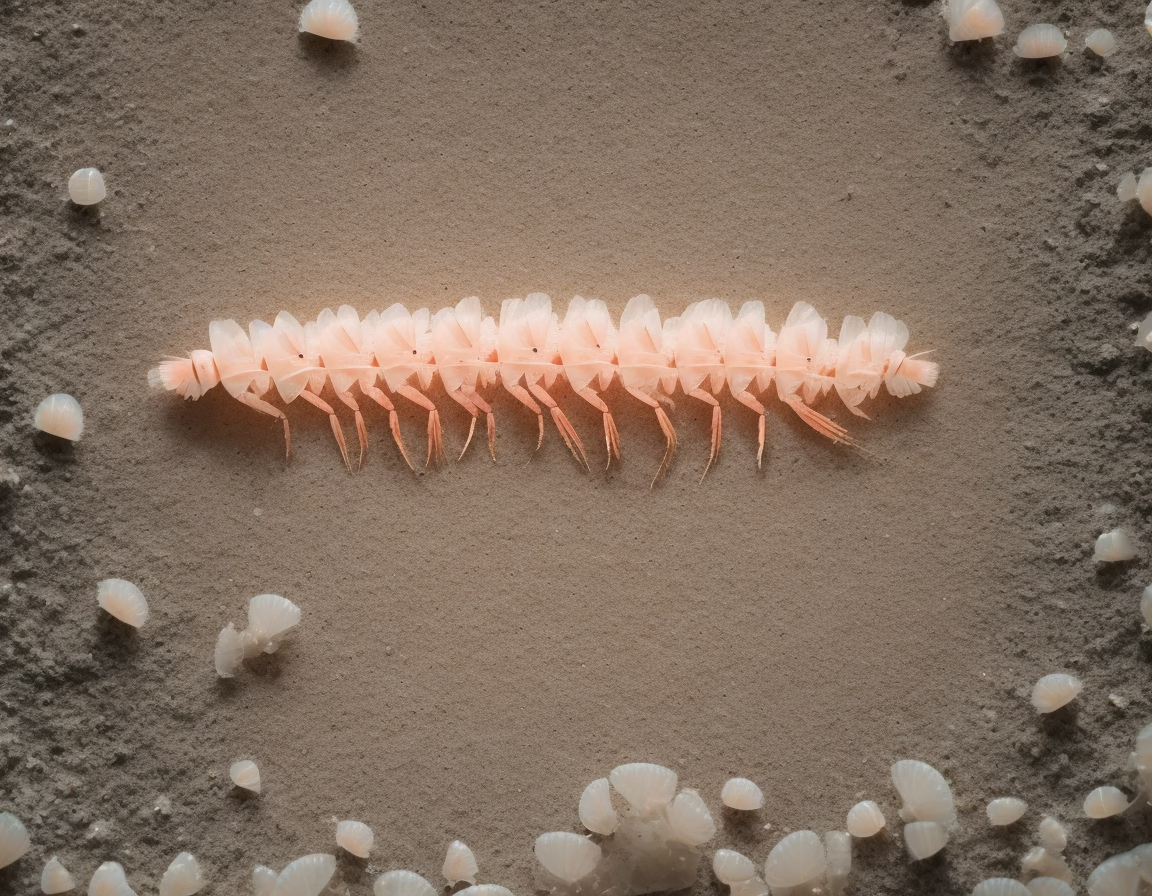
Larger animals survive there too. Shrimp-like amphipods live at depths between 6,800 and 11,000 meters – pressure researchers have compared to balancing an SUV on a fingertip – apparently thanks to a symbiotic relationship with Psychromonas bacteria living in their gut, which may help them process food or resist the surrounding chemistry (National Geographic, 2025). In 2024, researchers aboard the Chinese submersible Fendouzhe found thousands of worms and mollusks living at depths between roughly 2,500 and 9,500 meters across various hadal trenches (Discover Magazine, 2025). None of this life is visible from the surface, and almost none of it was known to exist before submersibles started reaching these depths directly.
Frequently Asked Questions
What is the deepest point in the ocean?
The Challenger Deep, in the Mariana Trench’s southern end, is the ocean’s deepest known point, measured at approximately 10,935 meters (±6 m) in a 2021 peer-reviewed study – though older estimates place it as deep as 10,994 meters (Greenaway et al., 2021).
Why do sources disagree on the exact depth?
Measuring nearly 11 kilometers of water column requires correcting for seawater compressibility, regional gravity anomalies, and instrument calibration – factors that different surveys account for slightly differently, producing a range of credible figures rather than one exact number (Greenaway et al., 2021).
How many people have reached the bottom of the Challenger Deep?
Exactly four: Jacques Piccard and Don Walsh in 1960, James Cameron in 2012, and Victor Vescovo in 2019 – a list short enough that more people have commanded a Space Shuttle mission than have visited the deepest point on Earth.
Are most of the deepest ocean points in one ocean?
Yes – eight of the ten deepest points on Earth are in the Pacific Ocean, concentrated along the subduction zones of the Ring of Fire, with only the Milwaukee Deep and Meteor Deep representing the Atlantic (Marine Insight, 2026).
Is the Challenger Deep deeper than Everest is tall?
Yes, by a wide margin – Everest’s 8,849-meter height would still leave its summit roughly 2,000 meters below the surface if it were dropped into the Challenger Deep.
Does anything live in the Challenger Deep?
Yes – a 2025 expedition found more than 7,000 microbial species in its sediments, 89% of them new to science, alongside pressure-tolerant amphipods and other invertebrates that survive there through specialized biology and symbiotic bacteria (Interesting Engineering, 2025).
Sources
- Greenaway, S.F., Sullivan, K.D., Umfress, S.H., Beittel, A.B., Wagner, K.D. (2021). “Revised depth of the Challenger Deep from submersible transects; including a general method for precise, pressure-derived depths in the ocean.” Deep Sea Research Part I: Oceanographic Research Papers, 178, 103644. https://doi.org/10.1016/j.dsr.2021.103644
- Marine Insight, “The 10 Deepest Parts of the Ocean,” https://www.marineinsight.com/10-deepest-parts-of-the-ocean/ (2026)
- World Atlas, “Deepest Oceans and Seas,” https://www.worldatlas.com/geography/deepest-oceans-and-seas.html (2026)
- Interesting Engineering, “7,000+ new species discovered in Earth’s deepest ocean trench,” https://interestingengineering.com/science/new-species-discovered-in-earths-deepest-ocean-trench (2025)
- National Geographic, “Possible microbes in the Mariana Trench hint at life on Jupiter’s moon Europa,” https://www.nationalgeographic.com/science/article/possible-microbes-mariana-trench-hint-at-life-jupiters-moon-europa (2025)
- Discover Magazine, “The Mariana Trench Plunges 36,000 Feet — Hiding Mysterious Creatures and a Beer Bottle,” https://www.discovermagazine.com/what-has-been-found-in-the-deep-waters-of-the-mariana-trench-45102 (2025)