
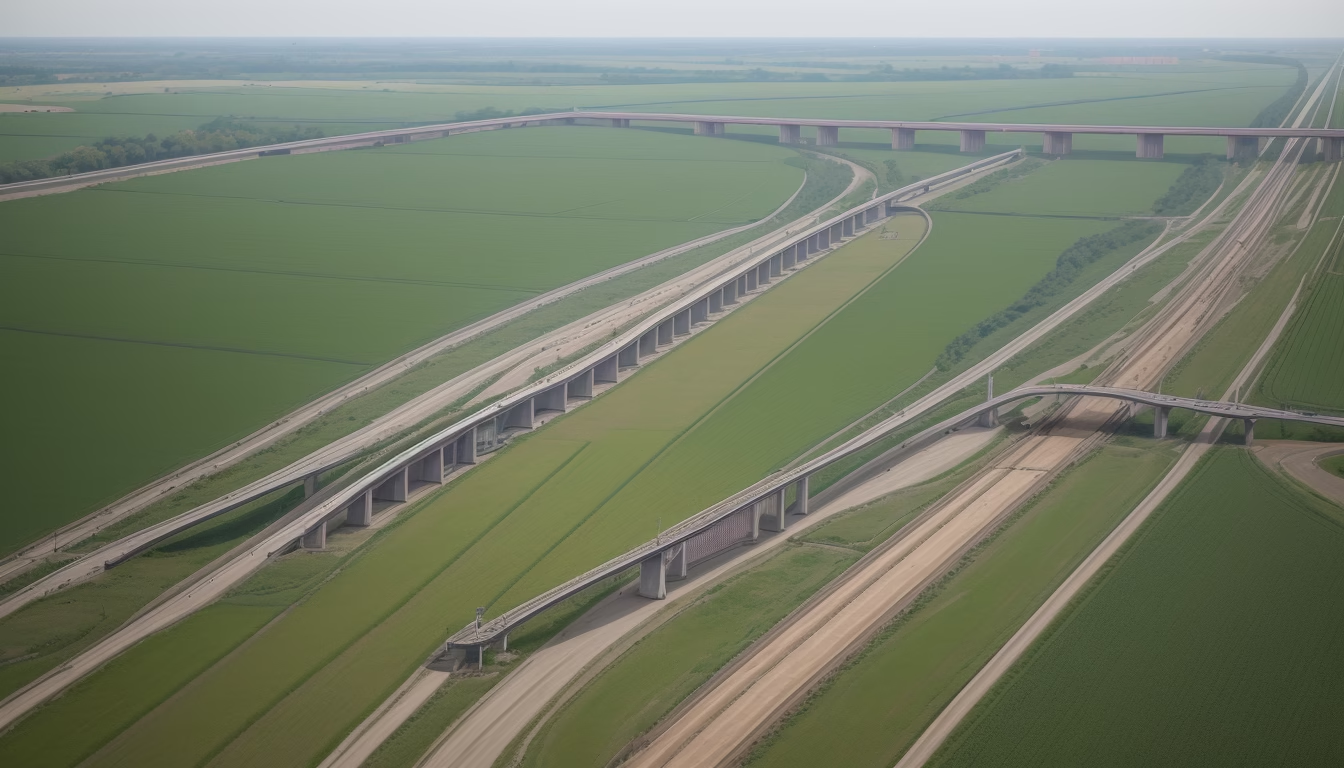
The list of longest bridges often evokes images of iconic spans over water or dramatic arch structures – the Golden Gate Bridge, at roughly 2.7 km, or the Akashi Kaikyo Bridge in Japan. But the current record holders barely resemble either. The current record holders are predominantly long elevated viaducts that run across flat land to maintain level railway tracks and avoid land disputes. Only one on this list truly crosses open water for its entire length: the Lake Pontchartrain Causeway in Louisiana. Every other entry is longer than the Golden Gate Bridge by a factor of at least 14, and the longest is more than 60 times its length – not because the engineering is more dramatic, but because the purpose is entirely different: keeping a train level across a floodplain, not spanning a strait.
Key Takeaways
- The Danyang‑Kunshan Grand Bridge is the longest bridge at 164.8 km, a high‑speed rail viaduct on China’s Beijing‑Shanghai line (Mastt, 2026).
- Six of the ten bridges are high‑speed rail viaducts, spanning a combined total of 669.3 km across China and Taiwan (Mastt, 2026).
- Only one bridge in this list crosses water for its entire length: the Lake Pontchartrain Causeway at 38.0 km (Mastt, 2026).
What Is the Danyang‑Kunshan Grand Bridge?
The Danyang‑Kunshan Grand Bridge stretches 164.8 km, making it the world’s longest bridge and a high‑speed rail viaduct on China’s Beijing‑Shanghai High‑Speed Railway (Mastt, 2026). Constructed to keep the rail line level across flat terrain, its design helps prevent land subsidence and reduces construction costs by avoiding extensive tunneling through the Yangtze River Delta’s soft, waterlogged ground.
What Is the Changhua‑Kaohsiung Viaduct?
The Changhua‑Kaohsiung Viaduct spans 157.3 km across Taiwan’s high‑speed rail network (Mastt, 2026). Built over flat land, it connects cities along Taiwan’s western corridor. At 157.3 km, it trails the Danyang-Kunshan Grand Bridge by only 7.5 km – the two are close enough in length that either could plausibly have taken the top spot with a different survey methodology.
What Is the Tianjin Grand Bridge?
The Tianjin Grand Bridge is a high‑speed rail viaduct covering 113.7 km in China (Mastt, 2026). It lies between Beijing and Tianjin, facilitating fast rail transport across the northern plains. At 113.7 km, it is 43.6 km shorter than the Changhua-Kaohsiung Viaduct above it – the single biggest length gap anywhere in the top ten.
What Is the Cangde Grand Bridge?
The Cangde Grand Bridge stretches 105.8 km in China as a high‑speed rail viaduct (Mastt, 2026). Its construction aimed to reduce travel time between major urban centers, and at 105.8 km it sits only 7.9 km behind the Tianjin Grand Bridge – the two form a close pair in the middle of the ranking.
What Is the Weinan Weihe Grand Bridge?
The Weinan Weihe Grand Bridge covers 79.7 km in China, serving as a high‑speed rail viaduct (Mastt, 2026). It runs through the central plains of Shaanxi province, enabling rapid transit between northern and southern regions. At 79.7 km, it is over 26 km shorter than the Cangde Grand Bridge above it, marking the point in the list where lengths begin dropping off more steeply.
What Is the Bang Na Expressway?
The Bang Na Expressway is an elevated highway spanning 54.0 km in Thailand (Mastt, 2026). It functions as a toll road rather than a rail line – the first entry on this list built primarily for cars rather than trains. At 54.0 km, it is the shortest of the pure highway viaducts on this list by a wide margin over its road-based peers further down the ranking.
What Is the Beijing Grand Bridge?
The Beijing Grand Bridge stretches 48.0 km in China, another high‑speed rail viaduct (Mastt, 2026). It lies within the Greater Beijing area, facilitating fast rail connections between major districts. At 48.0 km, it is the shortest of the six high-speed rail viaducts on this list, trailing the Bang Na Expressway above it by just 6 km despite serving a completely different purpose.
What Is the Dhaka Elevated Expressway?
The Dhaka Elevated Expressway spans 46.73 km in Bangladesh (Mastt, 2026). It serves as an elevated highway viaduct, connecting the capital to surrounding regions. At 46.73 km, it trails the Beijing Grand Bridge by just 1.27 km – one of the closest margins anywhere in the top ten, despite the two bridges serving entirely different countries and transport modes.
What Is the Metro Manila Skyway System?
The Metro Manila Skyway System covers 39.2 km in the Philippines, an elevated expressway viaduct (Mastt, 2026). It connects key urban districts across Manila, allowing high-speed traffic on a level roadway. At 39.2 km, it sits 7.53 km ahead of the Lake Pontchartrain Causeway in tenth place, making it the last entry on the list built primarily over land rather than water.
What Is the Lake Pontchartrain Causeway?
The Lake Pontchartrain Causeway is the only bridge on this list that spans open water for its entire length, covering 38.0 km in the United States (Mastt, 2026). It crosses Lake Pontchartrain in Louisiana, connecting the city of New Orleans to the mainland. At 38.0 km, it is barely 1.2 km shorter than the Metro Manila Skyway System above it – and yet it is the only bridge in the entire top ten that earns the word “bridge” in the traditional sense, rather than “viaduct.”

How Is “Longest Bridge” Actually Measured?
These rankings measure total structure length – the full bridge including approaches and elevated spans – rather than the length of a single main span, which is how classic suspension bridges like the Golden Gate are usually described (Mastt, 2026). That distinction is why this list looks so different from lists of the “longest suspension bridge span” or “longest cable-stayed bridge,” which rank a different, narrower category built almost entirely from bridges over water. A viaduct made of thousands of short, repeated spans can rack up a much longer total length than a single dramatic span ever could, simply because nothing about its design limits how many times that span can be repeated across flat land.
Why These Bridges Matter
High‑speed rail viaducts are central to modern transportation, enabling rapid transit across vast distances without the need for tunnels or extensive land acquisition. Their elevated design keeps tracks level and reduces construction costs compared with cutting a level path through hills or wetlands directly. Elevated highway viaducts also improve traffic flow by bypassing congested roads, especially in densely populated regions like Bangkok, Dhaka, and Manila.
This is also why the list looks nothing like it would have a century ago, when “longest bridge” meant the longest single span across open water – a title long associated with the Golden Gate or, later, the Akashi Kaikyo. High-speed rail construction rewrote the definition simply by needing something no traditional bridge design was built for: hundreds of kilometers of perfectly level track over land that was never flat, stable, or empty enough to lay rails on directly. The list is less a ranking of engineering ambition over water and more a record of how far Asia’s rail networks have had to reach to stay level.
That shift also means the ranking is unlikely to stay still for long. China alone has continued extending its high-speed rail network well past the lines that produced this list, and Asia’s other developing rail and expressway networks are following a similar pattern – building level, elevated routes across land that was never going to cooperate on its own. A list like this one is less a fixed record than a snapshot of infrastructure still being built, which is part of why the entries skew so heavily toward the past two decades rather than a century of bridge engineering.
Frequently Asked Questions
How many of these bridges are located in China?
Exactly five of the ten longest bridges are in mainland China: the Danyang-Kunshan Grand Bridge, Tianjin Grand Bridge, Cangde Grand Bridge, Weinan Weihe Grand Bridge, and Beijing Grand Bridge (Mastt, 2026). A sixth, the Changhua-Kaohsiung Viaduct, is in Taiwan – governed separately, so it isn’t counted toward the mainland total even though it uses similar high-speed rail engineering.
What types of bridges are represented in this list?
Six are high-speed rail viaducts, three are elevated highway or expressway viaducts, and one is a true water-span bridge (Mastt, 2026). That split matters: the rail viaducts and highway viaducts are built for entirely different loads and speeds, even though both categories exist mainly to keep a route level over land rather than to cross a specific obstacle.
Why is the Lake Pontchartrain Causeway unique?
It is the only bridge on this list that spans open water for its entire length, crossing Lake Pontchartrain in Louisiana at 38.0 km (Mastt, 2026). Every other entry on the list is a viaduct built over solid ground, which makes the Causeway the sole representative of what most people picture when they hear the phrase “world’s longest bridge.”
Why are almost all of the longest bridges in Asia?
Nine of the ten bridges on this list are in China, Taiwan, Thailand, Bangladesh, or the Philippines – a reflection of the scale of high-speed rail and elevated-highway construction across Asia over the past two decades (Mastt, 2026). Regions building extensive new rail and expressway networks from scratch tend to produce far more of these long viaducts than regions retrofitting older infrastructure.
Is a viaduct the same thing as a bridge?
Not quite. A viaduct is technically a type of bridge, but the term usually describes a long, elevated structure carrying a road or railway across land, valleys, or multiple smaller obstacles, rather than a single defined body of water. Nine of the ten entries on this list are viaducts in that sense; only the Lake Pontchartrain Causeway is a bridge in the more traditional sense of spanning water start to finish.