
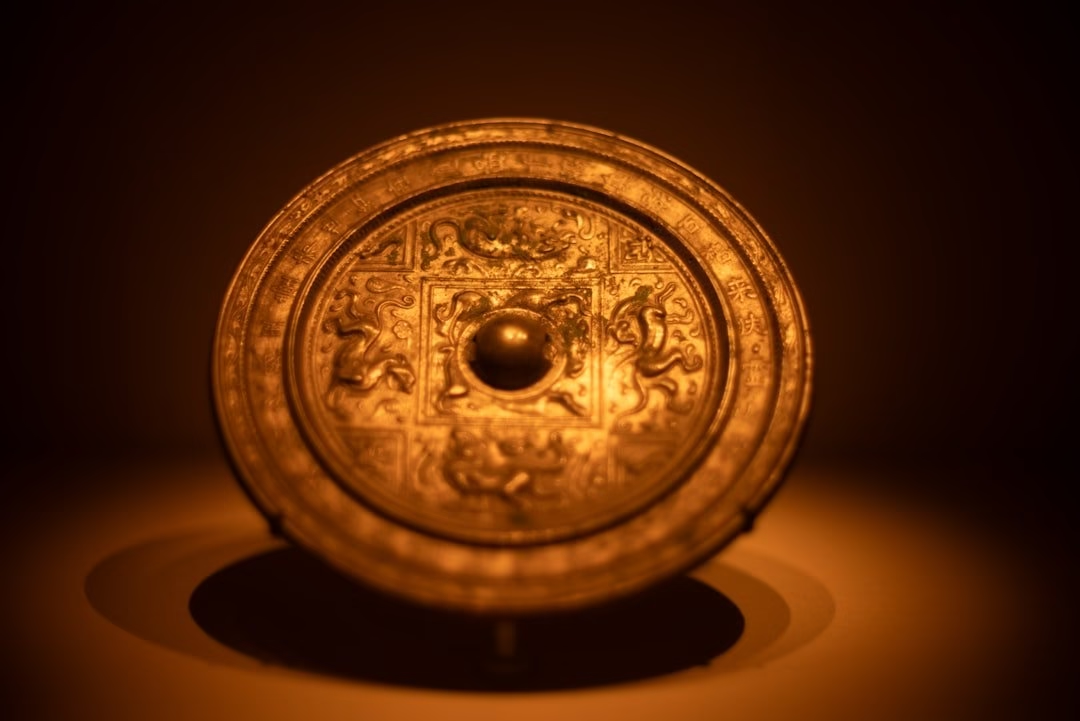
In the damp soil of a German forest, roughly two thousand years after it was placed there, archaeologists recovered a bowl unlike almost anything else from the Roman world. Crafted from silver and decorated with gold, it bears the image of Athena — helmeted, composed, accompanied by the owl that served as her symbol across the ancient Mediterranean. Whoever buried it did so deliberately, and they never came back to retrieve it.
The vessel, reported by Live Science in May 2026, belongs to a category of object that archaeologists call a hortus find — buried treasure, typically concealed during a moment of danger. What makes this piece extraordinary is not just its material value but the cultural story it encodes: a Roman luxury object, steeped in Greek religious imagery, lying beneath Germanic soil at the edge of an empire perpetually at war with the peoples beyond its northern frontier.
A World Balanced on the Rhine
To understand why a silver Athena bowl ended up buried in a German forest, it helps to understand the world that produced it. By the first and second centuries CE, the Rhine and Danube rivers formed the rough northern boundary of Roman imperial ambition. Beyond those rivers lived confederations of Germanic peoples — the Cherusci, the Marcomanni, the Chatti — whom Roman writers alternately portrayed as savage adversaries and grudging trading partners.
Roman goods flowed across this frontier constantly. Merchants, diplomats, and soldiers carried coins, ceramics, glassware, and metalwork into territories Rome never formally controlled. Some of these objects were gifts intended to secure alliances with local chieftains. Others arrived through trade or plunder. A high-quality silver bowl depicting a Roman-Hellenistic deity could have traveled north through any of these channels.
The Germanic communities on the receiving end of this material exchange were not passive recipients. They selected, repurposed, and reinterpreted Roman objects within their own frameworks of meaning. A vessel that Romans associated with Athena — goddess of wisdom and crafted skill — may have carried entirely different significance once it crossed the frontier. Whether its final owner understood the iconography or simply prized the precious metal is a question the soil cannot answer.
What the Bowl Shows — and What It Hides
According to the Live Science report, the bowl features both silver and gold, with imagery centered on Athena and her owl. In the Greco-Roman tradition, this pairing carried layered meaning: the owl represented nocturnal wisdom, keen sight in darkness, and the goddess’s association with Athens itself. On fine metalwork, such imagery signaled both the owner’s cultivated taste and their connection to the broader Hellenistic world that Rome had absorbed and transmuted into its own cultural inheritance.
Technically, producing a vessel of this quality required advanced metalworking. The combination of silver and gold elements — likely achieved through techniques of gilding or inlay — placed the object firmly in the repertoire of skilled workshop production, probably somewhere in the Roman Empire’s heartland rather than on its periphery. Scholars working on comparable pieces note that provincial workshops sometimes reproduced metropolitan styles, but the refinement described here points toward a well-resourced atelier.
It is worth noting that this find arrives in the same news cycle as a separate discovery reported by Ancient Origins: evidence that ancient builders in the Near East were applying complex lime-plaster techniques roughly 8,000 years before Roman craftsmen were doing the same. Taken together, these two stories form a quiet argument about the deep history of human technical skill — that sophisticated material culture has never been the exclusive property of any single civilization or era.
The Logic of Burial
Objects like the Athena bowl were buried for reasons that archaeologists can sometimes reconstruct and sometimes only guess at. The most common interpretation, drawing on patterns seen across hundreds of comparable finds, is emergency concealment: a person or community under threat hid their most valuable portable property with the intention of retrieving it later. When they never returned, the burial became permanent.
The Germanic frontier was frequently violent. Roman punitive campaigns, inter-tribal conflicts, and the general instability of communities living adjacent to a militarized imperial border all created conditions in which hiding valuables made practical sense. The Varus disaster of 9 CE — in which three Roman legions were annihilated in the Teutoburg Forest — reshaped the entire strategic landscape of northern Europe and left communities on both sides of the frontier in prolonged uncertainty.
“The Rhine frontier was less a wall than a membrane — permeable to goods, people, and ideas in both directions.”
— Archaeologist’s characterization of the Roman-Germanic border zone, as summarized by Live Science
An alternative interpretation, less dramatic but equally plausible, is that the burial was deliberate and ritual in nature — an offering to the earth, to ancestors, or to powers the depositor understood in terms entirely their own. Ritual deposits of valuable metalwork are well attested across Iron Age and early medieval Europe, and the line between emergency concealment and votive offering is not always clear in the archaeological record.
The Lamb of God Coins: A Parallel Story of Buried Desperation
The Athena bowl is not the only significant metalwork discovery generating discussion in early 2026. Archaeology Magazine reported separately on a cache of medieval English coins — struck with the image of the Lamb of God — found in Denmark. According to that report, the coins were likely issued by an English king during a period of political desperation, probably to fund military campaigns or diplomatic payments that crossed the North Sea.
The parallel with the Athena bowl is instructive. In both cases, high-value metalwork produced in one culture ended up buried in territory associated with another, and in both cases the circumstances of burial point toward crisis rather than calm. Coins and vessels of exceptional quality tend to disappear underground precisely when the world above ground becomes dangerous. The pattern repeats across millennia: the more unstable the political situation, the more the archaeological record fills with buried treasure.
What these finds share, beyond precious metal and careful craftsmanship, is the human impulse to preserve something of value against an uncertain future. The people who buried them could not have imagined that their act of concealment would become, two thousand years later, the primary reason we know these objects existed at all.
What the Athena Bowl Changes — and What Remains Open
For historians and archaeologists of the Roman-Germanic frontier, a find of this quality adds texture to an already complex picture of cultural exchange. It reinforces the argument — long made by scholars of Roman provincial archaeology — that the northern frontier was a zone of interaction and mutual influence, not simply a boundary between civilization and its opposite. Roman objects did not only travel north as spoils of war; they also moved as gifts, commodities, and symbols of prestige in a frontier economy that Rome’s own writers often failed to understand or chose to misrepresent.
The bowl also contributes to ongoing debates about Germanic religious practice and the reception of classical iconography beyond the empire’s formal borders. Did the Germanic owner of an Athena bowl worship Athena, or associate her with a local deity, or simply regard the vessel as beautiful and valuable regardless of its imagery? These are questions that material evidence alone cannot resolve, and they remain genuinely open.
Several practical uncertainties also surround the find itself. The precise location and date of burial have not been definitively established in available reports. The mechanism by which a Roman luxury object of this caliber reached a Germanic forest — trade, gift exchange, military plunder, diplomatic tribute — is a matter of inference rather than documented fact. And the identity of whoever buried it, and whatever befell them afterward, is likely lost entirely.
What survives is the object itself: silver, gold, the face of a goddess, and an owl that has been watching the dark for two thousand years.
Sources
- Athena bowl: A silver and gold vessel of the goddess and her owl, buried in a German forest 2,000 years ago — Live Science
- Lamb of God Coins Issued by Desperate English King Found in Denmark — Archaeology Magazine
- Ancient Builders Mastered Complex Plaster Technique 8,000 Years Before Romans — Ancient Origins