
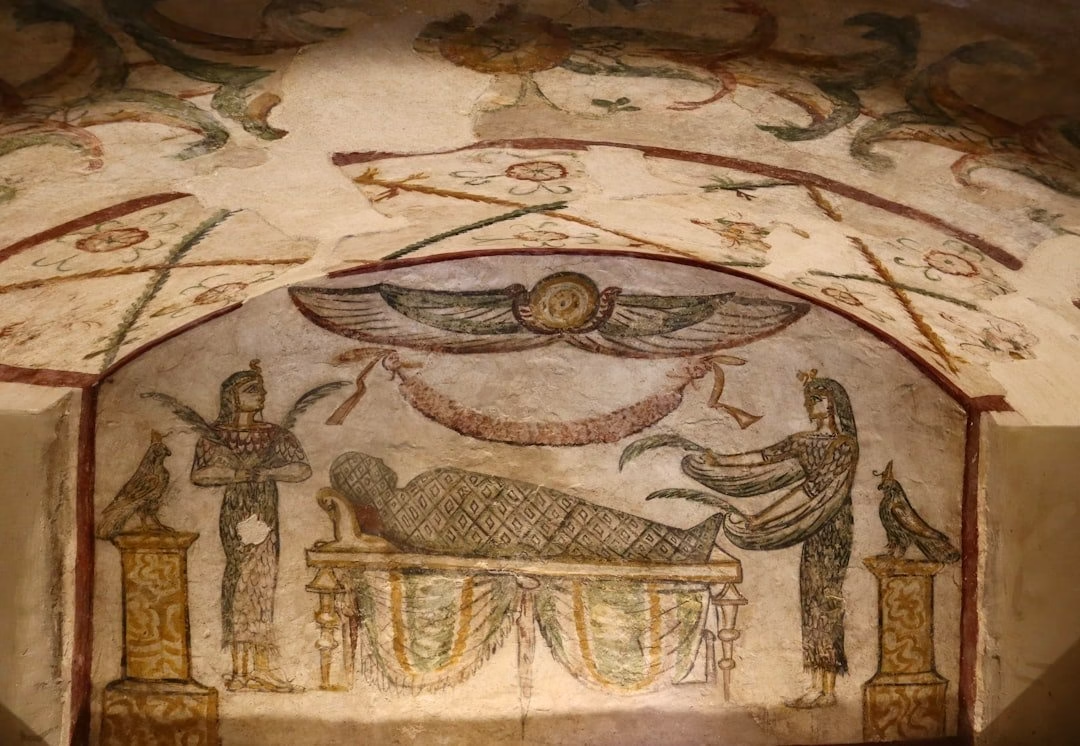
In the spring of 2025, workers preparing a construction site in Alexandria, Egypt, struck something unexpected beneath the modern city’s foundations. What emerged from the soil was not rubble but craftsmanship — a mosaic floor, its colored tesserae still arranged in patterns that had waited, undisturbed, for roughly two thousand years. The discovery triggered what archaeologists call a rescue excavation: a fast, careful intervention to document and preserve a site before development resumes.
The find included the remains of a Roman-era bathhouse and an adjoining villa, according to reporting by Archaeology News Online Magazine in May 2026. Together, they offer a rare, intact glimpse into the daily rhythms of a city that was, for several centuries, one of the most cosmopolitan places on earth. Alexandria was already ancient when Rome arrived. That layering is precisely what makes discoveries like this so instructive.
Alexandria Before and After the Roman Conquest
Alexandria was founded in 331 BCE by Alexander the Great on a narrow strip of land between the Mediterranean coast and Lake Mareotis. Within a generation it had become the capital of the Ptolemaic kingdom and, under rulers like Ptolemy I and II, arguably the intellectual center of the ancient world. The Great Library, the Lighthouse of Pharos — one of the Seven Wonders — and a polyglot population of Greeks, Egyptians, Jews, and merchants from across the eastern Mediterranean all contributed to a city unlike any other of its era.
Roman rule arrived in 30 BCE when Octavian — soon to be Augustus — defeated Mark Antony and Cleopatra VII. Rather than destroying the city, Rome absorbed it. Alexandria became the capital of the new province of Aegyptus and the empire’s primary conduit for grain shipped west to feed Rome’s population. The city retained much of its Greek character while acquiring Roman institutions: public baths, temples rebuilt in Roman style, and the social architecture of a provincial capital.
This is the world the newly discovered bathhouse likely inhabited. Roman baths — known as thermae or balnea depending on their scale — were far more than places to wash. They served as social hubs where citizens of different ranks could meet, converse, and conduct business. Finding one in Alexandria confirms that the Roman civic model took firm root in the city’s urban fabric, even as older Egyptian and Hellenistic traditions persisted alongside it.
What the Excavation Revealed
According to Archaeology News Online Magazine, the rescue excavation uncovered two distinct but related structures: the bathhouse proper and a villa whose floors were decorated with mosaic panels. The mosaics are among the most visually striking elements of the find. Roman mosaic work ranged from simple geometric borders to elaborate figural scenes drawn from mythology, daily life, or the natural world, and the skill required to produce them made decorated floors a reliable marker of wealth and status.
The villa’s mosaic floors suggest the structure belonged to someone of considerable means — a merchant, a Roman administrator, or a wealthy member of the local elite. Villas of this type typically contained a series of reception rooms, private quarters, and service areas arranged around a central courtyard. The proximity of the bathhouse implies either that the bath was a private facility attached to the estate or that a public bath stood adjacent to a high-status residential neighborhood, a common pattern in Roman urban planning.
Rescue excavations inevitably operate under time pressure, which means the picture they produce is often partial. Archaeologists working the Alexandria site had to balance speed with rigor, recording what they could before the development schedule reasserted itself. The mosaics, the structural walls, and any associated artifacts — lamps, pottery, coins — will now be analyzed to establish a firmer date range and to learn more about the people who lived and bathed there.
The Challenge of Excavating a Living City
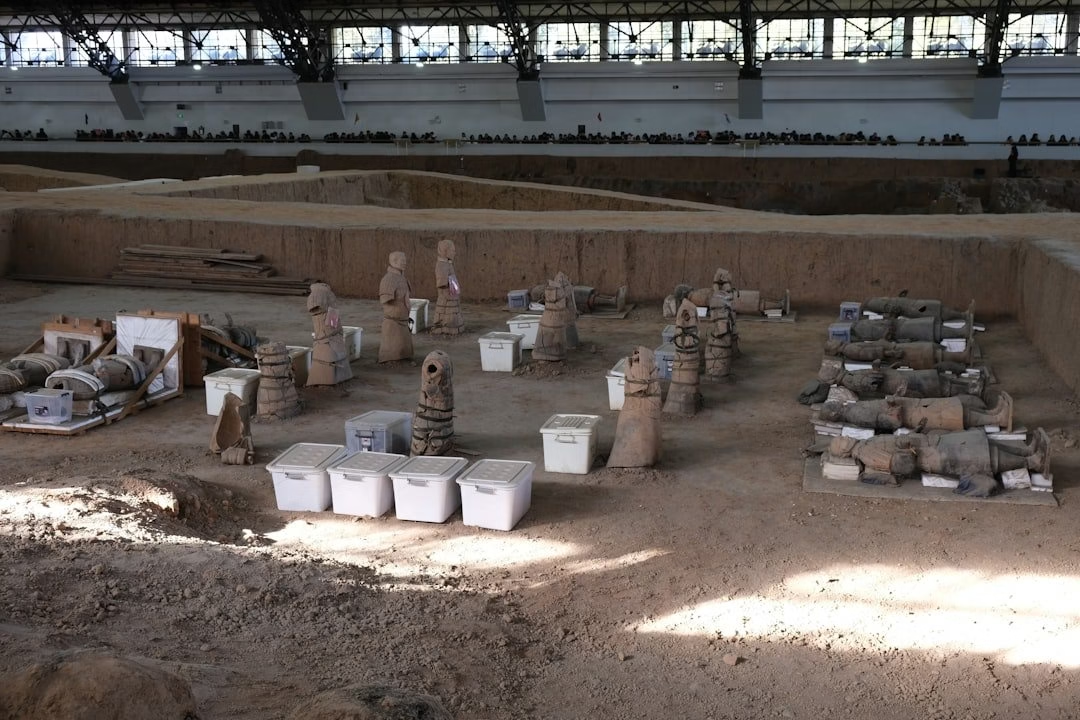
Alexandria presents particular difficulties for archaeologists. Modern buildings sit directly on top of ancient ones, and much of the ancient city lies not only underground but beneath the harbor waters, which have risen significantly since antiquity. The royal quarter of the Ptolemaic city, where Cleopatra’s palace likely stood, is now submerged. Rescue excavations triggered by construction work therefore remain one of the primary ways scholars recover information about the ancient city’s layout and material culture.
This dynamic is not unique to Egypt. In Nottingham, England, a milestone reached in early May 2026 — the recording of one thousand distinct underground cave systems beneath the city — illustrates how thoroughly human activity has carved its way into the ground beneath living urban centers, according to Archaeology News Online Magazine. Cave systems there were used for storage, tanning, and shelter across many centuries. In both cases, modern cities are unwitting custodians of layered histories that only surface when someone starts digging.
The logistical and legal frameworks governing rescue archaeology vary considerably across countries. Egypt has in recent decades strengthened its oversight of construction projects in historically sensitive zones, and the Alexandria discovery suggests those protocols are working as intended. The site was flagged, excavators were brought in, and what might otherwise have been destroyed is now part of the archaeological record.
Roman Baths as Windows Into Daily Life
Among the most valuable things a bathhouse can tell historians is how ordinary urban life was organized. Roman bathing culture followed a recognizable sequence: bathers moved through a series of heated rooms — the tepidarium, or warm room, followed by the caldarium, the hot room — and then returned through the warm room to the frigidarium, the cold plunge. The engineering required to maintain these temperature gradients involved underfloor heating systems called hypocausts, in which hot air circulated beneath raised floors and through hollow wall tiles.
Evidence of hypocaust systems, when present, allows archaeologists to confirm a structure’s function beyond reasonable doubt and to estimate its probable scale and date. Roman bathing technology evolved over several centuries, and specific design features can help narrow a structure’s construction to a particular period within the Roman imperial era. Whether the Alexandria excavation recovered hypocaust remains has not been specified in available reports, but it will be among the first technical questions specialists will try to answer.
“The ancient Egyptians built a civilization that endured for over three thousand years, leaving behind a legacy of achievements.”
— WorldAtlas, May 2026
That legacy did not end with the pharaohs. The Roman period added its own architectural and cultural layers to what Egypt had already accumulated. The bathhouse and villa found beneath a modern Alexandrian construction site are, in a sense, evidence of that continuation — proof that the city remained a place worth building beautifully even after the Ptolemaic dynasty was gone.
What This Discovery Adds to the Historical Record
For scholars of Roman Egypt, every new excavation in Alexandria is significant precisely because so little of the ancient city has been systematically uncovered. Unlike Rome or Pompeii, where extensive areas have been exposed and studied over centuries, Alexandria has yielded its past reluctantly, in fragments and under pressure. Each fragment nevertheless adjusts the larger picture.
The mosaic floors, once fully analyzed, may shed light on artistic exchange between Alexandria and other centers of Roman mosaic production — North Africa, the Levant, Italy itself. The bathhouse may clarify which areas of the ancient city were residential, which commercial, and where the two overlapped. Coin finds, if any accompanied the excavation, could help pin the site’s active period to a specific stretch of Roman rule, perhaps the first or second century CE when Alexandria was at the height of its importance within the empire.
Historians also use such finds to think about social stratification. A private bath attached to a wealthy villa tells a different story than a public facility serving a mixed neighborhood. The answer matters because it shapes our understanding of who had access to Roman amenities in a provincial city, and whether that access was determined by citizenship, wealth, ethnicity, or some combination of all three.
What Remains Unknown
Much about this discovery is still unresolved. The precise date of construction for both the bathhouse and the villa has not yet been established, and without that anchor it is difficult to place the structures within Alexandria’s political and social history with confidence. The identities of the villa’s occupants are probably unrecoverable — Roman Egypt produced enormous quantities of papyrus documents, but the connection between a specific text and a specific building is almost never made.
The full extent of the site also remains uncertain. Rescue excavations by nature expose only what lies within the boundaries of a planned construction project. Walls that continue beyond those boundaries, rooms that extend under neighboring buildings, or earlier phases of occupation that predate the Roman structures may all exist without any prospect of near-term investigation. It is likely that the structures uncovered represent only a portion of what once stood there.
Finally, scholars debate how representative any single Alexandrian find is of the city as a whole. Alexandria was not a typical Roman provincial town — it was enormous, diverse, and shaped by centuries of Greek rule before Rome ever arrived. Patterns observed in smaller, better-documented cities may not translate cleanly to Alexandria’s more complex urban reality. The bathhouse and its mosaics are a genuine addition to the historical record. How they fit into the broader story of the city is a question that will take years, and further excavation, to begin answering.
Sources
- Ancient bathhouse and Roman villa with mosaics unearthed in Alexandria during rescue excavation — Archaeology News Online Magazine
- Nottingham reaches 1,000 recorded underground caves in major archaeological milestone in England — Archaeology News Online Magazine
- Why Ancient Egypt Was One Of The Greatest Civilizations In History — WorldAtlas