
A City Running on Half Its Engine
The tea arrives before you’ve even sat down in Wadi Musa, the small town that spills down the hillside above Petra’s entrance. The guesthouse owner pours it without asking — mint, sweet, in a scratched glass — and then tells you that last month he had four guests total. Four. He mentions it not to complain, exactly, but the way someone mentions rain: as a fact that shapes everything. Outside, the canyon road is mostly quiet. A few horses wait near the Siq entrance. A vendor rearranges scarves that no one has touched since morning.
Why Jordan Matters Right Now
According to reporting by The New York Times published in May 2026, regional conflict in the Middle East has driven tourists away from Jordan at a significant rate, with Jordanians across the tourism industry describing severe economic strain as a result. The country itself is not a conflict zone — Jordan has remained stable — but traveler anxiety about the broader region has collapsed visitor numbers that the country’s hospitality and guiding sectors depend on entirely.
That creates a specific kind of travel moment. Petra, which in peak years sees crowds thick enough to make the Treasury feel like a theme park queue, is currently accessible in a way it hasn’t been in over a decade. Wadi Rum’s camps have space. Tour guides who normally stay booked for months are available on short notice. For travelers who’ve hesitated because of overcrowding concerns, the calculus has shifted — though it’s worth being honest that spending money here right now has a direct and visible impact on people who are genuinely struggling.
The tradeoff is real: some infrastructure that thrives on volume — shuttle services, large group tours, certain restaurants that only open when buses are running — may be operating on reduced hours or not at all. Flexibility matters more than usual.
What to Know Before You Go
Jordan sits between Israel and the West Bank to the west, Saudi Arabia to the south and east, Iraq to the northeast, and Syria to the north. The country is roughly 89,000 square kilometers — about the size of Portugal — with most of the tourism infrastructure concentrated in three areas: the capital Amman in the northwest, the ancient city of Petra in the south, and the desert landscape of Wadi Rum further south still. The Red Sea port town of Aqaba is at the country’s southern tip, about 325 kilometers from Amman by road.
The currency is the Jordanian dinar (JOD). At time of writing, 1 JOD trades at roughly $1.41 USD, and it has been pegged to the dollar for decades, so that rate is stable. Arabic is the official language; English is widely spoken in tourism contexts. May is a good month to visit — temperatures in Petra typically sit between 15°C and 27°C (59°F–81°F), warm enough for comfortable hiking but before the summer heat that pushes midday temperatures past 38°C (100°F) in Wadi Rum.
Getting there: Royal Jordanian and several international carriers fly into Queen Alia International Airport in Amman. From Europe, flight times run around 4–5 hours. From the US East Coast, expect 11–13 hours with a connection. The JETT bus from Amman to Wadi Musa (Petra) takes about 3.5 hours and costs under 10 JOD one way.
What to Do
Petra — but go early and go deep. The Treasury is the image everyone knows, but the real case for Petra is its scale. The site covers about 264 square kilometers, and most visitors never get past the colonnaded street. The Monastery (Ad Deir), reached by climbing 800 rock-cut steps, is larger than the Treasury and, especially right now, far quieter. Budget a full day minimum — the entry fee is 50 JOD for a one-day pass, 55 JOD for two days, which is the better value if you want to cover any real ground.
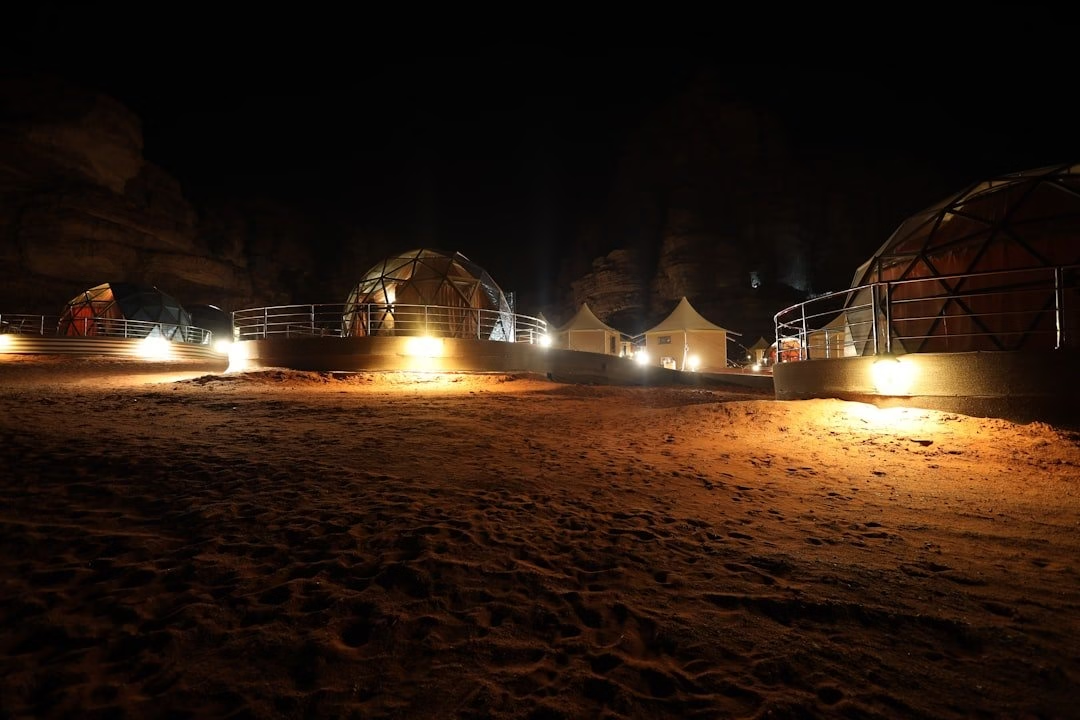
Wadi Rum overnight. The desert here is not what people expect from the word desert: it’s red and pink sandstone punctuated by enormous rock formations that cast sharp shadows by late afternoon. The standard experience is an overnight camp with a 4WD tour covering sites like Lawrence’s Spring and the Mushroom Rock formation. Camps vary significantly in quality. Costs have been running around 35–70 JOD per person for a full overnight experience including dinner, though with reduced bookings, negotiating flexibility on short notice is more realistic than usual.
Amman’s downtown, specifically Rainbow Street and the Roman Theatre area. The newer western neighborhoods — Abdoun, Sweifieh — are fine but don’t offer much a traveler needs to seek out. Downtown Amman, locally called Al-Balad, has the Roman Theatre (free to enter the exterior, small fee to go inside) and a compact area of old covered markets. Rainbow Street in the Jabal Amman neighborhood, about 2 kilometers from the city center, has independent cafes and a calmer pace. It’s where you’re more likely to have a real conversation than in the tourist-facing strip below.
The Dead Sea. About 55 kilometers southwest of Amman, the Dead Sea sits at 430 meters below sea level — the lowest point on Earth’s surface. The buoyancy is genuinely disorienting in a way that photographs don’t capture. Most public beaches have shrunk as the water level drops — the Dead Sea has lost roughly a third of its surface area over the past 50 years, a documented environmental crisis worth being aware of when you go. Resort day passes run around 25–40 JOD and include beach access and pools.
What to Skip
The Petra by Night show. Three nights a week, the path to the Treasury is lined with paper bag candles and visitors sit while Bedouin music plays. The concept sounds atmospheric. In practice, the walk is slow and crowded even when overall site numbers are down, the music is amplified and repetitive, the Treasury is barely lit, and the whole event lasts about an hour before everyone shuffles back out. It costs 17 JOD on top of your site entry and consistently gets mixed reviews from visitors who expected something more intimate. Skip it and use the money on an extra day in the site instead.
Practical Notes
Visa: As of May 2026, most Western passport holders can obtain a Jordan Pass online before travel, which combines a visa (waiving the standard 40 JOD fee) with entry to over 40 sites including Petra. The Jordan Pass starts at 70 JOD. Verify current entry requirements at the official Jordan Tourism Board site before booking.
Safety: The sources cited do not flag specific safety concerns for tourists in Jordan’s main travel corridors at the time of writing. Jordan has maintained political stability, but the broader regional context means monitoring your government’s travel advisories before and during a trip is more important than usual.
Cost level: Jordan is a mid-range destination. Budget travelers managing guesthouses and local transport can get by on 40–60 JOD per day. A comfortable mid-range trip — decent hotel, guided day in the desert, sit-down meals — runs closer to 100–150 JOD per day before flights.
Ethical note: The tourism downturn documented by The New York Times has real consequences for guides, drivers, guesthouse owners, and vendors whose incomes depend almost entirely on visitor spending. Tipping above standard in the current climate is noticed and, by most accounts, genuinely appreciated.
Sources
- Jordanians Struggle as Mideast Wars Scare Tourists Away — The New York Times