
Salem is one of Tamil Nadu’s most industrious cities — a place where mango orchards, steel plants, and textile mills share the same landscape. But behind its modern identity lies a name that has traveled through centuries, carrying meanings that shift depending on which language, which era, and which traveler you ask.
The question of how Salem got its name is not one with a single answer. It is a small mystery that opens into larger ones: about how places remember themselves, how names stick or fade, and what it means for a city to carry so many possible origins at once.
The Name and Its Many Meanings
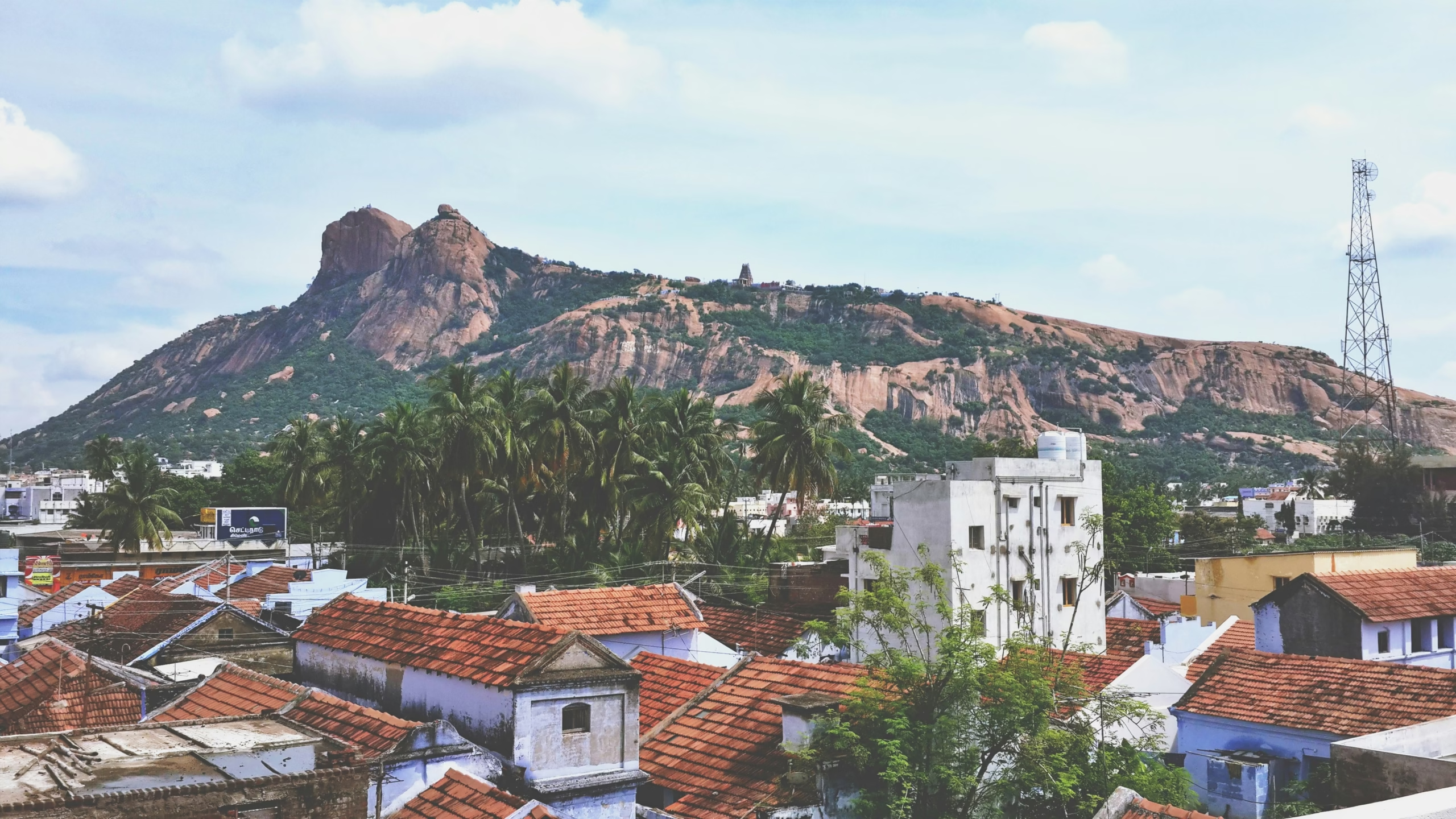
The most widely circulated explanation connects Salem to the word Sailam or Shailam, a Sanskrit-derived term meaning “mountain.” The city sits at the foothills of the Shevaroy range, and the association with hills and rocky terrain is geographically sensible. In this telling, Salem is simply “the place near the mountain” — a descriptive label that hardened into a proper name over centuries.
But Tamil speakers have long pointed to another possibility. The Tamil word Salem or Cheralam can be broken down into Chera (a reference to the ancient Chera dynasty) and alam (a suffix meaning “region” or “place”). In this reading, Salem becomes “the land of the Cheras” — a historical marker rather than a geographical one.
A third theory, less commonly cited but still present in local memory, links the name to Selam, an old Tamil word associated with prosperity or flourishing. This interpretation fits the region’s agricultural richness — the mango belt, the tapioca fields, the fertile soil that made Salem a granary long before it became an industrial center.
None of these explanations fully excludes the others. Place names often accumulate meaning rather than settling on one. What is clear is that by the medieval period, the name Salem was fixed in records — appearing in inscriptions, traveler accounts, and eventually colonial maps with a consistency that suggests it had long been in common use.
Before the Name: Ancient Settlement
The Salem region has been inhabited for millennia. Archaeological evidence from nearby sites points to continuous human presence stretching back to the Iron Age. The geography helped: rivers (the Thirumanimuthar flows through the city), hills for shelter, and plains for cultivation created conditions that encouraged settlement long before written records began.
The region sits at a natural crossroads. To the east lies the Kaveri delta and the Tamil heartland. To the west, the Western Ghats rise toward Kerala and the spice routes. To the north, the Deccan plateau opens toward Karnataka. This positioning meant that whoever controlled Salem controlled access between multiple ecological and political zones — a fact that would shape its history repeatedly.
Sangam literature, the classical Tamil poetic corpus, references landscapes and settlements that scholars have tentatively linked to the broader Salem-Kongu region. While direct identification is difficult, the terrain described — hills, forests, fertile valleys, and the mingling of pastoral and agricultural life — matches what the area still looks like today.
The Chera, Pandya, and Chola Years
Salem’s location placed it in the contested zone between Tamil Nadu’s three great early dynasties: the Cheras to the west, the Pandyas to the south, and the Cholas to the east. Rather than belonging firmly to any one kingdom, the region seems to have shifted allegiance depending on the balance of power — a pattern that would continue for centuries.
The Chera connection is particularly relevant to the name debate. The Cheras ruled much of what is now western Tamil Nadu and Kerala, and their influence extended into the Kongu region where Salem sits. If Cheralam is indeed the root of the modern name, it may reflect this period of Chera dominance — a political label that outlasted the dynasty itself.
Under the Cholas, from roughly the 9th to 13th centuries, the region was integrated more firmly into a centralized Tamil state. Chola inscriptions mention administrative divisions and temple grants in the area, suggesting that Salem was by then a recognized settlement with enough economic activity to warrant official attention. The Chola emphasis on temple-building left marks across the region — some of which survive in modified form today.
The Pandya period that followed brought its own shifts, though by then the name Salem appears to have been well established. The medieval Tamil country was not a place of fixed borders but of overlapping spheres, and Salem’s position in the middle of it all meant it experienced the rise and fall of dynasties as a series of administrative adjustments rather than dramatic transformations.
Under the Nayakas and Beyond
The Vijayanagara Empire’s expansion into Tamil Nadu in the 14th and 15th centuries brought new administrative structures. Local governors — the Nayakas — were appointed to manage regions on behalf of the empire, and Salem fell under the jurisdiction of the Madurai Nayakas. This period saw increased temple construction, irrigation investment, and the gradual crystallization of village boundaries and land rights that would shape rural life for centuries.
European arrival added new layers. The Portuguese, Dutch, and eventually the British all passed through or traded in the region, but Salem was never a major colonial port or fortress. Its importance was agricultural and, increasingly, textile-related. By the 18th century, Salem cloth was known in regional markets, and the town had become a center for handloom weaving.
The British colonial period formalized Salem’s administrative identity. The Salem district was established, boundaries were drawn, and the town became a collector’s headquarters. The name, by then centuries old, was simply adopted into English usage without much question about its origins — a common pattern for Indian place names that predated colonial rule by many generations.
Salem Today
Modern Salem wears multiple identities. It is known as the “Steel City” for its SAIL plant and associated industries. It is the “Mango City” for the varieties grown in its orchards — the Salem Bangalora mango has GI tag status. It is a textile hub, an educational center, and a major transit point on the route between Chennai and Coimbatore.
The Shevaroy Hills still rise to the west, visible from much of the city on clear days. The name’s possible connection to “mountain” remains geographically apt, even if the city has long since spread beyond any single defining landscape feature.
What is striking about Salem is how little its modern industrial identity depends on its ancient name. Unlike some Indian cities where the name actively shapes the brand (think Madurai and its temple, or Thanjavur and its art), Salem’s name is almost a footnote to its contemporary self. The steel plant, the mangoes, the textile mills — these are what people know. The name simply persists, carrying its multiple possible meanings without insisting on any of them.
Why the Name Matters
The uncertainty around Salem’s name is not a failure of research. It is a reminder of how places actually accumulate identity. A city is not a solved equation. It is a layering of geological fact, political accident, linguistic drift, and human choice — and the name is where all of that compresses into a single word.
Whether Salem comes from Shailam (mountain), Cheralam (Chera land), or Selam (prosperity), each reading captures something true about the place. The hills are real. The Chera connection is historically plausible. The agricultural abundance is undeniable. The name may simply be doing what good names do: holding more meaning than any single origin story can contain.
For someone traveling through Tamil Nadu, Salem is often a passing point — a stop on the way to Yercaud’s hill station, or a junction on the railway line. But the name, with its layered history, suggests a longer story: of a place that has been inhabited, contested, named, and renamed, yet never quite pinned down to one meaning. That resistance to final definition may be the most honest thing about it.
Sources
- Salem District Gazetteer — Government of Tamil Nadu
- A History of South India — K.A. Nilakanta Sastri, Oxford University Press
- The Cheras: A Study — Elamkulam P.N. Kunjan Pillai
- Kongu Nadu: A Historical Overview — Tamil Nadu State Archaeology Department
- Archaeological Survey of India reports on Iron Age sites in western Tamil Nadu
- Government of India Geographical Indications Registry — Salem Bangalora Mango GI status